

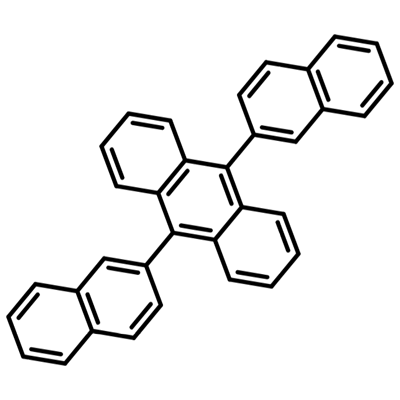
ADN, or 9,10-Bis(2-naphthyl)anthracene (CAS 122648-99-1), is an organic semiconductor best known as a host material in the emissive layer of blue organic light-emitting diodes. Its high thermal and morphological stability makes it a dependable choice for building durable devices.
Thanks to its wide energy band gap, ADN also serves as a host for full color OLEDs when combined with co-doping. In a co-doped emissive layer, a two-step energy transfer between dopants allows the emission color to be tuned and device performance to be improved, enabling blue, white and red devices from the same host.
The material is a white powder with HOMO = 5.8 eV and LUMO = 2.6 eV, absorption maxima at 375,395 nm and fluorescence at 425 nm (in THF). It is offered in sublimed grade at >99.0% purity and unsublimed grade at >98.0% purity; sublimation is used to reach ultra pure-grade material.
- Host material for the emissive layer of blue and deep blue OLEDs.
- Wide band gap host for full color OLEDs using co-doping for color tuning.
- Host for white OLEDs doped with emitters such as perylene, DCJTB or rubrene.
- Host or co-host with Alq3 for red-emitting OLEDs.
- Electron transporting and fluorescent host material for organic electronics research.
| Brand | Ossila |
|---|---|
| CAS number | 122648-99-1 |
| Molecular formula | — |
| Purity | >99.0% (sublimed), >98.0% (unsublimed) |
| Category | — |
| Pack sizes | Sublimed 1 g, Sublimed 5 g, Unsublimed 5 g |
| Physical form | White powder |
| Storage | — |
- Product code: M462
- Molecular weight: 430.54 g/mol
- Absorption: λ max 375,395 nm (in THF)
- Fluorescence: λ em 425 nm (in THF)
- HOMO/LUMO: HOMO = 5.8 eV, LUMO = 2.6 eV
- Melting point: 382-384 °C (lit.)
- Synonyms: ADN, 9,10-di(naphth-2-yl)anthracene, 9,10-di(2-naphthyl)anthracene
- Classification: Electron transporting materials, Light emitter layer materials, Fluorescent host materials
—
—