

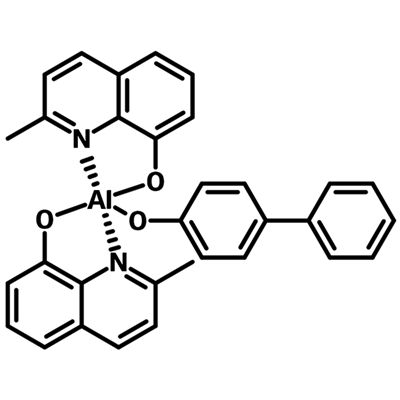
BAlq, chemically bis(8-hydroxy-2-methylquinoline)-(4-phenylphenoxy)aluminum (CAS 146162-54-1), is an organic semiconductor for building organic light-emitting diodes. It serves as a blue-emitting layer material and can also act as a hole-blocking layer or as a "barrier-softening" interfacial layer placed between the electron transporting and emissive layers.
In phosphorescent OLEDs (PHOLEDs), BAlq works as a host and as an electron-transport type hole-blocking layer, notably in red devices, where it helps raise efficiency and extend device lifetime. Used for hole blocking, it has been reported to enable lifetimes of up to 160,000 hours at 100 cd/m2.
The material is photochemically stable, has a glass transition temperature of 99 °C, and is supplied as a light-yellow powder or crystals purified by sublimation to ≥ 99%. Its HOMO and LUMO levels are 5.9 eV and 2.9 eV.
- Blue-emitting layer material in organic light-emitting diodes.
- Hole-blocking layer in OLED and PHOLED device stacks.
- Barrier-softening interfacial layer between the electron transporting and emissive layers.
- Host material and electron-transport type hole-blocking layer in red PHOLEDs.
- Hole-blocking or electron-side layer in white OLED architectures.
| Brand | Ossila |
|---|---|
| CAS number | 146162-54-1 |
| Molecular formula | C32H25AlN2O3 |
| Purity | ≥ 99% (sublimed) |
| Category | — |
| Pack sizes | 1 g |
| Physical form | — |
| Storage | — |
- Product code: M421
- Molecular weight: 512.53 g/mol
- Melting point: 207 - 214 °C (lit.)
- Glass transition temperature: 99 °C
- Color: Light-yellow powder/crystals
- Absorption: λmax 259 nm (in THF)
- Fluorescence: λem 334,477 nm (in THF)
- HOMO/LUMO: HOMO = 5.9 eV, LUMO = 2.9 eV
- Synonyms: BAlq3; Aluminum 4-biphenylolate 2-methyl-8-quinolinolate
—
—