

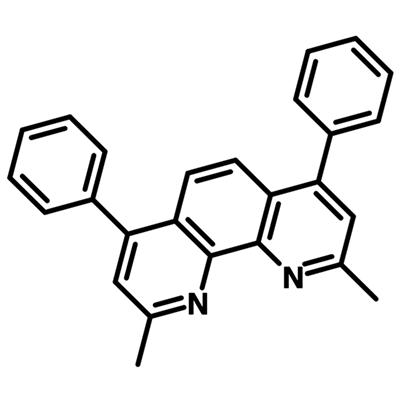
Bathocuproine (BCP), chemically 2,9-dimethyl-4,7-diphenyl-1,10-phenanthroline (CAS 4733-39-5), is a widely used hole-blocking material for organic electronics. It has a wide band gap and high electron affinity, so in a device stack it serves as an electron-transport layer and an exciton-blocking barrier that stops excitons from diffusing towards the aluminium electrode.
The molecule is built on a phenanthroline core carrying methyl and phenyl groups. Its nitrogen atoms can form complexes with metal electrodes, which helps charge transport and device stability. Placed as a buffer layer between the acceptor and the cathode, BCP can markedly raise the power conversion efficiency (PCE) of polymer organic solar cells; it has been shown to reduce nonradiative exciton recombination at the C60–Al interface and to create an Ohmic contact between C60 and Al.
Ossila supplies BCP as a light yellow powder in a sublimed grade (>99.5%) and an unsublimed grade (>98.0%). Sublimation is used to obtain ultra-pure material for vacuum-deposited devices.
- Hole-blocking and electron-transport layer in OLEDs, including white, red and green devices.
- Buffer layer between acceptor and cathode to improve PCE in polymer organic solar cells.
- Interlayer between C60 and Al electrodes in organic photovoltaic devices.
- Hole-blocking layer in perovskite solar cells.
- Electron-injection layer material in organic electronic devices and OFET research.
| Brand | Ossila |
|---|---|
| CAS number | 4733-39-5 |
| Molecular formula | C26H20N2 |
| Purity | >99.5% (sublimed), >98.0% (unsublimed) |
| Category | — |
| Pack sizes | 1 g, 5 g |
| Physical form | Light yellow powder |
| Storage | — |
- Product code: B231
- Full name: 2,9-Dimethyl-4,7-diphenyl-1,10-phenanthroline
- Synonyms: Bathocuproine, BCP
- Molecular weight: 360.45 g/mol
- HOMO / LUMO: HOMO ~ 6.4 eV, LUMO ~2.9 eV
- Melting point: 280-282°C (lit.)
- Classification: ETL, EIL, Hole-blocking layer, OFET, OLED, Organic Photovoltaics, Perovskite solar cells, Sublimed materials
—
—