

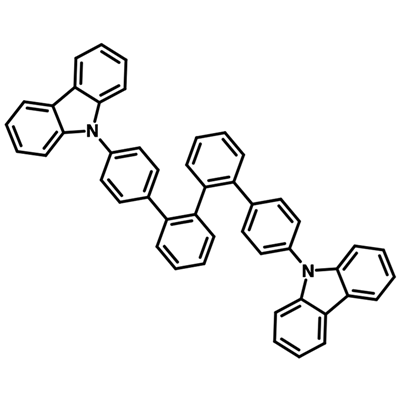
BCBP, or 2,2'-bis(4-(carbazol-9-yl)phenyl)-biphenyl (CAS 858131-70-1), is a host material for phosphorescent OLEDs. It is used to host blue, green and red phosphorescent dopants in high-efficiency organic light-emitting devices, and it is supplied as a sublimed white powder or crystals with purity above 99.0% (HPLC).
Its molecule combines a bridged biphenyl core with two electron-rich carbazolyl side groups. The bridge is thought to extend conjugation and lift the HOMO level, which eases hole injection and helps keep turn-on voltages low. Carbazole-based hosts are widely chosen for their high triplet energy and good hole mobility, and BCBP has a triplet energy (E T) of 2.8 eV.
Compared with the well-known host CBP, which has a glass transition temperature of 69 °C, BCBP offers markedly better thermal stability, with a Tg of 173 °C and TGA showing >330 °C at 0.5% weight loss. Reported devices using BCBP include a blue FIrpic-doped OLED reaching a maximum EQE of 22.0%.
- Host matrix for blue, green and red phosphorescent dopants in OLED emissive layers.
- Hole transport layer (HTL) material in organic electronic devices.
- Host material in TADF-OLED research.
- Fabrication of blue, red and white electrophosphorescent devices, as shown in reported device structures.
| Brand | Ossila |
|---|---|
| CAS number | 858131-70-1 |
| Molecular formula | C48H32N2 |
| Purity | Sublimed >99.0% (HPLC) |
| Category | — |
| Pack sizes | 100 mg, 250 mg, 500 mg, 1 g |
| Physical form | — |
| Storage | — |
- Product code: M2194A1
- Full Name: 2,2'-bis(4-(carbazol-9-yl)phenyl)-biphenyl
- Synonyms: 2,2'-bis(4-carbazolylphenyl)-1,1'-biphenyl
- Molecular Weight: 636.78 g/mol
- Glass Transition Temperature: Tg = 173 °C (lit.)
- TGA: >330 °C (0.5% weight loss)
- Absorption: λmax 325 nm in DCM
- Fluorescence: λem 373 nm in DCM
- HOMO / LUMO: HOMO = 6.1 eV, LUMO = 2.6 (Eg = 3.5 eV; ET = 2.8 eV)
- Color: White powder/crystals
- Classification: Organic electronics, Hole transport layer materials (HTL), Fluorescent and phosphorescent host materials, TADF-OLEDs, Sublimed materials
—
—