

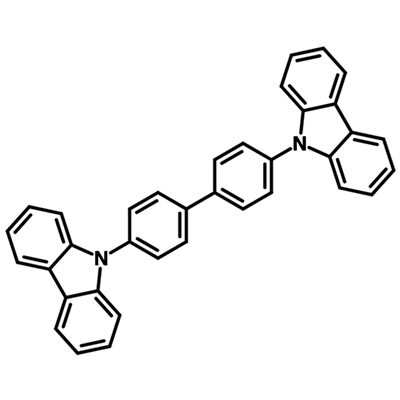
CBP, or 4,4′-Bis(N-carbazolyl)-1,1′-biphenyl (CAS 58328-31-7), is a carbazole-based small molecule widely chosen as a host material in fluorescent and phosphorescent organic light-emitting diodes (OLEDs). Its two carbazolyl units make it electron-rich, which gives the material high hole mobility.
With a triplet energy of 2.6 eV, CBP has been shown to host green, yellow and red phosphorescent emitters whose triplet energies lie below its own. Its HOMO and LUMO levels are 6.0 eV and 2.9 eV, and it is also classed among hole-injection, hole-transport and hole-blocking layer materials.
Ossila supplies this grade as a white powder purified by sublimation to a purity above 99.5%, in 1 g and 5 g packs. Ossila CBP was used in the study "Complete polarization of electronic spins in OLEDs" by T. Scharff et al., Nat. Commun., 12, 2071 (2021).
- Host matrix for green, yellow and red phosphorescent emitters in OLED emissive layers.
- Host material in fluorescent OLED devices.
- Component of white and tandem OLED device architectures.
- Hole-transport, hole-injection or hole-blocking layer in organic electronic devices.
- Research into spin and exciton physics in organic light-emitting devices.
| Brand | Ossila |
|---|---|
| CAS number | 58328-31-7 |
| Molecular formula | C36H24N2 |
| Purity | > 99.5% (sublimed) |
| Category | — |
| Pack sizes | 1 g, 5 g |
| Physical form | White powder |
| Storage | — |
- Product code: M391
- Molecular Weight: 484.59 g/mol
- HOMO / LUMO: HOMO 6.0 eV, LUMO 2.9 eV
- Triplet Energy: 2.6 eV
- Melting Point: 281-285 (lit.) °C
- Synonyms: CBP, 4,4′-Bis(9-carbazolyl)-1,1′-biphenyl, 4,4-N,N′-Dicarbazole-1,1′-biphenyl, DCBP, BSBCz, BSB-Cz
For device fabrication, process and handle the material inside a glove box to preserve its purity and device efficiency by keeping out particulates, moisture and airborne impurities. Refer to the MSDS for safety information.
—