

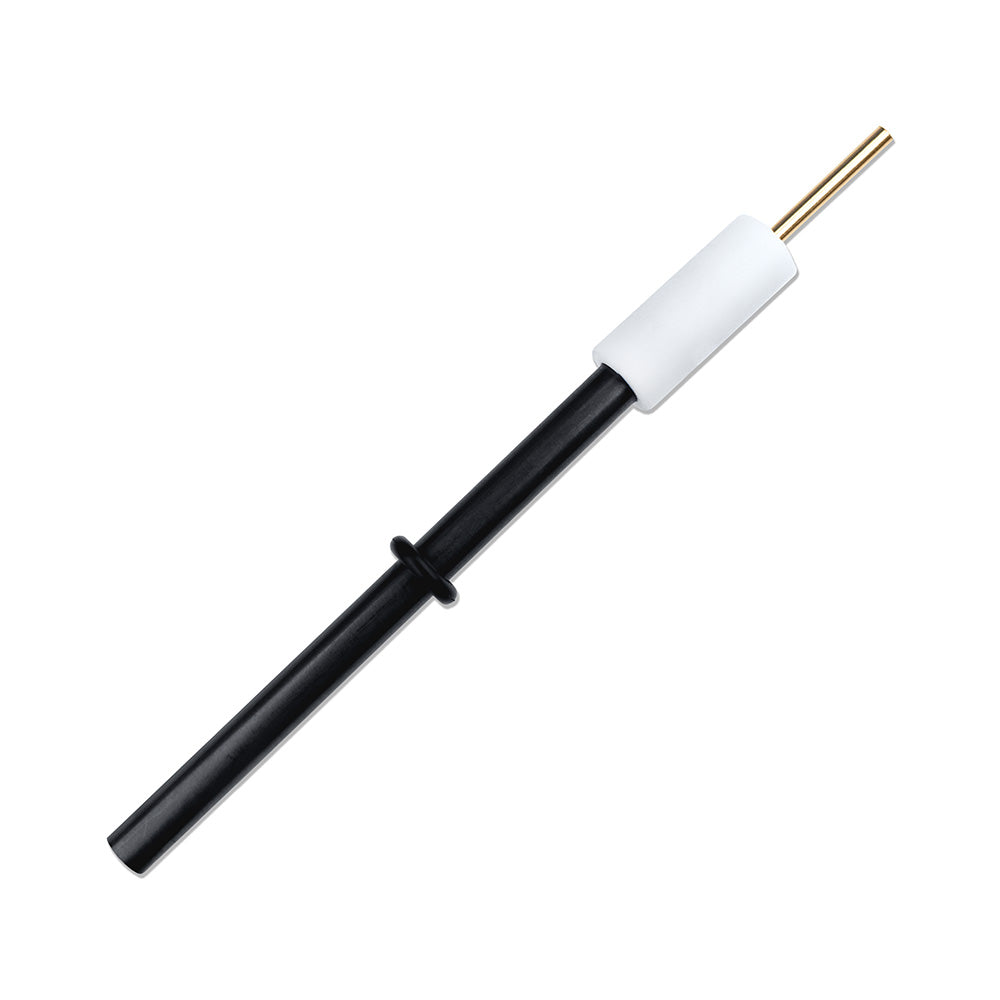
The Ossila Graphite Rod Counter Electrode (C2025G1) is a single 6 mm graphite rod made for use as the counter electrode in standard electrochemistry cells. It suits cyclic voltammetry, bulk electrolysis and hydrogen evolution reaction (HER) studies, and alongside platinum it is one of the most widely used counter electrode choices.
The rod is made from high purity graphite (99.99%), with a 6 mm disc diameter and an 80 mm body length. Graphite conducts electricity well thanks to its mobile delocalized electrons, is chemically inert and tolerates high temperatures. Because it is a non-metal that is far more abundant and less expensive than platinum, it is a practical option for long-term and larger-scale work. Its large surface area helps achieve a favourable ratio relative to the working electrode.
Users should be aware that graphite can oxidize and corrode, which may release particles or by-products that poison or deactivate the working electrode. It also offers a narrower stable potential range than platinum and can show lower catalytic activity for some reactions. For HER catalyst evaluation, however, graphite is often preferred because it avoids platinum dissolution.
- Counter electrode for cyclic voltammetry in standard electrochemical cells.
- Bulk electrolysis and electrosynthesis experiments.
- Counter electrode (anode) for evaluating new hydrogen evolution reaction (HER) electrocatalysts.
- Standard corrosion test cells.
- Research on battery and energy storage devices.
| Brand | Ossila |
|---|---|
| CAS number | — |
| Molecular formula | — |
| Purity | 99.99% |
| Category | — |
| Pack sizes | — |
| Physical form | — |
| Storage | — |
- Product code: C2025G1
- Product Code: C2025G1
- Body Material: High purity graphite
- Disc Diameter: 6 mm
- Body Length: 80 mm
- Variant: Single Electrode
—
—