

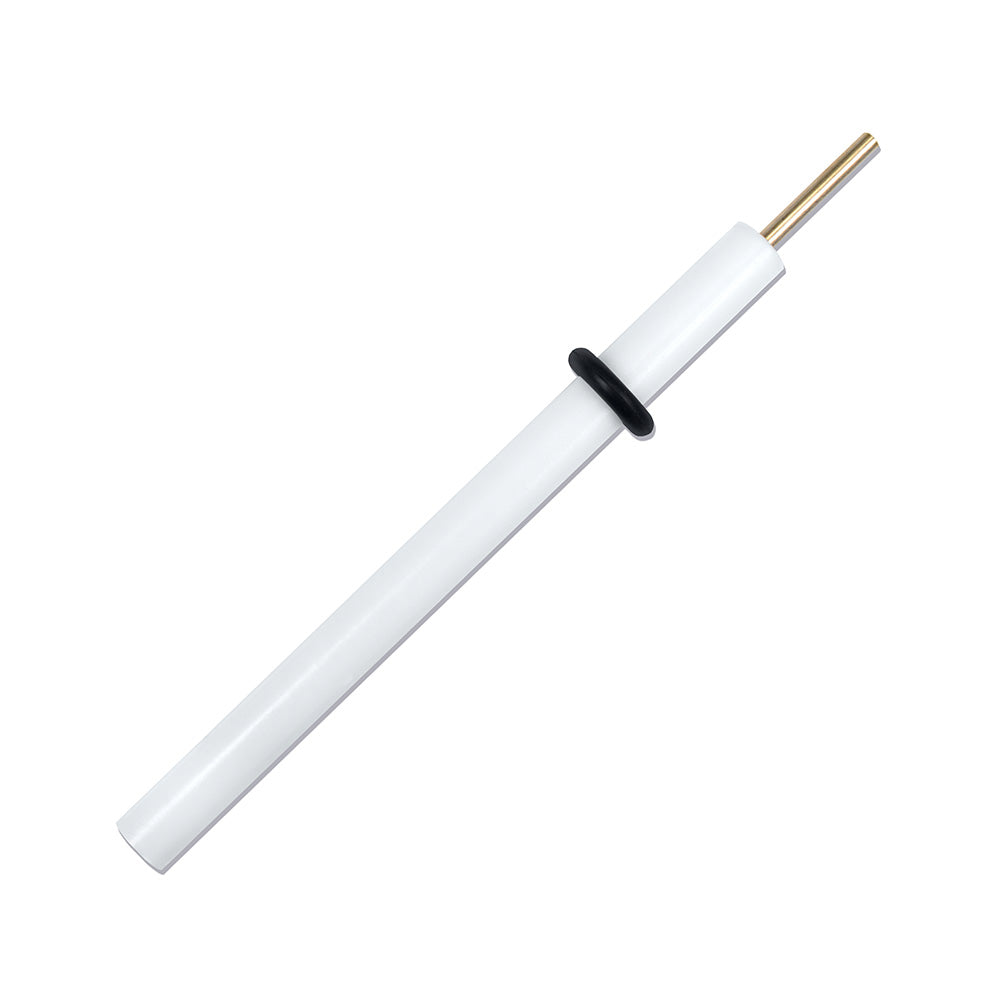
The Ossila C2013M1 is a graphite working electrode with a 4 mm disc diameter, made for electrochemical studies such as cyclic voltammetry, linear sweep voltammetry and electrolysis. Its standard shape lets it sit in any conventional electrochemistry cell.
Like glassy carbon electrodes, graphite electrodes are carbon-based. Graphite is less chemically inert than glassy carbon, but it conducts better and costs less. It is valued for chemical stability, good electrical conductivity and a high melting point, and is among the most widely used electrode materials, serving as either anode or cathode.
Compared with platinum or gold electrodes, graphite allows scans to reach more negative potentials while still offering good anodic potential windows. Its layered structure also makes surface renewal simple: polishing exposes a fresh surface thanks to the flexible edge plane and peeling along the basal plane. The electrode performs well in long-term experiments, and 2 mm and 3 mm disc versions are also offered.
- Cyclic voltammetry measurements in standard electrochemistry cells.
- Linear sweep voltammetry studies.
- Bulk electrolysis experiments.
- Use as an anode or cathode in general electrochemical applications.
- Long-term electrochemical experiments requiring a conductive carbon electrode.
| Brand | Ossila |
|---|---|
| CAS number | — |
| Molecular formula | — |
| Purity | — |
| Category | — |
| Pack sizes | — |
| Physical form | — |
| Storage | — |
- Product code: C2013M1
- Product code: C2013M1
- Electrode material: Graphite
- Disc diameter: 4 mm
- Other available disc diameters: 2 mm, 3 mm
- Electrode type: Working electrode
—
—