

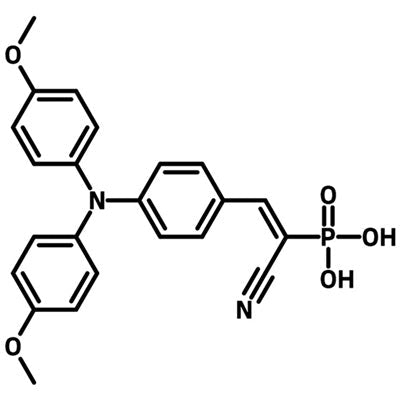
MPA-CPA, (2-(4-(Bis(4-methoxyphenyl)amino)phenyl)-1-cyanovinyl)phosphonic acid (CAS 2212003-31-9), is a self-assembled monolayer (SAM) molecule used as a hole transport or hole extraction layer in p-i-n perovskite solar cells and non-fullerene acceptor polymer solar cells. Its structure combines a dimethoxy-triphenylamine terminal group, a cyano-vinyl linker and a phosphonic acid anchor. It is supplied as an orange powder with a purity of > 98% (HPLC).
The molecule is amphiphilic: the hydrophilic cyano-vinyl and phosphonic acid groups make the coated surface highly wettable, so perovskite precursor solutions spread into uniform, large-area films without a pre-wetting step, while the phosphonic acid anchor forms a coherent, pinhole-free contact between electrode and absorber. Cyano and phosphonic groups coordinate with lead ions through Pb–N and Pb–O bonds, passivating deep-level defects at the buried interface; perovskite films on MPA-CPA reach a PLQY of 17%, twice the value reported with 2PACz.
As a hole-selective contact, MPA-CPA offers an alternative to PEDOT:PSS and can be deposited from solution at low concentration, around 1 mM.
- Hole-selective self-assembled monolayer for inverted (p-i-n) perovskite solar cells.
- Hole transport or extraction layer in non-fullerene acceptor polymer and organic solar cells.
- Passivation of buried interface defects to improve perovskite film quality.
- Solution-processed replacement for PEDOT:PSS hole transport layers.
| Brand | Ossila |
|---|---|
| CAS number | 2212003-31-9 |
| Molecular formula | C23H21N2O5P |
| Purity | > 98% (HPLC) |
| Category | — |
| Pack sizes | 250 mg, 500 mg, 1 g |
| Physical form | Orange powder |
| Storage | — |
- Product code: M2447A1
- Molecular Weight: 436.40 g/mol
- HOMO/LUMO: HOMO = 5.5 eV, LUMO = 2.1 eV
- Typical Solvent: Anhydrous ethanol (IPA, IPA/DMF)
- Typical Concentration: 1.0 mg/ml
Processing is typically carried out in a nitrogen-filled glove box: MPA-CPA is dissolved in anhydrous ethanol at 1.0 mg/ml, spin coated for 30 s at 3000 rpm and annealed for 10 min at 100 ℃ before cooling to room temperature. An MSDS sheet is available from the manufacturer.
—