

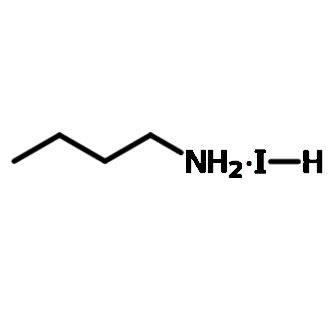
n-Butylammonium iodide (BAI), also known as butylamine hydroiodide, is a perovskite precursor material from Ossila supplied at 98% purity. It is used in the synthesis of organic-inorganic hybrid perovskites for electronic devices such as field-effect transistors, light-emitting diodes and photovoltaics.
Added to 3D-perovskite precursor solutions, BAI restricts the growth of 3D-perovskite grains, which strongly reduces film roughness. Because the butylammonium cation has a longer chain than methylammonium, it is thought to be too large to sit at the corners of the PbX4 (X = I, Br, Cl) octahedral layers. This leads to layered perovskite structures, also called Ruddlesden–Popper phases.
Layers incorporating butylammonium halides have shown marked gains in lifetime and operational stability in LED devices. The material has the formula C4H12IN, a molecular weight of 201.05 g/mol and is supplied as powder/crystals.
- Additive in 3D-perovskite precursor solutions to suppress grain growth and produce smoother films.
- Formation of layered 2D Ruddlesden–Popper perovskite structures.
- Fabrication of perovskite light-emitting diodes with improved lifetime and operational stability.
- Research on perovskite solar cells and photovoltaic devices.
- Preparation of perovskite active layers for field-effect transistors.
| Brand | Ossila |
|---|---|
| CAS number | 36945-08-1 |
| Molecular formula | C4H12IN |
| Purity | 98% |
| Category | — |
| Pack sizes | 10 g |
| Physical form | Powder/crystals |
| Storage | — |
- Product code: M2057A1
- Molecular weight: 201.05 g/mol
- Synonyms: BAI, Butylamine Hydroiodide
- Melting point: 173 °C (exp.)
- Classification / Family: Perovskite precursor materials, Perovskite solar cells, Perovskite LEDs
—
—