

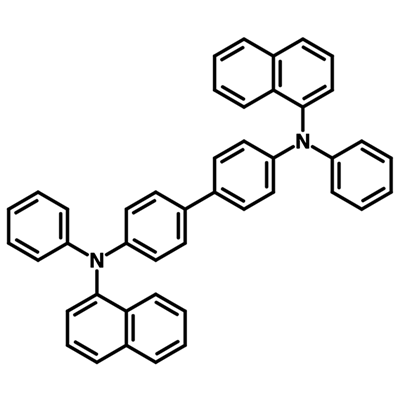
NPB, also called NPD, is N,N′-Di(1-naphthyl)-N,N′-diphenyl-(1,1′-biphenyl)-4,4′-diamine (CAS 123847-85-8), a triphenylamine-based organic semiconductor valued for its strong hole transport performance. Product code M362 is the unsublimed grade, supplied as an off-white powder with purity above 98.0%.
It is among the most widely adopted hole transport materials in OLED research and production, and it also serves in polymer photovoltaics (OPV) and perovskite solar cells. Its glass transition temperature of up to 95 °C helps keep thin-film morphology stable, which supports longer device lifetimes.
With a HOMO of 5.5 eV and a LUMO of 2.4 eV, NPB can also act as a hole-injection or electron-blocking layer. Ossila NPB has been used in published work on inverted perovskite quantum-dot light-emitting diodes (J. Pan et al., J. Mater. Chem. C, 8, 5572-5579 (2020)).
- Hole transport layers in white, green, blue, red and yellow OLEDs.
- Hole-injection and electron-blocking layers in organic light-emitting devices.
- Charge transport layers in polymer solar cells and organic photovoltaics.
- Hole transport layers in perovskite solar cells and perovskite quantum-dot LEDs.
- Interconnection layers in tandem OLED architectures.
- Research on organic field-effect transistors (OFETs).
| Brand | Ossila |
|---|---|
| CAS number | 123847-85-8 |
| Molecular formula | C44H32N2 |
| Purity | > 98.0% (unsublimed) |
| Category | — |
| Pack sizes | — |
| Physical form | Off-White powder |
| Storage | — |
- Product code: M362
- Molecular weight: 588.74 g/mol
- HOMO/LUMO: HOMO = 5.5 eV, LUMO = 2.4 eV
- Absorption: λ max 339 nm
- Fluorescence: λ em 450 nm (in THF)
- Melting point: 279-283 °C (lit.)
- Glass transition temperature: up to 95 °C
- Synonyms: NPB, NPD, N,N′-Bis(naphthalen-1-yl)-N,N′-bis(phenyl)benzidine
—
—