

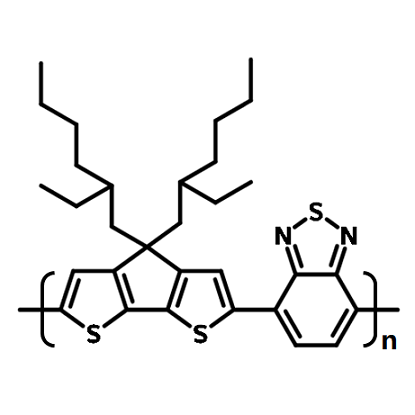
PCPDTBT is a low band-gap polymer semiconductor built from alternating cyclopenta dithiophene and benzothiadiazole units. Researchers use it widely as the donor material in high-performance organic photovoltaic (OPV) devices, where its strong charge-carrier properties are valued.
With a bandgap of 1.5 eV, the polymer absorbs across a wide part of the visible spectrum and continues into the infrared region. Its HOMO and LUMO levels sit at -5.3 eV and -3.6 eV. The material dissolves in chloroform, chlorobenzene and dichlorobenzene, and chlorobenzene is the recommended processing solvent at 10mg/ml.
Because of its non-linear side chains, PCPDTBT is usually regarded as amorphous, although highly crystalline films with branched side chains can be produced by solvent vapor crystallization. Batch M2096A3 has a molecular weight (Mw) of 66,499 and a PDI of 2.09.
- Active layer donor polymer in bulk heterojunction organic solar cells.
- Low band-gap absorber for OPV devices harvesting visible and infrared light.
- Hole-transport layer material in perovskite solar cells.
- Semiconducting polymer for organic field-effect transistors (OFETs).
- Component in all-polymer solar cell research.
| Brand | Ossila |
|---|---|
| CAS number | 920515-34-0 |
| Molecular formula | (C31H38N2S3)n |
| Purity | — |
| Category | — |
| Pack sizes | 100 mg, 250 mg, 500 mg, 1 g |
| Physical form | — |
| Storage | — |
- Product code: M2096A3
- Full name: Poly[2,6-(4,4-bis-(2-ethylhexyl)-4H-cyclopenta[2,1-b;3,4-b′]dithiophene)-alt-4,7(2,1,3-benzothiadiazole)]
- Synonym: C-PCPDTBT
- Batch: M2096A3
- Molecular weight (Mw): 66,499
- PDI: 2.09
- Bandgap: 1.5 eV
- HOMO / LUMO: HOMO = -5.3 eV, LUMO = -3.6 eV
- Soluble in: Chloroform, chlorobenzene, dichlorobenzene
- Recommended processing solvent at 10mg/ml: Chlorobenzene
—
—