

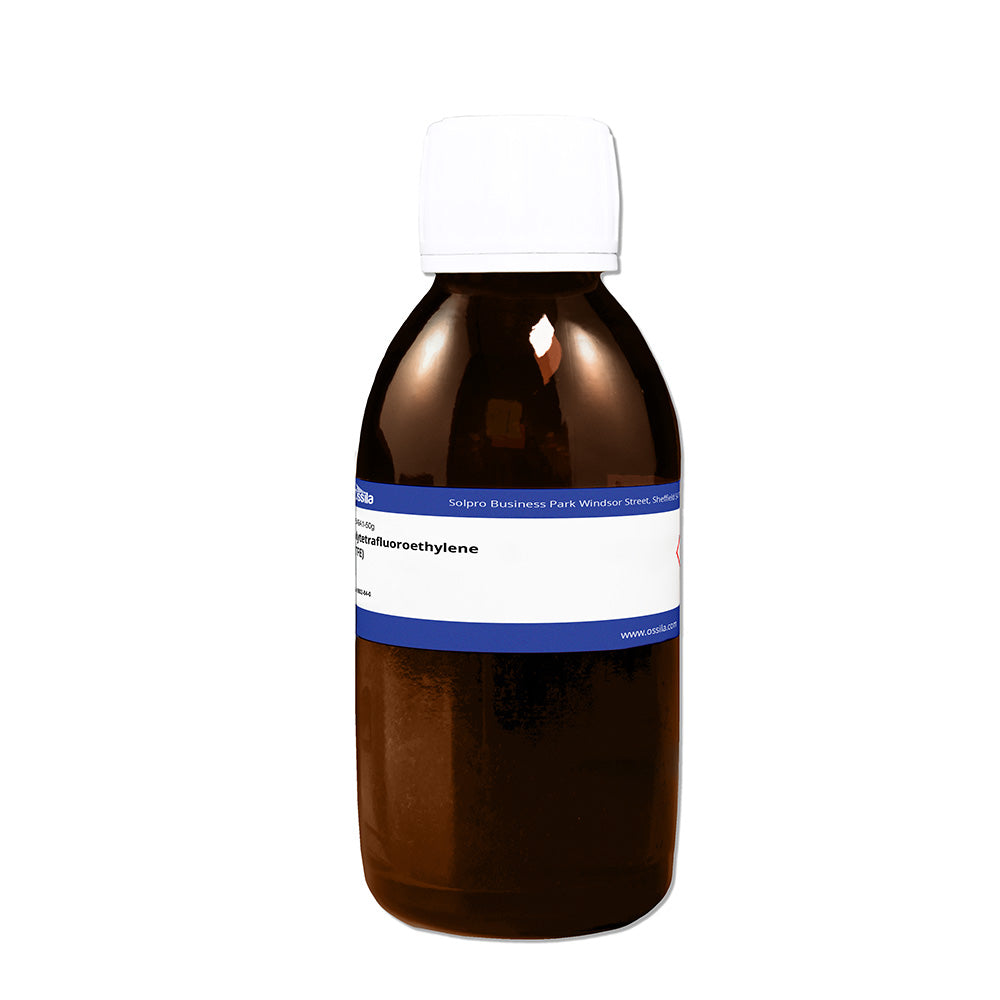
Ossila Polytetrafluoroethylene (PTFE), CAS 9002-84-0, also known as Teflon, is a perfluorinated ethylene polymer supplied as a white powder. It serves as a binder for solvent-free, dry-processed battery electrodes and for composite membranes. Its chemical inertness comes from the short C-F bond (ca. 1.35 Å) and high bond energy (ca. 130 kcal/mol), and it remains thermally stable until decomposition above 260 °C.
Under high-shear mixing, PTFE changes phase and forms nano-fibrils. The resulting fibrous network helps hold active cathode materials together as they change volume during charge and discharge. Reported cycling tests with 0.5 wt% PTFE binder show 97% capacity retention after 200 cycles at C/3. In aqueous zinc-ion batteries, its hydrophobicity aids zinc-ion desolvation, giving an average specific capacity of 149.8 mAh/g at 2A/g.
For oxygen evolution electrodes, PTFE acts as a multifunctional binder that increases electrochemically active sites and improves mass transfer, with a reported low decay rate of 0.034 mV/h at 500 mA/cm2 over 1000 hours. The grade has a molecular weight of ca. 5,000,000 and a particle size of 580 μm.
- Binder for solvent-free dry electrode processing in lithium-ion, sodium-ion and solid-state battery research.
- Fibrillating binder that stabilises active cathode materials during cycling.
- Hydrophobic binder for cathodes in aqueous zinc-ion batteries.
- Multifunctional binder for high-current-density oxygen evolution electrodes.
- Component of polymer composite electrolytes and composite membranes.
| Brand | Ossila |
|---|---|
| CAS number | 9002-84-0 |
| Molecular formula | (C2F4)n |
| Purity | — |
| Category | — |
| Pack sizes | 50 g, 100 g, 250 g |
| Physical form | White powder |
| Storage | — |
- Product code: M2549A1
- Full Name: Poly(1,1,2,2-tetrafluoroethylene)
- Synonyms: Poly(tetrafluoroethene), Poly(tetrafluoroethylene), Teflon, PTFE
- Bulk Density: 0.47 g/ml (JIS K6892)
- Standard Specific Gravity: 2.160 (ASTM D4895)
- Molecular Weight: ca. 5,000,000
- Particle Size: 580 μm (JIS K6891)
- Extrusion Pressure (RR36): 130 daN (Daikin method)
- Decomposition Temperature: above 260 °C
—
—