

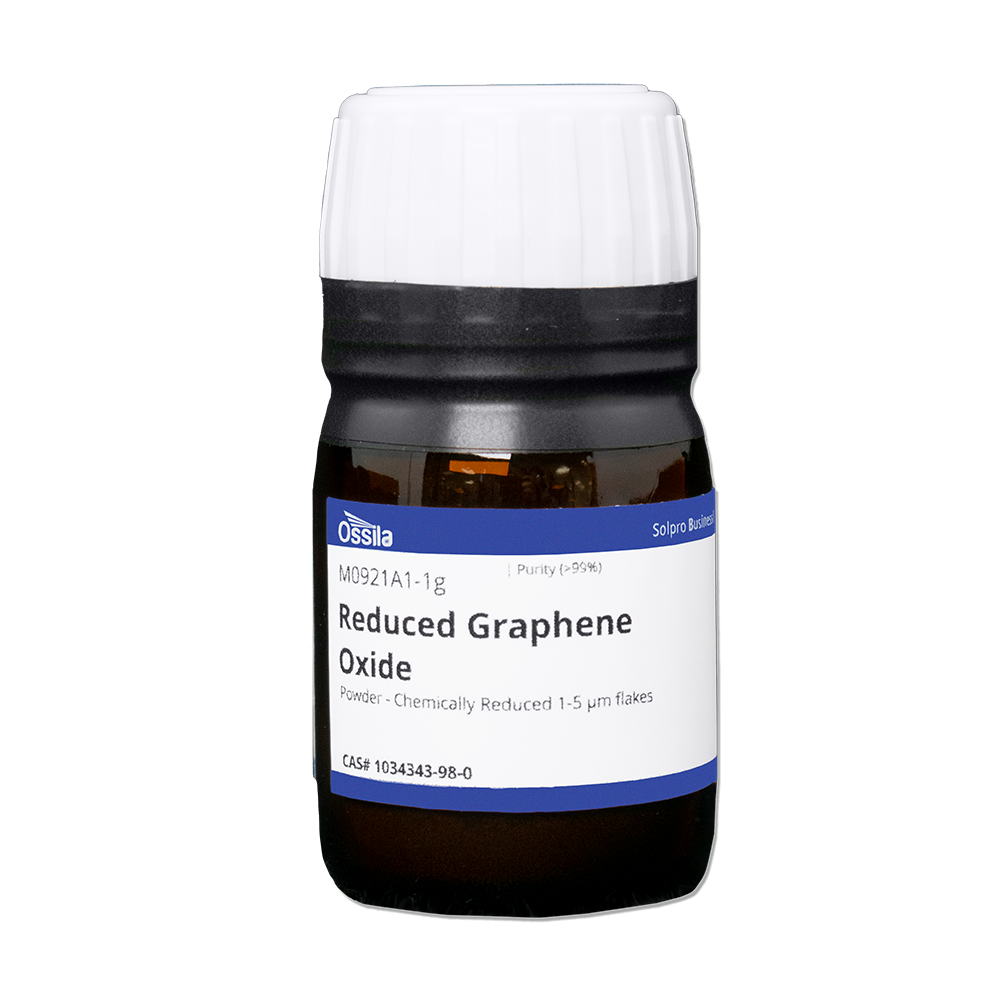
Ossila M0921A1 is a chemically reduced graphene oxide (rGO) powder with a purity above 99%. Reduced graphene oxide (CAS 1034343-98-0) is graphene oxide from which oxygen-containing groups have been removed, so that its properties move closer to those of pure graphene. It is offered in 1 g and 5 g packs.
Because this grade is reduced chemically rather than thermally, it keeps the flake size and layer ratios of the original graphene oxide and has a lower defect density than thermally reduced material. It does retain more oxygen-containing functional groups than the thermal version. Flakes measure 1 – 5 μm across and 0.5 – 2.0 nm thick, with 2 – 5 layers and a surface area of about 16 m2/g.
The powder disperses in polar solvents such as water or DMF, although less readily than graphene oxide. For the most stable dispersions, concentrations up to around 0.1 mg.ml-1 in a 3:2 mix of isopropyl alcohol and ethylene glycol are suggested, broken up with a mechanical agitator rather than sonication, which can damage the flakes.
- Research on 2D semiconducting materials and carbon nanomaterials as a graphene-like alternative to graphene oxide.
- Organic electronics work, including OLEDs, OPVs and OFETs.
- Preparation of dispersions in water, DMF or isopropyl alcohol/ethylene glycol for solution processing.
- Studies of graphene and graphene oxide chemistry where flake size and low defect density must be preserved.
| Brand | Ossila |
|---|---|
| CAS number | 1034343-98-0 |
| Molecular formula | CxHyOz |
| Purity | >99% |
| Category | — |
| Pack sizes | 1 g, 5 g |
| Physical form | — |
| Storage | — |
- Product code: M0921A1
- Product Code: M0921A1
- Reduction Method: Chemically Reduced
- Flake Size: 1 – 5 μm
- Flake Thickness: 0.5 – 2.0 nm
- Layers: 2 – 5 layers
- Surface Area: ~ 16 m2/g
- Recommended Solvents: H2O, DMF
- Synonyms: rGO, Reduced graphene oxide, Functionalized graphene
- Packaging: Light resistant bottle
Supplied in a light resistant bottle. Consult the MSDS for chemically reduced graphene oxide before handling. When dispersing, use mechanical agitation instead of sonication to avoid damaging the flakes.
—