

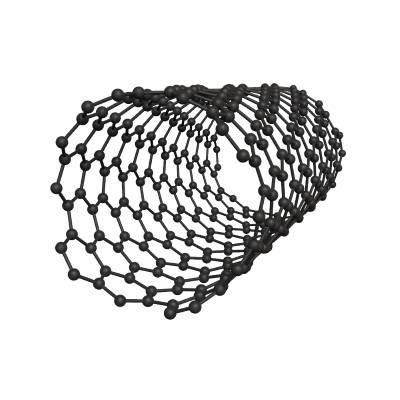
Ossila M2395A1 is a grade of single-walled carbon nanotubes (SWCNT, CAS 308068-56-6) supplied as a black fibrous dry powder. Each nanotube is a graphene sheet rolled into a hollow cylinder whose wall is a single atom thick, which places the material among the one-dimensional carbon nanomaterials.
This grade has a diameter of 1 – 2 nm, a length of 1 – 3 μm, a surface area of 400 m2/g and a purity of > 65%. Because of their structure and very small dimensions, SWCNTs show notable mechanical, electrical, thermal and optical properties. That makes them useful both as a research subject in their own right and as a filler in composite materials.
As produced, the nanotubes do not dissolve. Small concentrations can be dispersed with surfactants and ultrasonication, and DI water, DMF, THF, ethanol and acetone are recommended as dispersants. The grade is offered in 500 mg and 1 g packs.
- Fundamental research into the mechanical, electrical, thermal and optical behaviour of one-dimensional carbon materials.
- Reinforcing or functional filler in composite materials.
- Research on thin-film electronics built from carbon nanomaterials.
- Preparation of surfactant-assisted nanotube dispersions for further processing and characterization.
| Brand | Ossila |
|---|---|
| CAS number | 308068-56-6 |
| Molecular formula | CxHy |
| Purity | > 65% |
| Category | — |
| Pack sizes | 500 mg, 1 g |
| Physical form | Black fibrous powder |
| Storage | — |
- Product code: M2395A1
- Product code: M2395A1
- Diameter: 1 – 2 nm
- Length: 1 – 3 μm
- Surface Area: 400 m2/g
- Recommended Dispersants: DI Water, DMF, THF, Ethanol, Acetone
- Synonyms: Single-Walled Carbon Nanotubes, Single-Wall Carbon Nanotube, Carbon Nanotube, SWNT, CNT
- Classification: 1D materials, Carbon nanomaterials, Nanomaterials, Polycyclic aromatic hydrocarbons, thin-film electronics
Disperse the nanotubes with a surfactant kept below its critical micelle concentration, then apply an ultrasonic probe or bath. Limit the sonication time and power, because excessive sonication can damage the nanotubes and shorten their average length. Centrifugation separates individual nanotubes from bundles. Consult the manufacturer's MSDS for safety information.
—