


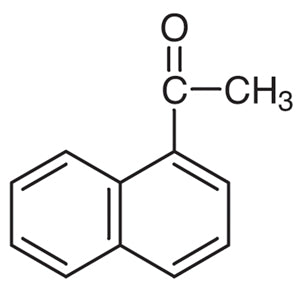
1'-Acetonaphthone is a chemical compound widely used as a foundational material in various chemical reactions. It serves as a key component in the synthesis of complex organic compounds, making it an essential reagent in chemical laboratories. Its role as a building block is critical in reactions that require substitution or functional group modifications. This compound is particularly valued for its versatility and stability, allowing it to be used in a wide range of experimental setups. In Indonesian laboratories, it is commonly employed in research projects focused on organic synthesis, where its chemical properties enable precise and controlled reactions.
The compound’s unique molecular structure, featuring an aromatic ring with a ketone group at the 1' position, contributes to its chemical reactivity and stability. Its non-polar nature and relatively high melting point make it easy to handle and process in laboratory conditions. These properties ensure that it remains consistent and reliable during chemical reactions, reducing the risk of unwanted side reactions. Additionally, its resistance to degradation under normal laboratory conditions enhances its usability in long-term experiments and repeated synthesis processes.
In Indonesian laboratories, 1'-Acetonaphthone is frequently used in organic chemistry research, especially in the development of new compounds and pharmaceutical intermediates. Its stability and reactivity make it a preferred choice for chemists working on complex synthesis pathways. The compound’s availability and compatibility with various reaction conditions further support its widespread use in both academic and industrial research settings.
- Organic synthesis is a primary application where 1'-Acetonaphthone is used due to its ability to participate in substitution and condensation reactions, making it ideal for creating complex organic molecules.
- Pharmaceutical research benefits from its role in the synthesis of drug intermediates, as it provides a stable and reactive platform for functional group modifications.
- Analytical chemistry laboratories use it as a standard reference material for spectroscopic and chromatographic analyses due to its well-defined molecular structure and purity.
- Teaching laboratories incorporate it into undergraduate and graduate courses to demonstrate fundamental reaction mechanisms and synthetic strategies in organic chemistry.
- Industrial research and development applications rely on its consistent performance in large-scale chemical processes, ensuring reproducibility and reliability in production settings.
| Brand | TCI |
|---|---|
| CAS number | 941-98-0 |
| Molecular formula | — |
| Purity | — |
| Category | Chemistry > Building Blocks > Non-Heterocyclic Building Blocks |
| Pack sizes | Available in various quantities as per standard laboratory supply |
| Physical form | Solid |
| Storage | Store in a cool, dry place away from direct sunlight and moisture |
1'-Acetonaphthone should be stored in a cool, dry environment to maintain its chemical stability and prevent degradation. It is recommended to keep it in airtight containers to avoid exposure to moisture and air, which could affect its reactivity. The compound is non-hazardous under normal conditions but should be handled with care to avoid contamination. In laboratory settings, it is advisable to store it in a designated chemical storage cabinet to ensure safety and accessibility. Proper labeling of containers is essential to prevent mix-ups and ensure safe handling. Regular inspection of storage conditions helps maintain the integrity of the compound for long-term use in chemical experiments.
—
Produk Terkait
-
2'-Acetonaphthone TCI A0053
Regular price From Rp 530.250,00Regular priceRp 370.650,00Sale price From Rp 530.250,00 -
1'-Acetonaphthone TCI A0052
Regular price From Rp 1.060.500,00Regular priceRp 741.300,00Sale price From Rp 1.060.500,00 -
2'-Methoxy-1'-acetonaphthone TCI M2875
Regular price Rp 2.199.750,00Regular priceRp 1.554.000,00Sale price Rp 2.199.750,00 -
4-Methyl-1-acetonaphthone TCI M1202
Regular price From Rp 1.696.800,00Regular priceRp 1.186.500,00Sale price From Rp 1.696.800,00 -
2'-Hydroxy-1'-acetonaphthone TCI H0936
Regular price Rp 2.147.250,00Regular priceRp 1.517.250,00Sale price Rp 2.147.250,00 -
1'-Hydroxy-2'-acetonaphthone TCI H0935
Regular price From Rp 1.378.650,00Regular priceRp 979.650,00Sale price From Rp 1.378.650,00 -
Decahydro-1H,3H-4,10:5,9-dimethanonaphtho[2,3-c:6,7-c']difuran-1,3,6,8-tetraone TCI D5970
Regular price Rp 5.062.050,00Regular priceRp 3.539.550,00Sale price Rp 5.062.050,00


