


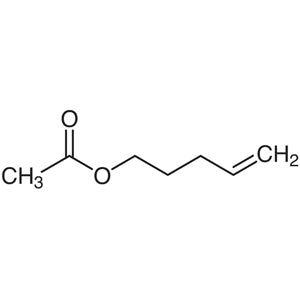
4-Pentenyl Acetate is a chemical compound widely used as a foundational material in various laboratory reactions. It belongs to the category of non-heterocyclic building blocks, making it a versatile reagent for the synthesis of complex organic molecules. In laboratory settings, it serves as a precursor for the production of aromatic compounds, esters, and other organic substances with specific structural requirements. Its role is critical in organic chemistry research, particularly in the development of new compounds and functional group transformations.
The compound is valued for its molecular structure, which includes a long carbon chain and an ester functional group. These characteristics contribute to its volatility and solubility in organic solvents, facilitating its use in a wide range of chemical processes. Its ability to react with various functional groups makes it an ideal choice for substitution reactions and the formation of new compounds. Additionally, its chemical stability and reactivity under controlled conditions enhance its reliability in laboratory applications.
In Indonesian laboratories, 4-Pentenyl Acetate is commonly used in organic chemistry research, especially in academic and research institutions. It is also utilized in the development of pharmaceutical, cosmetic, and industrial chemical products. Its availability in the local market makes it a practical and accessible option for researchers working on diverse chemical projects.
- Organic synthesis: 4-Pentenyl Acetate is ideal for creating complex organic molecules due to its reactive ester group and long carbon chain.
- Aromatic compound production: It serves as a building block for synthesizing aromatic structures, offering structural versatility in chemical reactions.
- Ester functional group modification: Its ester functionality allows for easy substitution and modification in various synthetic pathways.
- Industrial chemical development: It is used in the formulation of industrial chemicals, providing a reliable source for compound synthesis.
- Cosmetic and pharmaceutical research: Its chemical properties make it suitable for developing new products in the pharmaceutical and cosmetic industries.
| Brand | TCI |
|---|---|
| CAS number | 1576-85-8 |
| Molecular formula | — |
| Purity | — |
| Category | Chemistry > Building Blocks > Non-Heterocyclic Building Blocks |
| Pack sizes | Available in various quantities as per supplier specifications |
| Physical form | Liquid |
| Storage | Store in a cool, dry place away from direct sunlight |
4-Pentenyl Acetate should be stored in a cool, dry environment to maintain its chemical stability. It is recommended to keep the compound in a tightly sealed container to prevent evaporation due to its volatile nature. Suitable containers include glass or high-density polyethylene bottles to ensure compatibility and minimize chemical interactions. As a flammable substance, it should be stored away from heat sources and open flames. Proper ventilation is essential when handling the compound to avoid inhalation of vapors. Laboratory personnel should wear appropriate personal protective equipment, such as gloves and safety goggles, to ensure safe handling and reduce exposure risks.
—
Produk Terkait
-
ButylAcetate[forSpectrophotometry] TCI A0228
Regular price Rp 1.538.250,00Regular priceRp 1.075.200,00Sale price Rp 1.538.250,00 -
VinylAcetateMonomer(stabilizedwithHQ) TCI A0045
Regular price Rp 477.750,00Regular priceRp 333.900,00Sale price Rp 477.750,00 -
PropylAcetate TCI A0044
Regular price From Rp 477.750,00Regular priceRp 333.900,00Sale price From Rp 477.750,00 -
PhenylAcetate TCI A0043
Regular price Rp 452.550,00Regular priceRp 316.050,00Sale price Rp 452.550,00 -
n-OctylAcetate TCI A0042
Regular price From Rp 505.050,00Regular priceRp 352.800,00Sale price From Rp 505.050,00 -
NonylAcetate TCI A0041
Regular price From Rp 505.050,00Regular priceRp 352.800,00Sale price From Rp 505.050,00 -
4-NitrophenylAcetate TCI A0040
Regular price From Rp 3.896.550,00Regular priceRp 2.724.750,00Sale price From Rp 3.896.550,00 -
4-NitrobenzylAcetate TCI A0039
Regular price From Rp 1.298.850,00Regular priceRp 908.250,00Sale price From Rp 1.298.850,00


