


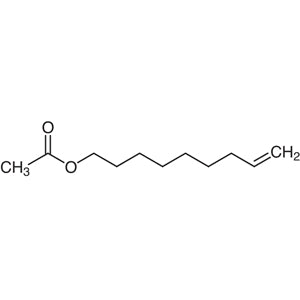
8-Nonenyl Acetate is a chemical compound widely used in laboratory settings, particularly in the synthesis of organic compounds. As a building block in chemical research, it serves as a fundamental component for creating more complex molecular structures. Its versatility makes it a valuable tool for chemists working on a variety of synthetic pathways. This compound is commonly employed in organic synthesis, where it functions as a key intermediate in the development of new chemical entities. Its role in laboratory research is critical for advancing chemical innovation and understanding molecular behavior.
The properties of 8-Nonenyl Acetate make it a preferred choice in laboratory applications. It is a stable compound that can be easily manipulated under controlled reaction conditions. Its molecular structure, featuring a long carbon chain and an ester group, contributes to its reactivity and utility in chemical reactions. The compound is colorless and has a mild aroma, which makes it suitable for use in sensitive experiments. Additionally, its solubility in organic solvents such as ethyl acetate and ether facilitates its handling and integration into various synthetic processes. These characteristics enhance its effectiveness in laboratory environments.
In Indonesian laboratories, 8-Nonenyl Acetate is commonly used in chemical research, especially in the fields of organic synthesis and analytical chemistry. It plays a significant role in the development of new compounds and the study of molecular interactions. Its presence in research activities supports the advancement of scientific knowledge and the creation of innovative chemical solutions. As a reliable and versatile compound, it remains an essential resource for chemists in Indonesia.
- Organic Synthesis: 8-Nonenyl Acetate is widely used in the synthesis of complex organic molecules due to its reactivity and structural versatility.
- Analytical Chemistry: It serves as a standard reference material for analytical techniques such as gas chromatography and mass spectrometry.
- Polymer Science: The compound is utilized in the development of new polymers and materials due to its functional ester group.
- Medicinal Chemistry: It is employed in the synthesis of pharmaceutical compounds and drug derivatives.
- Research and Development: 8-Nonenyl Acetate is a key component in R&D projects aimed at creating new chemical products and formulations.
| Brand | TCI |
|---|---|
| CAS number | 13038-22-7 |
| Molecular formula | — |
| Purity | — |
| Category | Chemistry > Building Blocks > Non-Heterocyclic Building Blocks |
| Pack sizes | Available in various quantities as per supplier specifications |
| Physical form | Colorless liquid |
| Storage | Store in a cool, dry place away from direct sunlight |
8-Nonenyl Acetate should be stored in a cool, dry place, away from direct sunlight and sources of heat. It is recommended to use airtight containers made of glass or polyethylene to prevent contamination and evaporation. Due to its chemical nature, it should be handled in a well-ventilated area to avoid inhalation of vapors. Proper personal protective equipment, such as gloves and safety goggles, should be worn when handling the compound. It is important to keep the compound away from incompatible materials, such as strong oxidizers. Regular monitoring of storage conditions ensures the stability and integrity of the material.
—
Produk Terkait
-
ButylAcetate[forSpectrophotometry] TCI A0228
Regular price Rp 1.538.250,00Regular priceRp 1.075.200,00Sale price Rp 1.538.250,00 -
PropylAcetate TCI A0044
Regular price From Rp 477.750,00Regular priceRp 333.900,00Sale price From Rp 477.750,00 -
PhenylAcetate TCI A0043
Regular price Rp 452.550,00Regular priceRp 316.050,00Sale price Rp 452.550,00 -
n-OctylAcetate TCI A0042
Regular price From Rp 505.050,00Regular priceRp 352.800,00Sale price From Rp 505.050,00 -
NonylAcetate TCI A0041
Regular price From Rp 505.050,00Regular priceRp 352.800,00Sale price From Rp 505.050,00 -
4-NitrophenylAcetate TCI A0040
Regular price From Rp 3.896.550,00Regular priceRp 2.724.750,00Sale price From Rp 3.896.550,00 -
4-NitrobenzylAcetate TCI A0039
Regular price From Rp 1.298.850,00Regular priceRp 908.250,00Sale price From Rp 1.298.850,00


