


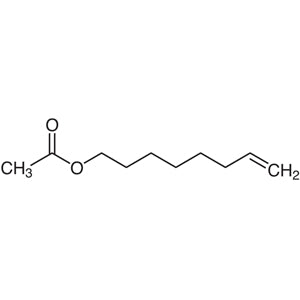
7-Octenyl Acetate is a chemical compound widely used in laboratory settings, particularly in organic synthesis applications. As a key component within the category of building blocks, it serves as a foundational material for the creation of more complex chemical structures. Its role in laboratory research is critical, as it is often utilized as a reagent or auxiliary in various chemical reactions. This compound is valued for its versatility and reactivity, making it an essential tool for chemists working in both academic and industrial environments.
The unique molecular structure of 7-Octenyl Acetate allows it to interact effectively with a variety of functional groups, enhancing its utility in synthetic processes. Its reactivity makes it suitable for reactions such as esterification, hydrolysis, and substitution. Additionally, its stability under controlled conditions ensures reliable performance in laboratory experiments. These properties make it a preferred choice for researchers seeking precision and consistency in their chemical work.
In Indonesian laboratories, 7-Octenyl Acetate is commonly found in organic chemistry research, especially in academic institutions, research centers, and pharmaceutical industries. It is used as a building block for the synthesis of various chemical compounds, including those with high reactivity and specific functional groups. Its application extends to the development of raw materials for specialized chemical products, supporting both research and industrial applications.
- Organic Synthesis: Used in the creation of complex organic molecules due to its reactivity and compatibility with various functional groups.
- Esterification Reactions: Serves as a key reagent in esterification processes due to its acetyl group, enabling the formation of ester compounds.
- Pharmaceutical Research: Applied in the development of pharmaceutical compounds requiring high reactivity and chemical stability.
- Industrial Chemistry: Utilized in the production of specialty chemicals that require precise molecular structures and functional group modifications.
- Analytical Chemistry: Employed as a standard or reference material in analytical procedures for its consistent chemical properties.
| Brand | TCI |
|---|---|
| CAS number | 5048-35-1 |
| Molecular formula | — |
| Purity | — |
| Category | Chemistry > Building Blocks > Non-Heterocyclic Building Blocks |
| Pack sizes | Available in various quantities as per supplier specifications |
| Physical form | Liquid |
| Storage | Store in a cool, dry place away from direct sunlight and incompatible materials |
7-Octenyl Acetate should be stored in a cool, dry environment, away from direct sunlight and sources of heat. It is recommended to keep the compound in a tightly sealed container to prevent evaporation and contamination. Due to its reactivity, it should be stored separately from strong oxidizing agents and incompatible substances. Proper ventilation is essential when handling this material to minimize exposure to vapors. Laboratory personnel should wear appropriate personal protective equipment, including gloves and safety goggles, when working with this compound. Regular monitoring of storage conditions ensures the compound remains stable and safe for use in research applications.
—
Produk Terkait
-
ButylAcetate[forSpectrophotometry] TCI A0228
Regular price Rp 1.538.250,00Regular priceRp 1.075.200,00Sale price Rp 1.538.250,00 -
VinylAcetateMonomer(stabilizedwithHQ) TCI A0045
Regular price Rp 477.750,00Regular priceRp 333.900,00Sale price Rp 477.750,00 -
PropylAcetate TCI A0044
Regular price From Rp 477.750,00Regular priceRp 333.900,00Sale price From Rp 477.750,00 -
PhenylAcetate TCI A0043
Regular price Rp 452.550,00Regular priceRp 316.050,00Sale price Rp 452.550,00 -
n-OctylAcetate TCI A0042
Regular price From Rp 505.050,00Regular priceRp 352.800,00Sale price From Rp 505.050,00 -
NonylAcetate TCI A0041
Regular price From Rp 505.050,00Regular priceRp 352.800,00Sale price From Rp 505.050,00 -
4-NitrophenylAcetate TCI A0040
Regular price From Rp 3.896.550,00Regular priceRp 2.724.750,00Sale price From Rp 3.896.550,00 -
4-NitrobenzylAcetate TCI A0039
Regular price From Rp 1.298.850,00Regular priceRp 908.250,00Sale price From Rp 1.298.850,00


