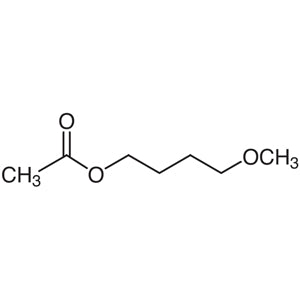
2-Methoxybutyl Acetate is a chemical compound widely used in laboratory settings as a building block for constructing complex molecular structures. It plays a crucial role in organic synthesis, enabling researchers to develop new compounds and materials with specific functional properties. This versatile reagent is commonly found in chemical research and industrial applications, where it contributes to the creation of a wide range of organic molecules. Its utility extends across various scientific disciplines, making it an essential component in modern chemical laboratories.
The compound is known for its volatility and solubility in organic solvents, which makes it highly suitable for use in a variety of chemical reactions. Its non-heterocyclic nature ensures stability in reactions requiring precise structural control, making it a preferred choice for synthetic chemists. The ease of handling and compatibility with different reaction conditions further enhance its appeal in both academic and industrial research environments. These properties allow it to be used effectively in a broad spectrum of chemical processes.
In Indonesian laboratories, 2-Methoxybutyl Acetate is frequently utilized in organic chemistry research, particularly in universities and research institutions. It is also employed in the pharmaceutical and chemical industries for the development of new products and materials. Its reliability and adaptability make it a valuable resource for researchers working on complex molecular synthesis projects.
- Organic synthesis: This compound is ideal for constructing complex organic molecules due to its reactivity and compatibility with various synthetic pathways.
- Pharmaceutical research: It is used in the development of new drug compounds, supporting the creation of molecules with specific therapeutic properties.
- Industrial chemical production: Its solubility and volatility make it suitable for use in the manufacturing of specialty chemicals and intermediates.
- Academic research: It is commonly used in university laboratories for teaching and experimental purposes, aiding in the understanding of organic reaction mechanisms.
- Material science applications: It contributes to the synthesis of polymers and other advanced materials, supporting innovation in material development.
| Brand | TCI |
|---|---|
| CAS number | 1173168-18-7 |
| Molecular formula | — |
| Purity | — |
| Category | Chemistry > Building Blocks > Non-Heterocyclic Building Blocks |
| Pack sizes | Available in various sizes as per standard laboratory supply options |
| Physical form | Liquid |
| Storage | Store in a cool, dry place away from direct sunlight and incompatible materials |
This compound should be stored in a cool, dry location, away from direct sunlight and sources of heat. It is recommended to use airtight containers made of materials compatible with organic solvents to prevent evaporation and contamination. Due to its volatility, it should be handled in a well-ventilated area, preferably under a fume hood, to minimize exposure. Proper personal protective equipment, such as gloves and safety goggles, should be worn when handling the substance. It is important to avoid contact with incompatible materials and to ensure that storage conditions are consistent with standard chemical safety practices.
—
Produk Terkait
-
4-MethoxybutylAcetate TCI A1676
Regular price From Rp 530.250,00Regular priceRp 370.650,00Sale price From Rp 530.250,00 -
3-MethoxybutylAcetate TCI A0759
Regular price From Rp 980.700,00Regular priceRp 685.650,00Sale price From Rp 980.700,00 -
ButylAcetate[forSpectrophotometry] TCI A0228
Regular price Rp 1.538.250,00Regular priceRp 1.075.200,00Sale price Rp 1.538.250,00 -
VinylAcetateMonomer(stabilizedwithHQ) TCI A0045
Regular price Rp 477.750,00Regular priceRp 333.900,00Sale price Rp 477.750,00 -
PropylAcetate TCI A0044
Regular price From Rp 477.750,00Regular priceRp 333.900,00Sale price From Rp 477.750,00 -
PhenylAcetate TCI A0043
Regular price Rp 452.550,00Regular priceRp 316.050,00Sale price Rp 452.550,00 -
n-OctylAcetate TCI A0042
Regular price From Rp 505.050,00Regular priceRp 352.800,00Sale price From Rp 505.050,00 -
NonylAcetate TCI A0041
Regular price From Rp 505.050,00Regular priceRp 352.800,00Sale price From Rp 505.050,00