

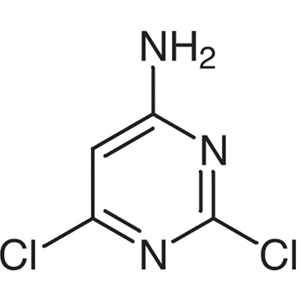
4-Amino-2,6-dichloropyrimidine is a chemical compound classified under heterocyclic building blocks, widely used in laboratory settings for the synthesis of complex molecules. This compound serves as a fundamental component in organic chemistry, enabling the creation of various functional groups through chemical reactions. Its unique molecular structure, featuring amino and dichloro groups, makes it a versatile reagent for synthetic pathways. In research and development, it plays a crucial role in the design and production of pharmaceuticals, agrochemicals, and industrial chemicals. Its presence in laboratory experiments contributes significantly to the advancement of chemical science.
The compound is valued for its stability and controlled reactivity, making it a preferred choice in synthetic chemistry. Its molecular structure allows for substitution reactions and other transformations, enabling the development of compounds with specific functionalities. The presence of both amino and chloro groups provides flexibility in structural modifications, expanding its applicability across different chemical fields. Its solid form also facilitates ease of handling and storage, ensuring consistent availability for laboratory use. These properties make it a reliable and efficient reagent in chemical synthesis processes.
In Indonesian laboratories, 4-Amino-2,6-dichloropyrimidine is extensively used in organic chemistry research. It is commonly found in academic and industrial settings where the synthesis of complex molecules is required. Its role in the development of new compounds, such as pharmaceuticals and pesticides, is well recognized. Researchers rely on this compound for its predictable behavior and adaptability in various chemical reactions, supporting a wide range of experimental applications. Its availability and reliability make it an essential tool in chemical research and development in Indonesia.
Related TCI products
- TCI A3058 310400-38-5 4-Amino-5,6-dichloropyrimidine
- TCI A1395 5413-85-4 5-Amino-4,6-dichloropyrimidine
- TCI A1110 56-05-3 2-Amino-4,6-dichloropyrimidine
- TCI T2550 1780-27-4 4,5,6-Trichloropyrimidine
- TCI T2512 5750-76-5 2,4,5-Trichloropyrimidine
- TCI T1810 32980-71-5 2,4,6,8-Tetrachloropyrimido[5,4-d]pyrimidine
- Organic synthesis is a primary application where this compound serves as a key building block for creating complex molecules.
- Pharmaceutical research benefits from its use in the development of new drugs, as it can be modified to produce various functional groups.
- Agrochemical development leverages its structure for the synthesis of pesticides and herbicides, contributing to crop protection.
- Industrial chemical production utilizes its reactivity for the creation of specialized compounds used in manufacturing.
- Structural modification studies rely on its flexible molecular framework to explore new chemical functionalities and properties.
| Brand | TCI |
|---|---|
| CAS number | 10132-07-7 |
| Molecular formula | — |
| Purity | — |
| Category | Chemistry > Building Blocks > Heterocyclic Building Blocks |
| Pack sizes | Available in various quantities as per standard laboratory requirements |
| Physical form | Solid |
| Storage | Store in a cool, dry place away from light and moisture |
This compound should be stored in a cool, dry environment, away from direct sunlight and moisture to maintain its chemical integrity. It is recommended to use airtight containers to prevent exposure to air and humidity. Due to its chemical nature, it should be handled with appropriate personal protective equipment, including gloves and safety goggles. Proper ventilation is essential when working with this material to minimize inhalation risks. It is important to keep it away from incompatible substances to avoid any potential chemical reactions. Regular monitoring of storage conditions ensures the compound remains stable and suitable for use in laboratory experiments.
—
Produk Terkait
-
4-Amino-5,6-dichloropyrimidine TCI A3058
Regular price Rp 900.900,00Regular priceRp 645.750,00Sale price Rp 900.900,00 -
5-Amino-4,6-dichloropyrimidine TCI A1395
Regular price Rp 662.550,00Regular priceRp 478.800,00Sale price Rp 662.550,00 -
2-Amino-4,6-dichloropyrimidine TCI A1110
Regular price Rp 2.518.950,00Regular priceRp 1.776.600,00Sale price Rp 2.518.950,00 -
4,5,6-Trichloropyrimidine TCI T2550
Regular price Rp 2.464.350,00Regular priceRp 1.738.800,00Sale price Rp 2.464.350,00 -
2,4,5-Trichloropyrimidine TCI T2512
Regular price Rp 1.670.550,00Regular priceRp 1.183.350,00Sale price Rp 1.670.550,00 -
2,4,6,8-Tetrachloropyrimido[5,4-d]pyrimidine TCI T1810
Regular price Rp 2.914.800,00Regular priceRp 2.053.800,00Sale price Rp 2.914.800,00 -
2,4,5,6-Tetrachloropyrimidine TCI T1217
Regular price Rp 1.060.500,00Regular priceRp 757.050,00Sale price Rp 1.060.500,00 -
5-(4-Bromophenyl)-4,6-dichloropyrimidine TCI B4950
Regular price Rp 2.013.900,00Regular priceRp 1.423.800,00Sale price Rp 2.013.900,00



![32980-71-5 2,4,6,8-Tetrachloropyrimido[5,4-d]pyrimidine - AMI Scientific](http://amiscientific.com/cdn/shop/files/TCI2510T1810.jpg?v=1767142228&width=533)

