

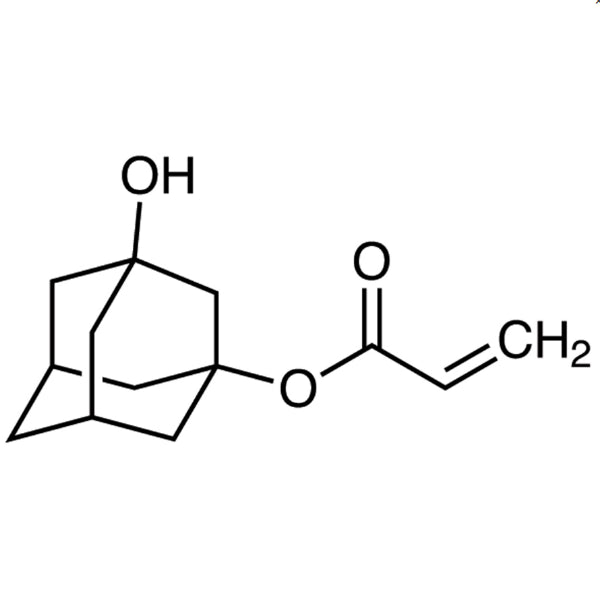
1-Acryloyloxy-3-hydroxyadamantane is a specialized chemical compound widely used in scientific and industrial applications, particularly in the fields of materials science and polymer chemistry. This compound serves as a key monomer in the synthesis of advanced polymers, offering unique structural and chemical properties that make it indispensable in modern laboratory research. Its molecular structure combines an acryloyloxy group with a hydroxyadamantane framework, enabling it to participate in various polymerization reactions and contribute to the development of high-performance materials. Due to its versatility, it is frequently employed in both academic and industrial settings for the creation of novel materials with tailored properties.
The compound's high reactivity and ability to form covalent bonds with a variety of functional groups make it a preferred choice for researchers working on hybrid polymers and composite materials. Its unique adamantane core provides exceptional chemical stability, which enhances the durability and resistance of the final products. This stability is crucial in applications where long-term performance and resistance to environmental factors are required. Additionally, the compound’s molecular structure allows for controlled modification, making it adaptable to a wide range of synthetic strategies and functionalization approaches.
In Indonesian laboratories, 1-Acryloyloxy-3-hydroxyadamantane is commonly used in applied research across various disciplines, including materials science, chemistry, and technology. It is particularly valuable in the development of advanced materials for electronic, medical, and industrial applications. Researchers in Indonesia rely on this compound to explore new polymer systems and improve the properties of existing materials. Its use is widespread in both academic and industrial research settings, contributing to innovation and technological advancement in the region.
TCI brochures (PDF)
- Monomers 2025-05-28 · p. 3
Related TCI products
- TCI B2937 13048-34-5 1,10-Bis(acryloyloxy)decane (stabilized with MEHQ)
- TCI B2936 13048-33-4 1,6-Bis(acryloyloxy)hexane (stabilized with MEHQ)
- TCI B2935 1070-70-8 1,4-Bis(acryloyloxy)butane (stabilized with MEHQ)
- TCI B2863 107481-28-7 1,9-Bis(acryloyloxy)nonane (stabilized with MEHQ)
- TCI A3322 83883-26-5 4-[[6-(Acryloyloxy)hexyl]oxy]benzoic Acid
- TCI O0727 130953-14-9 4-[[6-(Acryloyloxy)hexyl]oxy]phenyl 4-Methoxybenzoate
- Polymer synthesis and modification for advanced materials due to its reactivity and structural versatility.
- Development of hybrid polymers and composite materials for enhanced mechanical and thermal properties.
- Research in electronic materials where chemical stability and durability are critical factors.
- Creation of biomedical materials requiring biocompatibility and long-term performance.
- Investigation of new functional materials for industrial applications such as coatings and adhesives.
| Brand | TCI |
|---|---|
| CAS number | 216581-76-9 |
| Molecular formula | — |
| Purity | — |
| Category | Materials Science > Polymer/Macromolecule Reagents > Monomers |
| Pack sizes | Available in various quantities as per standard laboratory supply |
| Physical form | Solid or liquid, depending on specific product formulation |
| Storage | Store in a cool, dry place away from direct sunlight and incompatible substances |
This compound should be stored in a cool, dry environment, away from direct sunlight and sources of heat. It is recommended to keep it in a sealed container to prevent moisture absorption and contamination. Due to its reactivity, it should be handled with appropriate personal protective equipment, including gloves and safety goggles. Storage should be in a well-ventilated area to minimize exposure to vapors. Avoid contact with incompatible materials such as strong oxidizing agents. Regular inspection of storage conditions is advised to ensure the integrity and safety of the material in the laboratory setting.
—
Produk Terkait
-
1,10-Bis(acryloyloxy)decane(stabilizedwithMEHQ) TCI B2937
Regular price From Rp 1.724.100,00Regular priceRp 1.205.400,00Sale price From Rp 1.724.100,00 -
1,6-Bis(acryloyloxy)hexane(stabilizedwithMEHQ) TCI B2936
Regular price From Rp 557.550,00Regular priceRp 405.300,00Sale price From Rp 557.550,00 -
1,4-Bis(acryloyloxy)butane(stabilizedwithMEHQ) TCI B2935
Regular price Rp 637.350,00Regular priceRp 445.200,00Sale price Rp 637.350,00 -
1,9-Bis(acryloyloxy)nonane(stabilizedwithMEHQ) TCI B2863
Regular price From Rp 505.050,00Regular priceRp 352.800,00Sale price From Rp 505.050,00 -
4-[[6-(Acryloyloxy)hexyl]oxy]benzoicAcid TCI A3322
Regular price From Rp 928.200,00Regular priceRp 664.650,00Sale price From Rp 928.200,00 -
4-[[6-(Acryloyloxy)hexyl]oxy]phenyl4-Methoxybenzoate TCI O0727
Regular price From Rp 2.942.100,00Regular priceRp 2.072.700,00Sale price From Rp 2.942.100,00 -
2-Methyl-1,4-phenyleneBis[4-[[6-(acryloyloxy)hexyl]oxy]benzoate] TCI M3585
Regular price Rp 2.439.150,00Regular priceRp 1.720.950,00Sale price Rp 2.439.150,00 -
2,5-Bis-O-[4-[[4-[[[4-(acryloyloxy)butoxy]carbonyl]oxy]benzoyl]oxy]benzoyl]-1,4:3,6-dianhydro-D-glucitol TCI B6483
Regular price From Rp 3.419.850,00Regular priceRp 2.406.600,00Sale price From Rp 3.419.850,00


![2,5-Bis-O-[4-[[4-[[[4-(acryloyloxy)butoxy]carbonyl]oxy]benzoyl]oxy]benzoyl]-1,4:3,6-dianhydro-D-glucitol (CAS 223572-88-1) - TCI B6483 - AMI Scientific](http://amiscientific.com/cdn/shop/files/TCI2510B6483.jpg?v=1768816062&width=533)