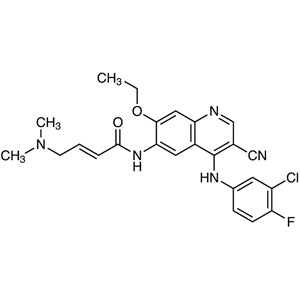
Afatinib is a chemical compound widely utilized in biochemical and pharmacological research. As an enzyme inhibitor, it plays a crucial role in blocking the activity of protein tyrosine kinase, particularly in signaling pathways associated with cancer cell growth. This compound is essential for laboratory research, enabling scientists to study biological activity and the mechanisms of drug action. Afatinib is a key reagent in life science laboratories, supporting various experimental procedures and investigations. Its versatility and effectiveness make it a valuable tool for researchers aiming to develop targeted therapies and understand cellular processes.
Afatinib is chemically stable and soluble in organic solvents such as ethanol and acetone, which enhances its usability in a wide range of chemical reactions and laboratory procedures. These properties make it a preferred choice for researchers who require reliable and consistent results. Its solid form and appropriate concentration allow for easy handling and application across different experimental scales. The compound's stability and solubility ensure that it maintains its integrity during storage and use, making it a dependable material for long-term research projects.
In Indonesian laboratories, Afatinib is commonly used in cancer research, particularly in the study of mechanisms that inhibit cancer cell growth. It is also employed in biological activity testing, the synthesis of new compounds, and qualitative and quantitative analysis in pharmacology and biochemistry. Its reliability and effectiveness have made it a primary choice for biomedical research in Indonesia, supporting both academic and industrial scientific endeavors.
TCI brochures (PDF)
- Antitumor Molecular-Targeted Agents 2026-09-17 · p. 1
- Receptor Tyrosine Kinase (RTK) Inhibitors 2026-04-06 · p. 2
- Antimicrobials and Antitumor Agents for Research and Experimental Use 2025-04-24 · p. 17
- Pharmaceutical Ingredients for Research and Experimental Use 2026-03-09 · p. 18
- Cancer research: Afatinib is used to study the inhibition of cancer cell growth by targeting specific signaling pathways.
- Biological activity testing: It enables researchers to assess the effects of compounds on cellular processes and enzyme activity.
- Drug development: Afatinib supports the development of new pharmaceuticals by providing insights into enzyme inhibition mechanisms.
- Biochemical analysis: It is employed in qualitative and quantitative studies to understand molecular interactions and reactions.
- Targeted therapy research: Afatinib is integral in exploring therapeutic strategies that focus on specific molecular targets in diseases.
| Brand | TCI |
|---|---|
| CAS number | 850140-72-6 |
| Molecular formula | — |
| Purity | — |
| Category | Life Science > Biochemicals and Reagents > Enzymes, Enzyme Inhibitors, Enzyme Substrates |
| Pack sizes | Available in various quantities suitable for different experimental needs |
| Physical form | Solid |
| Storage | Store in a cool, dry place away from direct sunlight |
Afatinib should be stored in a cool, dry environment to maintain its chemical stability and prevent degradation. It is recommended to keep the compound in a sealed container to minimize exposure to moisture and air, which can affect its integrity. When handling Afatinib, laboratory personnel should use appropriate personal protective equipment, such as gloves and safety goggles, to ensure safety. The compound is best stored in a well-ventilated area to avoid any potential hazards. Due to its solubility in organic solvents, it is important to handle it with care during preparation and experimentation. Proper storage and handling practices help preserve the quality and effectiveness of Afatinib for use in research applications.
—
Product Categories
- Biochemicals and ReagentsEnzymes, Enzyme Inhibitors, Enzyme SubstratesEnzyme Inhibitors [Biochemicals and Reagents]
- Biochemicals and ReagentsPharmaceutical Research Reagents (for Experimental Use)Antitumor Research Reagents (for Experimental Use)
- Cell BiologyCancer ResearchAntitumor Agents for Research
- Cell BiologyCancer ResearchTumor Growth Regulation [Cancer Research]
- Cell BiologyCell Signaling and NeuroscienceKinase/Phosphatase Biology
- Pharmaceutical Development and Drug Discovery ResearchPharmaceutical Research Reagents (for Experimental Use)Antitumor Research Reagents (for Experimental Use)
Produk Terkait
-
TyrphostinAG490 TCI T2962
Regular price Rp 1.431.150,00Regular priceRp 1.016.400,00Sale price Rp 1.431.150,00 -
TyrphostinAG1478 TCI T2944
Regular price Rp 6.704.250,00Regular priceRp 4.704.000,00Sale price Rp 6.704.250,00 -
Pelitinib TCI P2529
Regular price From Rp 3.498.600,00Regular priceRp 2.462.250,00Sale price From Rp 3.498.600,00 -
Mubritinib TCI M3058
Regular price From Rp 5.565.000,00Regular priceRp 3.907.050,00Sale price From Rp 5.565.000,00 -
Imatinib TCI I0906
Regular price From Rp 1.378.650,00Regular priceRp 979.650,00Sale price From Rp 1.378.650,00 -
SunitinibMalate TCI U0095
Regular price Rp 3.074.400,00Regular priceRp 2.165.100,00Sale price Rp 3.074.400,00 -
TyrphostinAG835 TCI T3540
Regular price From Rp 2.068.500,00Regular priceRp 1.461.600,00Sale price From Rp 2.068.500,00 -
TyrphostinA1 TCI T3074
Regular price From Rp 1.723.050,00Regular priceRp 1.220.100,00Sale price From Rp 1.723.050,00