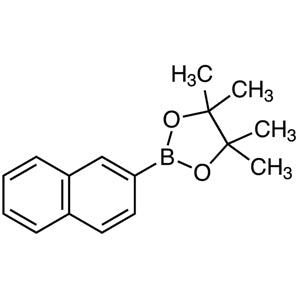
2-(9-Anthryl)-4,4,5,5-tetramethyl-1,3,2-dioxaborolane is an organoboron compound widely used in chemical research, particularly in the synthesis of complex molecules. This reagent plays a crucial role in modern organic chemistry due to its unique reactivity and compatibility with various transition metals. It is commonly employed in coupling reactions, where it serves as a versatile building block for constructing more complex molecular structures. Its presence in the laboratory enables chemists to explore new synthetic pathways and develop novel compounds with potential applications in multiple fields.
The compound's high reactivity, especially in the presence of heavy metals like palladium or nickel, makes it a preferred choice for advanced synthetic strategies. Its ability to participate in reactions such as Suzuki and Sardonic reactions highlights its importance in the field of organometallic chemistry. The stability and controlled reactivity of this reagent allow for precise manipulation in laboratory settings, ensuring reliable results. Additionally, its molecular structure provides flexibility, enabling it to be adapted to a wide range of chemical applications.
In Indonesian laboratories, this compound is frequently utilized in organic chemistry research, particularly in pharmaceutical and materials science studies. Researchers from universities and research institutions rely on it to develop new compounds with applications in healthcare and technology. Its use is integral to the advancement of chemical synthesis in the region, supporting both academic and industrial innovation.
TCI brochures (PDF)
- Suzuki-Miyaura Cross Coupling Reaction 2025-12-01 · p. 18
- Boron Compounds 2025-10-07 · p. 17
- Building Blocks for Organic Semiconductor 2026-03-24 · p. 9
Related TCI products
- TCI T3674 922518-84-1 4,4,5,5-Tetramethyl-2-[10-(2-naphthyl)anthracen-9-yl]-1,3,2-dioxaborolane
- TCI T3665 460347-59-5 4,4,5,5-Tetramethyl-2-(10-phenylanthracen-9-yl)-1,3,2-dioxaborolane
- TCI T3306 1149804-35-2 4,4,5,5-Tetramethyl-2-[10-(1-naphthyl)anthracen-9-yl]-1,3,2-dioxaborolane
- TCI D5307 624744-67-8 2-[9,10-Di(naphthalen-2-yl)anthracen-2-yl]-4,4,5,5-tetramethyl-1,3,2-dioxaborolane
- TCI B5770 1416243-42-9 2-[10-([1,1'-Biphenyl]-4-yl)anthracen-9-yl]-4,4,5,5-tetramethyl-1,3,2-dioxaborolane
- TCI T3875 1080632-76-3 2-([1,1':4',1''-Terphenyl]-4-yl)-4,4,5,5-tetramethyl-1,3,2-dioxaborolane
- Organic Synthesis: This reagent is ideal for complex molecule construction due to its reactivity and compatibility with transition metals.
- Pharmaceutical Research: It supports the development of new drug compounds through efficient coupling reactions.
- Materials Science: Used in creating advanced materials with specific chemical properties and structural integrity.
- Suzuki Coupling Reactions: Its role in these reactions makes it essential for synthesizing aromatic compounds.
- Sardonic Reactions: It enables the formation of complex organic structures with high selectivity and yield.
| Brand | TCI |
|---|---|
| CAS number | 709022-63-9 |
| Molecular formula | — |
| Purity | — |
| Category | Chemistry > Organometallic Reagents > Organoboron [Organometallic Reagents] |
| Pack sizes | Available in various quantities as per supplier specifications |
| Physical form | Solid or liquid, depending on the specific product variant |
| Storage | Store in a cool, dry place away from moisture and direct sunlight |
This reagent should be stored in a cool, dry environment to maintain its chemical integrity. It is recommended to use airtight containers to prevent exposure to moisture and air, which can affect its stability. Due to its reactivity, it should be handled with care, using appropriate personal protective equipment such as gloves and safety goggles. It is advisable to store it away from incompatible substances to avoid any potential chemical interactions. Proper labeling of storage containers is essential for safety and traceability in the laboratory setting. Regular monitoring of storage conditions ensures the reagent remains effective for its intended applications.
—
Produk Terkait
-
4,4,5,5-Tetramethyl-2-[10-(2-naphthyl)anthracen-9-yl]-1,3,2-dioxaborolane TCI T3674
Regular price From Rp 2.677.500,00Regular priceRp 1.887.900,00Sale price From Rp 2.677.500,00 -
4,4,5,5-Tetramethyl-2-(10-phenylanthracen-9-yl)-1,3,2-dioxaborolane TCI T3665
Regular price From Rp 4.028.850,00Regular priceRp 2.832.900,00Sale price From Rp 4.028.850,00 -
4,4,5,5-Tetramethyl-2-[10-(1-naphthyl)anthracen-9-yl]-1,3,2-dioxaborolane TCI T3306
Regular price Rp 4.001.550,00Regular priceRp 2.814.000,00Sale price Rp 4.001.550,00 -
2-[9,10-Di(naphthalen-2-yl)anthracen-2-yl]-4,4,5,5-tetramethyl-1,3,2-dioxaborolane TCI D5307
Regular price From Rp 2.411.850,00Regular priceRp 1.702.050,00Sale price From Rp 2.411.850,00 -
2-[10-([1,1'-Biphenyl]-4-yl)anthracen-9-yl]-4,4,5,5-tetramethyl-1,3,2-dioxaborolane TCI B5770
Regular price Rp 3.922.800,00Regular priceRp 2.758.350,00Sale price Rp 3.922.800,00 -
2-([1,1':4',1''-Terphenyl]-4-yl)-4,4,5,5-tetramethyl-1,3,2-dioxaborolane TCI T3875
Regular price Rp 3.392.550,00Regular priceRp 2.387.700,00Sale price Rp 3.392.550,00 -
4,4,5,5-Tetramethyl-2-(triphenylen-2-yl)-1,3,2-dioxaborolane TCI T3322
Regular price From Rp 4.001.550,00Regular priceRp 2.814.000,00Sale price From Rp 4.001.550,00 -
4,4,5,5-Tetramethyl-2-(2-naphthyl)-1,3,2-dioxaborolane TCI T3298
Regular price From Rp 875.700,00Regular priceRp 627.900,00Sale price From Rp 875.700,00