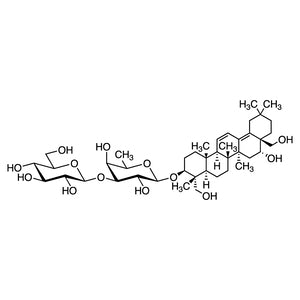
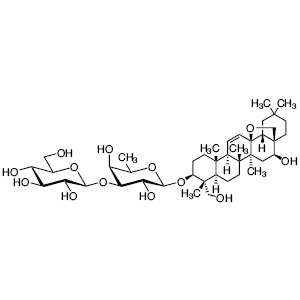
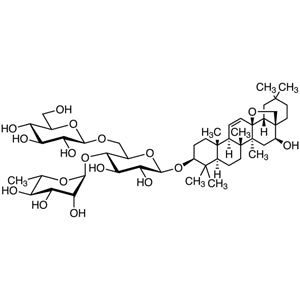
Saikosaponin D is a chemical compound classified under glycosides, playing a significant role in biochemical and pharmacological research. As a natural compound derived from plants, it is widely used in laboratories for its bioactive properties. This compound is essential for studies involving extraction, identification, and characterization of active compounds, particularly in the field of phytochemistry. Its presence in traditional medicinal plants makes it a valuable resource for scientific exploration.
Saikosaponin D is favored for its high purity, chemical stability, and solubility in organic solvents such as ethyl acetate and ethanol. These properties make it suitable for both qualitative and quantitative analyses in laboratory settings. Its molecular structure is well-defined, allowing for accurate identification using techniques like HPLC and UV-Vis spectroscopy. This ensures reliable results and enhances the accuracy of research findings.
In Indonesian laboratories, Saikosaponin D is commonly used in scientific research, especially in pharmaceutical, biochemical, and phytochemical studies. It is frequently found in investigations of bioactive compounds from medicinal plants, contributing to the development of new therapeutic agents and understanding of natural product chemistry.
TCI brochures (PDF)
- Terpenes 2025-09-22 · p. 10
- Phytochemicals 2025-12-17 · p. 7
- Bioactive Compound Research: Saikosaponin D is ideal for studying the pharmacological effects of natural compounds due to its known anti-inflammatory, antitumor, and antiviral properties.
- Phytochemical Analysis: Its solubility and stability make it suitable for extracting and analyzing bioactive compounds from medicinal plants.
- HPLC and Spectroscopy Studies: The compound's well-defined molecular structure allows for precise identification using advanced analytical techniques.
- Pharmaceutical Development: It is used in the development of new drugs, particularly those derived from plant-based sources.
- Academic Research: Saikosaponin D is a key component in research projects focused on natural product chemistry and drug discovery.
| Brand | TCI |
|---|---|
| CAS number | 20874-52-6 |
| Molecular formula | — |
| Purity | — |
| Category | Chemistry > Chemical Biology > Glycoscience |
| Pack sizes | Available in various quantities as per standard laboratory requirements |
| Physical form | Solid |
| Storage | Store in a cool, dry place away from light |
Saikosaponin D should be stored in a cool, dry place, away from direct sunlight and sources of heat. It is recommended to keep the compound in a tightly sealed container to prevent moisture absorption and contamination. Due to its chemical stability, it does not require refrigeration but should be protected from environmental factors that could degrade its quality. In laboratory settings, it is important to handle the compound with care, using appropriate personal protective equipment such as gloves and safety goggles. Proper labeling of storage containers is essential to ensure safe handling and prevent accidental exposure. Always follow standard laboratory safety protocols when working with organic compounds to maintain a safe and controlled environment.
—
Product Categories
- GlycoscienceDisaccharides [Glycoscience]
- GlycoscienceFunctional OligosaccharidesNatural Glycosides [Functional Oligosaccharides]
- GlycoscienceTrisaccharides [Glycoscience]
- Biochemicals and ReagentsCrude Medicine Ingredients for Research and Experimental Use
- Biochemicals and ReagentsTerpenesTriterpenes
- Cell BiologyCancer ResearchAntitumor Agents for Research
- Cell BiologyNutrition ResearchPhytochemicals
- Pharmaceutical Development and Drug Discovery ResearchCrude Medicine Ingredients for Research and Experimental Use
Produk Terkait
-
SaikosaponinB2 TCI A3610
Regular price Rp 6.438.600,00Regular priceRp 4.518.150,00Sale price Rp 6.438.600,00 -
SaikosaponinA TCI A3408
Regular price From Rp 2.411.850,00Regular priceRp 1.702.050,00Sale price From Rp 2.411.850,00 -
SaikosaponinC TCI A3189
Regular price Rp 4.373.250,00Regular priceRp 3.073.350,00Sale price Rp 4.373.250,00 -
GinsenosideRo TCI G0586
Regular price Rp 7.869.750,00Regular priceRp 5.518.800,00Sale price Rp 7.869.750,00 -
NotoginsenosideR1 TCI N1129
Regular price Rp 4.823.700,00Regular priceRp 3.388.350,00Sale price Rp 4.823.700,00 -
Naringin TCI N0073
Regular price Rp 1.670.550,00Regular priceRp 1.183.350,00Sale price Rp 1.670.550,00 -
MonoammoniumGlycyrrhizinate TCI M3857
Regular price From Rp 662.550,00Regular priceRp 478.800,00Sale price From Rp 662.550,00 -
alpha-Hederin TCI H1646
Regular price Rp 7.182.000,00Regular priceRp 5.037.900,00Sale price Rp 7.182.000,00