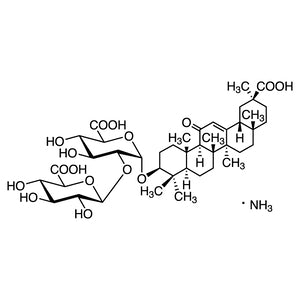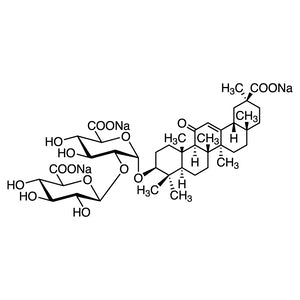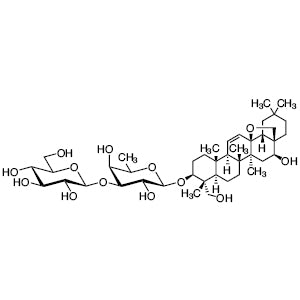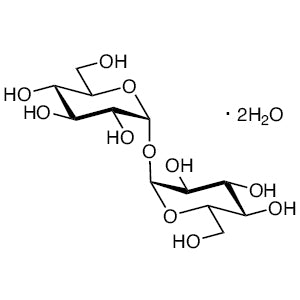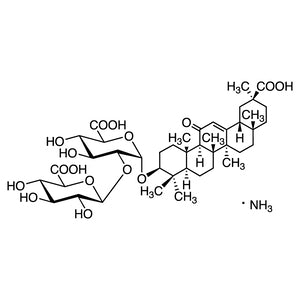
TCI M3857 is Monoammonium Glycyrrhizinate, the monoammonium salt of glycyrrhizic acid, the principal triterpenoid saponin derived from licorice root. Its molecule consists of an oleanane-type triterpenoid aglycone linked to two glucuronic acid units, which makes it structurally a glycoside and places it appropriately within the glycoscience category. In the laboratory, this material serves as a reference standard for the analysis of licorice content, as a test substance in natural product research, and as a model compound for studying saponin behaviour in solution systems and formulations.
The property that makes this monoammonium salt form the preferred choice is its markedly better solubility in water compared with free glycyrrhizic acid, together with improved storage stability and more consistent weighing. As a saponin, the compound is amphiphilic: it lowers surface tension, forms micelles, and stabilises dispersed systems, so it is frequently examined as a natural carrier and as a solubility enhancer for hydrophobic compounds. Its twin glucuronic acid groups impart a negative charge at neutral pH, making the compound responsive to pH conditions in the surrounding medium.
In Indonesian laboratories, this material is typically encountered in university and research-institute settings working on natural products, where licorice-derived constituents are quantified or characterised. It is also used in analytical laboratories preparing comparison standards for herbal and botanical raw material testing, and in formulation research groups exploring saponins as solubilising or dispersion-stabilising agents. The TCI brand is commonly specified where a consistent, well-documented organic reagent is required for repeatable method work.
TCI brochures (PDF)
- Terpenes 2025-09-22 · p. 9
- Reference standard for licorice content analysis, since the defined monoammonium salt form gives consistent weighing and reliable solution preparation for comparison against sample extracts.
- Natural product research test substance, where the compound serves as a well-characterised licorice-derived saponin for investigating plant constituents and their chemical behaviour.
- Model compound for saponin behaviour studies, allowing researchers to observe surface tension reduction and micelle formation under controlled laboratory solution conditions.
- Solubility enhancement research for hydrophobic compounds, exploiting the amphiphilic saponin structure that can carry poorly water-soluble substances in aqueous systems.
- Dispersion system stabilisation work in formulation studies, because the compound stabilises dispersed phases while its glucuronic acid groups provide pH-responsive negative charge.
| Brand | TCI |
|---|---|
| CAS number | 53956-04-0 |
| Molecular formula | — |
| Purity | — |
| Category | Chemistry > Chemical Biology > Glycoscience |
| Pack sizes | available in standard TCI research pack sizes; please confirm the required size when ordering |
| Physical form | — |
| Storage | store according to the manufacturer's instructions stated on the product label |
- Chemical form: monoammonium salt of glycyrrhizic acid, an oleanane-type triterpenoid saponin glycoside
Store this material in a cool, dry place away from direct sunlight and sources of heat, following the storage instructions printed on the manufacturer's label. Keep the product in its original tightly closed container, or transfer it to a clean, dry, chemically compatible container that is clearly labelled with the compound name and CAS number. Protect the contents from moisture, as saponin salts readily absorb water from humid air, which affects weighing accuracy. Handle the powder in a well-ventilated area or fume hood to avoid inhaling dust, and wear a laboratory coat, safety glasses, and gloves. Use clean, dry spatulas for each withdrawal to prevent cross-contamination, and close the container promptly after use.
—
Product Categories
- GlycoscienceApplications Using Glyco-materialsGlyco-engeneering [Applications Using Glyco-materials]
- GlycoscienceApplications Using Glyco-materialsGlyco-utilization [Applications Using Glyco-materials]
- GlycoscienceDisaccharides [Glycoscience]
- GlycoscienceFunctional OligosaccharidesNatural Glycosides [Functional Oligosaccharides]
- GlycoscienceOligosaccharides by Component SugarGlucuronic Acids [Oligosaccharides by Component Sugar]
- Biochemicals and ReagentsCrude Medicine Ingredients for Research and Experimental Use
- Biochemicals and ReagentsTerpenesTriterpenes
- Cell BiologyNutrition ResearchPhytochemicals
- Cell BiologyNutrition ResearchSweetener Research Reagents (for Experimental Use)
- Cell BiologyObesity and Diabetes ResearchSweetener Research Reagents (for Experimental Use)
- Pharmaceutical Development and Drug Discovery ResearchCrude Medicine Ingredients for Research and Experimental Use
Produk Terkait
-
MonoammoniumGlycyrrhizinate TCI G0151
Regular price Rp 769.650,00Regular priceRp 553.350,00Sale price Rp 769.650,00 -
DipotassiumGlycyrrhizinate TCI G0270
Regular price Rp 1.643.250,00Regular priceRp 1.164.450,00Sale price Rp 1.643.250,00 -
Glycyrrhizin TCI G0150
Regular price From Rp 610.050,00Regular priceRp 442.050,00Sale price From Rp 610.050,00 -
TrisodiumGlycyrrhizinate TCI G0217
Regular price Rp 4.028.850,00Regular priceRp 2.832.900,00Sale price Rp 4.028.850,00 -
SaikosaponinA TCI A3408
Regular price From Rp 2.411.850,00Regular priceRp 1.702.050,00Sale price From Rp 2.411.850,00 -
D-(+)-TrehaloseDihydrate TCI T0331
Regular price From Rp 557.550,00Regular priceRp 405.300,00Sale price From Rp 557.550,00 -
PotassiumHyaluronatefromBacteria TCI H1808
Regular price Rp 7.287.000,00Regular priceRp 5.111.400,00Sale price Rp 7.287.000,00 -
HyaluronicAcidSodiumSaltfromBacteria TCI H1791
Regular price From Rp 1.988.700,00Regular priceRp 1.405.950,00Sale price From Rp 1.988.700,00