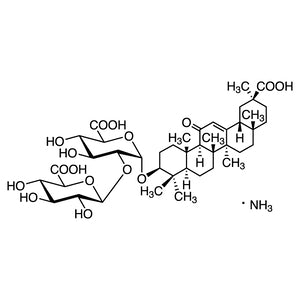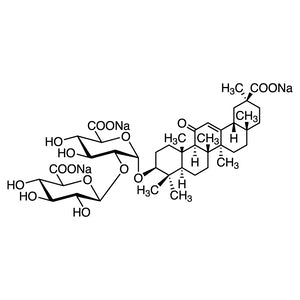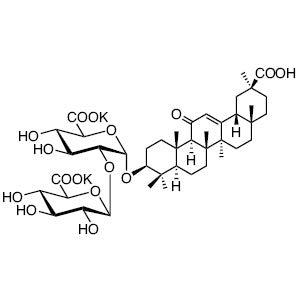
Dipotassium Glycyrrhizinate is the dipotassium salt of glycyrrhizic acid, the principal triterpenoid saponin derived from the roots of licorice. The salt form was developed so that an active compound which is poorly soluble in its native state becomes far easier to disperse in aqueous media, making it practical for both formulation work and biological assays. In the laboratory, this compound serves as a reference material for natural product research, topical preparation development, and studies of the anti-inflammatory and skin-protective activities that are widely reported for glycyrrhizin derivatives.
The characteristics that make this material a preferred choice are its good water solubility, its powder form that is easy to weigh accurately, and its adequate storage stability compared with the free acid form. The amphiphilic nature of the triterpene skeleton linked to two glucuronic acid units gives the molecule the ability to lower surface tension and to form aggregates in solution, a character that is of considerable interest to researchers working on delivery systems. The very strong sweetness associated with glycyrrhizin derivatives also makes the compound a subject of study in food science, although for research purposes the emphasis falls more on its physicochemical behaviour and its biological activity.
Pharmaceutical and cosmetic laboratories across Indonesia work with this material in natural product screening programmes, in the development of topical and personal care preparations, and in teaching contexts where a well-characterised saponin is needed. Its aqueous solubility suits the routine dissolution and dilution steps carried out in Indonesian laboratory settings, where straightforward handling and reliable behaviour in water-based systems are valued in day-to-day bench work.
- Natural product research: the compound serves as a defined reference material representing the major saponin of licorice root, supporting identification and comparative study work.
- Topical preparation development: its good water solubility and powder form allow formulators to incorporate the active into aqueous vehicles for topical and personal care preparations under study.
- Anti-inflammatory activity studies: glycyrrhizin derivatives are widely reported for anti-inflammatory effects, making this salt a practical starting material for biological assays in solution.
- Skin protection research: the skin-protective activity described for glycyrrhizin derivatives makes the compound suitable for evaluating protective effects in dermatological and cosmetic science investigations.
- Delivery system investigations: the amphiphilic triterpene-diglucuronide structure lowers surface tension and forms aggregates in solution, a behaviour relevant to surfactant and carrier system research.
| Brand | TCI |
|---|---|
| CAS number | 68797-35-3 |
| Molecular formula | — |
| Purity | — |
| Category | Chemistry > Chemical Biology > Glycoscience |
| Pack sizes | available in the pack sizes offered for this catalogue item |
| Physical form | powder |
| Storage | keep in a closed container under the conditions stated by the manufacturer on the product label |
Store the material in its original tightly closed container, kept dry and protected from moisture, since powdered saponin salts readily take up water from humid air. Amber glass or opaque plastic containers with well-fitting closures are suitable for aliquots, and containers should be clearly labelled with the compound name and CAS number. Follow the storage conditions given by the manufacturer on the product label. Handle the powder in a well-ventilated area or in a fume hood to avoid inhaling airborne dust, and wear a laboratory coat, gloves, and eye protection. Use clean, dry spatulas when weighing to prevent contamination of the bulk material, and consult the safety data sheet before use.
—
Product Categories
- GlycoscienceDisaccharides [Glycoscience]
- GlycoscienceFunctional OligosaccharidesNatural Glycosides [Functional Oligosaccharides]
- GlycoscienceOligosaccharides by Component SugarGlucuronic Acids [Oligosaccharides by Component Sugar]
- Biochemicals and ReagentsCarbohydrates
- Biochemicals and ReagentsCrude Medicine Ingredients for Research and Experimental Use
- Biochemicals and ReagentsTerpenesTriterpenes
- Cell BiologyNutrition ResearchPhytochemicals
- Cell BiologyNutrition ResearchSweetener Research Reagents (for Experimental Use)
- Cell BiologyObesity and Diabetes ResearchSweetener Research Reagents (for Experimental Use)
- Pharmaceutical Development and Drug Discovery ResearchCrude Medicine Ingredients for Research and Experimental Use
Produk Terkait
-
MonoammoniumGlycyrrhizinate TCI G0151
Regular price Rp 717.150,00Regular price -
Glycyrrhizin TCI G0150
Regular price From Rp 557.550,00Regular price -
TrisodiumGlycyrrhizinate TCI G0217
Regular price Rp 3.976.350,00Regular price -
MonoammoniumGlycyrrhizinate TCI M3857
Regular price From Rp 610.050,00Regular price -
Stevioside TCI S0594
Regular price Rp 2.677.500,00Regular price -
Amygdalin TCI A0443
Regular price From Rp 477.750,00Regular price -
SaikosaponinB2 TCI A3610
Regular price Rp 6.386.100,00Regular price -
SaikosaponinA TCI A3408
Regular price From Rp 2.359.350,00Regular price