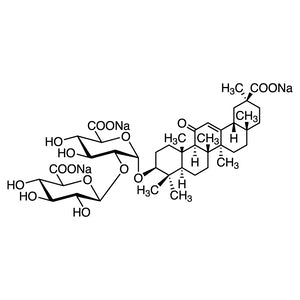
Monoammonium Glycyrrhizinate (TCI G0151) is a chemical compound widely used in chemical and biochemical experiments. It is a key component in the study of flavonoids and glycosides, playing a vital role in research related to natural products and their biological activities. This compound is commonly found in laboratory settings where researchers are investigating the pharmacological effects of herbal extracts and exploring the potential of plant-derived compounds for therapeutic applications. Its presence in various scientific studies highlights its importance in advancing knowledge in the field of medicinal chemistry.
The compound is valued for its chemical stability under specific conditions, which simplifies storage and handling in a laboratory environment. It exhibits good solubility in organic solvents, making it a preferred choice for synthesis reactions and analytical procedures. These properties enhance its versatility, allowing it to be used in a wide range of experimental setups. Its solubility and stability ensure consistent results, making it a reliable material for both qualitative and quantitative research.
In Indonesian laboratories, Monoammonium Glycyrrhizinate is frequently utilized in pharmacology, organic chemistry, and biochemistry research. Scientists rely on this compound for studies involving the pharmacological effects of medicinal plants and the development of new bioactive compounds. Its availability supports ongoing research efforts, enabling researchers to conduct experiments that contribute to scientific advancements in the health and pharmaceutical sectors.
TCI brochures (PDF)
- Obesity_Diabete Research Reagents 2026-07-10 · p. 1
- Traditional Medicine/Crude Medicine Research Reagents 2024-09-11 · p. 1
- Terpenes 2025-09-22 · p. 9
- Plant Research Reagents 2026-02-24 · p. 8
- Phytochemicals 2025-12-17 · p. 6
- Reagents for Glyco Chemistry & Biology 5th Edition · p. 84
- Pharmacological research utilizes Monoammonium Glycyrrhizinate to study the biological effects of herbal compounds and their potential therapeutic applications.
- Organic chemistry experiments often involve this compound for the synthesis of complex molecules and the analysis of natural product derivatives.
- Biochemical studies benefit from its use in isolating and characterizing active components from plant extracts, aiding in the understanding of their molecular mechanisms.
- Analytical chemistry applications rely on its solubility and stability for chromatographic and spectroscopic analyses of plant-based compounds.
- Herbal medicine research employs this compound to investigate the pharmacological properties of traditional remedies and their modern applications.
| Brand | TCI |
|---|---|
| CAS number | 53956-04-0 |
| Molecular formula | — |
| Purity | — |
| Category | Chemistry > Chemical Biology > Glycoscience |
| Pack sizes | — |
| Physical form | — |
| Storage | Store in a cool, dry place away from direct sunlight |
Monoammonium Glycyrrhizinate should be stored in a cool, dry environment to maintain its chemical stability. It is recommended to keep the compound in a tightly sealed container to prevent moisture absorption and contamination. While no specific storage conditions beyond these are provided, general laboratory safety practices should be followed, including the use of appropriate personal protective equipment when handling the material. The compound is generally stable under normal laboratory conditions, making it suitable for routine use in research settings. Proper labeling and storage are essential to ensure safe handling and prevent accidental exposure.
—
Product Categories
- GlycoscienceApplications Using Glyco-materialsGlyco-engeneering [Applications Using Glyco-materials]
- GlycoscienceApplications Using Glyco-materialsGlyco-utilization [Applications Using Glyco-materials]
- GlycoscienceDisaccharides [Glycoscience]
- GlycoscienceFunctional OligosaccharidesNatural Glycosides [Functional Oligosaccharides]
- GlycoscienceOligosaccharides by Component SugarGlucuronic Acids [Oligosaccharides by Component Sugar]
- Biochemicals and ReagentsCarbohydrates
- Biochemicals and ReagentsCrude Medicine Ingredients for Research and Experimental Use
- Biochemicals and ReagentsTerpenesTriterpenes
- Cell BiologyNutrition ResearchPhytochemicals
- Cell BiologyNutrition ResearchSweetener Research Reagents (for Experimental Use)
- Cell BiologyObesity and Diabetes ResearchSweetener Research Reagents (for Experimental Use)
- Pharmaceutical Development and Drug Discovery ResearchCrude Medicine Ingredients for Research and Experimental Use
Produk Terkait
-
MonoammoniumGlycyrrhizinate TCI M3857
Regular price From Rp 610.050,00Regular price -
DipotassiumGlycyrrhizinate TCI G0270
Regular price Rp 1.590.750,00Regular price -
Glycyrrhizin TCI G0150
Regular price From Rp 557.550,00Regular price -
TrisodiumGlycyrrhizinate TCI G0217
Regular price Rp 3.976.350,00Regular price -
D-(+)-TrehaloseDihydrate TCI T0331
Regular price From Rp 505.050,00Regular price -
Stevioside TCI S0594
Regular price Rp 2.677.500,00Regular price -
SaikosaponinA TCI A3408
Regular price From Rp 2.359.350,00Regular price -
D-(+)-TrehaloseAnhydrous TCI T0832
Regular price From Rp 1.115.100,00Regular price