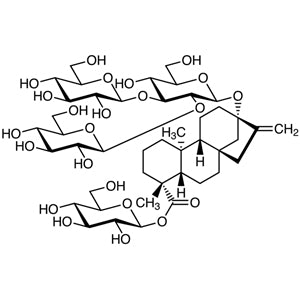
Stevioside is a naturally occurring chemical compound classified under the category of glycosides, derived from the *Stevia rebaudiana* plant. It plays a significant role in chemical biology and glycoscience research due to its unique ability to interact with specific proteins and enzymes. In the laboratory, it is widely used to study the mechanisms of biological activity, including its effects on glucose metabolism and the nervous system. Its presence in various research fields highlights its importance as a versatile tool for scientific investigation.
One of the key properties that make Stevioside a preferred choice is its chemical stability and complex molecular structure, which enable specific interactions with various biological targets. This stability ensures consistent results in experiments, making it a reliable material for research. Additionally, Stevioside exhibits good solubility in organic solvents such as ethanol and acetone, which simplifies processing and analysis in laboratory settings. These characteristics contribute to its widespread use in both academic and industrial research.
In Indonesian laboratories, Stevioside is commonly used in health, nutrition, and pharmacology research. It is a popular choice due to its availability and the assurance of quality. Researchers in Indonesia rely on Stevioside for its potential in developing natural therapeutic products. Its application spans across multiple scientific disciplines, making it an essential component in modern laboratory practices.
TCI brochures (PDF)
- Obesity_Diabete Research Reagents 2026-07-10 · p. 1
- Traditional Medicine/Crude Medicine Research Reagents 2024-09-11 · p. 1
- Terpenes 2025-09-22 · p. 8
- Plant Research Reagents 2026-02-24 · p. 8
- Phytochemicals 2025-12-17 · p. 7
- Reagents for Glyco Chemistry & Biology 5th Edition · p. 88
- Biochemical Research: Stevioside is used to investigate its interactions with proteins and enzymes, aiding in the understanding of biological mechanisms.
- Glucose Metabolism Studies: It is employed to study its effects on glucose metabolism, providing insights into metabolic disorders.
- Neuropharmacological Studies: Stevioside is utilized to explore its impact on the nervous system, contributing to research on neurological conditions.
- Natural Product Development: Its potential in developing therapeutic products makes it a valuable resource in pharmaceutical research.
- Nutritional Research: Stevioside is used to study its role in dietary applications and health benefits, supporting nutritional science investigations.
| Brand | TCI |
|---|---|
| CAS number | 57817-89-7 |
| Molecular formula | — |
| Purity | — |
| Category | Chemistry > Chemical Biology > Glycoscience |
| Pack sizes | Available in various quantities as per supplier specifications |
| Physical form | Powder |
| Storage | Store in a cool, dry place away from light |
Stevioside should be stored in a cool, dry place, away from direct sunlight to maintain its chemical stability. It is recommended to use airtight containers to prevent moisture absorption and contamination. Due to its solubility in organic solvents, it should be handled in a well-ventilated area to avoid inhalation of vapors. Laboratory personnel should wear appropriate personal protective equipment, such as gloves and safety goggles, when handling this compound. Proper labeling of containers is essential to ensure safe storage and usage. Stevioside is not flammable, but it should be kept away from incompatible materials to prevent any potential reactions. Following these guidelines ensures safe and effective use in laboratory settings.
—
Product Categories
- GlycoscienceDisaccharides [Glycoscience]
- GlycoscienceFunctional OligosaccharidesNatural Glycosides [Functional Oligosaccharides]
- Biochemicals and ReagentsCarbohydrates
- Biochemicals and ReagentsCrude Medicine Ingredients for Research and Experimental Use
- Biochemicals and ReagentsTerpenesDiterpenes
- Cell BiologyNutrition ResearchPhytochemicals
- Cell BiologyNutrition ResearchSweetener Research Reagents (for Experimental Use)
- Cell BiologyObesity and Diabetes ResearchSweetener Research Reagents (for Experimental Use)
- Pharmaceutical Development and Drug Discovery ResearchCrude Medicine Ingredients for Research and Experimental Use
Produk Terkait
-
DipotassiumGlycyrrhizinate TCI G0270
Regular price Rp 1.643.250,00Regular priceRp 1.164.450,00Sale price Rp 1.643.250,00 -
MonoammoniumGlycyrrhizinate TCI G0151
Regular price Rp 769.650,00Regular priceRp 553.350,00Sale price Rp 769.650,00 -
Glycyrrhizin TCI G0150
Regular price From Rp 610.050,00Regular priceRp 442.050,00Sale price From Rp 610.050,00 -
TrisodiumGlycyrrhizinate TCI G0217
Regular price Rp 4.028.850,00Regular priceRp 2.832.900,00Sale price Rp 4.028.850,00 -
RebaudiosideA TCI R0095
Regular price From Rp 1.881.600,00Regular priceRp 1.331.400,00Sale price From Rp 1.881.600,00 -
MonoammoniumGlycyrrhizinate TCI M3857
Regular price From Rp 662.550,00Regular priceRp 478.800,00Sale price From Rp 662.550,00 -
Amygdalin TCI A0443
Regular price From Rp 530.250,00Regular priceRp 386.400,00Sale price From Rp 530.250,00 -
D-(+)-TrehaloseAnhydrous TCI T0832
Regular price From Rp 1.167.600,00Regular priceRp 831.600,00Sale price From Rp 1.167.600,00