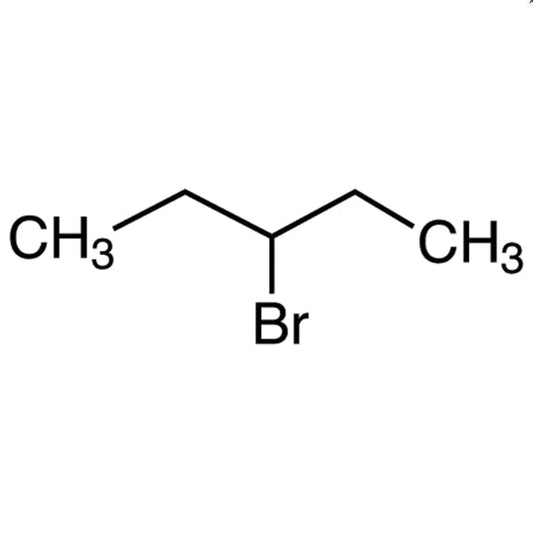
1-Bromopentane from TCI, also known as n-pentyl bromide, is a primary alkyl halide with a straight five-carbon chain. It is one of the most basic building blocks in organic synthesis and is used to attach a pentyl group to other molecules. In the laboratory, 1-Bromopentane acts as an electrophile in nucleophilic substitution reactions. It is also a starting material for Grignard and organolithium reagents. Researchers use it to prepare many alkyl-chain derivatives, from ethers and esters to quaternary ammonium salts.
Because it is a primary halide, 1-Bromopentane reacts well by the SN2 mechanism. Steric hindrance at the reacting carbon is low, so it tends to give clean substitution products. The carbon–bromine bond strikes a useful balance between reactivity and stability: the compound is more reactive than the corresponding chloride and is generally more economical and stable than the iodide. Its linear pentyl chain also helps chemists tune the lipophilicity of a target molecule, which matters in the design of active compounds, surfactants, liquid crystals and ionic liquids.
Organic chemistry, materials chemistry and pharmaceutical laboratories in Indonesia can use 1-Bromopentane for research and development work that needs a simple, dependable alkylating agent. University research groups use it in synthesis teaching and in thesis projects that involve chain extension or functional group introduction. Industrial and academic teams working on new materials, surfactant systems or drug candidates can use it to build pentyl-substituted intermediates. A consistent supply of TCI material supports reproducible results from one batch of experiments to the next.
TCI brochures (PDF)
- Building Blocks for Organic Semiconductor 2026-03-24 · p. 40
- Nucleophilic substitution (SN2) reactions: as a primary alkyl bromide with low steric hindrance, it reacts readily with nucleophiles and tends to give clean pentyl-substituted products.
- Grignard reagent preparation: reacting it with magnesium gives pentylmagnesium bromide, which lets chemists form new carbon–carbon bonds with carbonyl compounds and other electrophiles.
- Organolithium reagent synthesis: its carbon–bromine bond makes it a practical precursor for pentyllithium species used in metalation and carbon–carbon bond-forming steps in organic synthesis.
- Preparation of ethers, esters and quaternary ammonium salts: it alkylates alcohols, carboxylates and amines efficiently, so it is useful for building a wide range of pentyl-chain derivatives.
- Lipophilicity tuning in materials and drug design: its linear pentyl chain lets researchers adjust hydrophobic character in active compounds, surfactants, liquid crystals and ionic liquids.
| Brand | TCI (product code B0628) |
|---|---|
| CAS number | 110-53-2 |
| Molecular formula | — |
| Purity | — |
| Category | Chemistry > Building Blocks > Non-Heterocyclic Building Blocks |
| Pack sizes | available in several pack sizes; see the product listing for current options |
| Physical form | liquid |
| Storage | keep tightly closed in a cool, dry, well-ventilated place away from heat and ignition sources |
Store 1-Bromopentane in its original, tightly sealed container in a cool, dry and well-ventilated area. Keep it away from heat, sparks, open flames and direct sunlight, and separate it from strong oxidizing agents and strong bases. Use glass or other chemically compatible containers, and label any transfers clearly. Handle the compound in a fume hood, wearing chemical-resistant gloves, safety goggles and a laboratory coat. Avoid inhaling vapors and avoid contact with skin and eyes. Dispose of waste according to local regulations and your institution's procedures. Always read the supplier's Safety Data Sheet before use.
—
Product Categories
Produk Terkait
-
1-Bromopentadecane TCI B0936
Regular price From Rp 3.949.050,00Regular priceRp 2.761.500,00Sale price From Rp 3.949.050,00 -
3-Bromopentane TCI B4340
Regular price Rp 3.498.600,00Regular priceRp 2.446.500,00Sale price Rp 3.498.600,00 -
2,4-Dibromopentane TCI D1410
Regular price Rp 4.531.800,00Regular priceRp 3.168.900,00Sale price Rp 4.531.800,00 -
1,4-Dibromopentane TCI D1408
Regular price From Rp 610.050,00Regular priceRp 426.300,00Sale price From Rp 610.050,00 -
1,5-Dibromopentane TCI D0198
Regular price From Rp 743.400,00Regular priceRp 519.750,00Sale price From Rp 743.400,00 -
1-Bromoheptadecane TCI B0937
Regular price From Rp 3.340.050,00Regular priceRp 2.335.200,00Sale price From Rp 3.340.050,00 -
1-Bromotridecane TCI B0935
Regular price From Rp 2.518.950,00Regular priceRp 1.760.850,00Sale price From Rp 2.518.950,00 -
1-Bromoundecane TCI B0934
Regular price From Rp 1.035.300,00Regular priceRp 723.450,00Sale price From Rp 1.035.300,00