


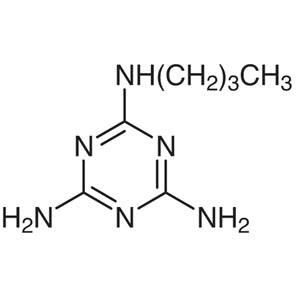
2,4-Diamino-6-butylamino-1,3,5-triazine is a chemical compound classified under heterocyclic building blocks, commonly used in organic chemistry and pharmaceutical research. As a fundamental building block, it plays a crucial role in the synthesis of complex molecules, including pharmaceuticals and industrial chemicals. Its unique structure allows for versatile chemical modifications, making it an essential tool for researchers aiming to develop new compounds with specific functional groups. This compound is widely utilized in laboratory settings for creating intermediates that serve as precursors to final products in various chemical processes.
The compound's high reactivity and stable heterocyclic framework make it a preferred choice in synthetic chemistry. It contains multiple amino groups and nitrogen atoms, which enhance its ability to participate in nucleophilic reactions, substitution, and hydrolysis. These properties enable it to interact effectively with a wide range of functional groups, supporting the synthesis of diverse chemical structures. Its versatility and reactivity are key factors in its popularity among chemists working on drug development and advanced material synthesis.
In Indonesian laboratories, 2,4-Diamino-6-butylamino-1,3,5-triazine is commonly used in organic chemistry research, pharmaceutical development, and industrial chemical production. Its broad applications and chemical versatility make it a valuable resource for researchers and industrial chemists seeking to create complex molecular structures. Its role in generating intermediates and enabling the synthesis of target compounds underscores its importance in both academic and industrial settings.
Related TCI products
- TCI D3239 50729-75-4 2,4-Diamino-6-[2-(2-undecyl-1-imidazolyl)ethyl]-1,3,5-triazine
- TCI D3238 38668-46-1 2,4-Diamino-6-[2-(2-methyl-1-imidazolyl)ethyl]-1,3,5-triazine
- TCI D2232 2827-45-4 2,4-Diamino-6-methoxy-1,3,5-triazine
- TCI D2227 504-08-5 2,4-Diamino-1,3,5-triazine
- TCI D2225 24860-40-0 2,4-Diamino-6-isopropoxy-1,3,5-triazine
- TCI D0583 542-02-9 2,4-Diamino-6-methyl-1,3,5-triazine
- Organic chemistry research benefits from this compound due to its ability to form complex molecular structures through various chemical reactions.
- Pharmaceutical development utilizes it as a building block for synthesizing active pharmaceutical ingredients with specific functional groups.
- Industrial chemical production relies on its reactivity for creating intermediates that lead to the final chemical products.
- Drug discovery processes incorporate this compound to explore new molecular scaffolds with potential therapeutic applications.
- Chemical synthesis projects use it for its versatility in forming diverse compounds through nucleophilic and substitution reactions.
| Brand | TCI |
|---|---|
| CAS number | 5606-24-6 |
| Molecular formula | — |
| Purity | — |
| Category | Chemistry > Building Blocks > Heterocyclic Building Blocks |
| Pack sizes | Available in various quantities as per supplier specifications |
| Physical form | Solid |
| Storage | Store in a cool, dry place away from direct sunlight and moisture |
This compound should be stored in a cool, dry environment, away from direct sunlight and moisture to maintain its stability and reactivity. It is recommended to use airtight containers made of glass or high-density polyethylene to prevent contamination and degradation. Due to its chemical reactivity, it should be handled with appropriate personal protective equipment, including gloves and safety goggles, to ensure laboratory safety. Avoid exposure to incompatible substances such as strong acids or bases. Proper ventilation is also essential when working with this compound to minimize inhalation risks. Regular monitoring of storage conditions is advised to maintain the integrity of the material throughout its shelf life.
—
Produk Terkait
-
2,4-Diamino-6-[2-(2-undecyl-1-imidazolyl)ethyl]-1,3,5-triazine TCI D3239
Regular price Rp 1.351.350,00Regular priceRp 960.750,00Sale price Rp 1.351.350,00 -
2,4-Diamino-6-[2-(2-methyl-1-imidazolyl)ethyl]-1,3,5-triazine TCI D3238
Regular price Rp 717.150,00Regular priceRp 516.600,00Sale price Rp 717.150,00 -
2,4-Diamino-6-methoxy-1,3,5-triazine TCI D2232
Regular price Rp 4.636.800,00Regular priceRp 3.258.150,00Sale price Rp 4.636.800,00 -
2,4-Diamino-1,3,5-triazine TCI D2227
Regular price From Rp 3.232.950,00Regular priceRp 2.276.400,00Sale price From Rp 3.232.950,00 -
2,4-Diamino-6-isopropoxy-1,3,5-triazine TCI D2225
Regular price Rp 2.464.350,00Regular priceRp 1.738.800,00Sale price Rp 2.464.350,00 -
2,4-Diamino-6-methyl-1,3,5-triazine TCI D0583
Regular price From Rp 505.050,00Regular priceRp 368.550,00Sale price From Rp 505.050,00 -
2,4-Diamino-6-diethylamino-1,3,5-triazine TCI D0512
Regular price Rp 8.295.000,00Regular priceRp 5.815.950,00Sale price Rp 8.295.000,00 -
6-(Dibutylamino)-1,3,5-triazine-2,4-dithiol TCI D3265
Regular price From Rp 769.650,00Regular priceRp 553.350,00Sale price From Rp 769.650,00


