

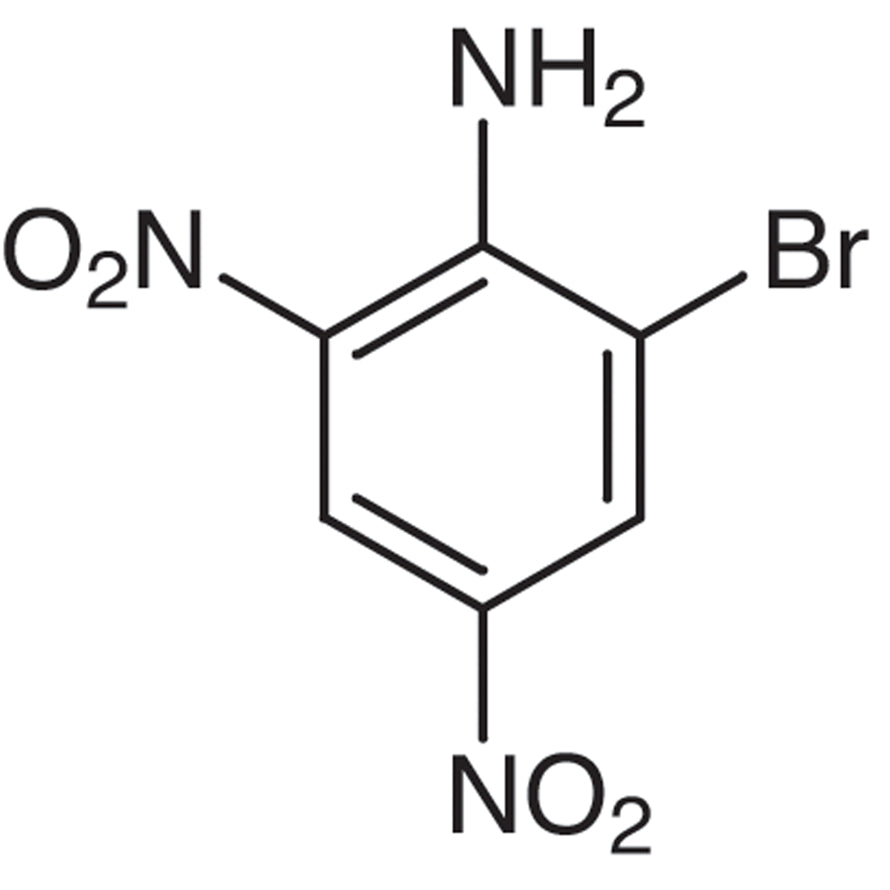
2-Bromo-4,6-dinitroaniline is a chemical compound widely used as a foundational building block in the synthesis of complex organic compounds. This aromatic compound features a bromine atom and two nitro groups positioned at specific sites, contributing to its high reactivity. In laboratory settings, it serves as a key reagent for creating various derivatives with applications across multiple scientific fields. Its unique molecular structure makes it a versatile tool for chemists seeking to design and develop new materials, pharmaceuticals, or functional chemicals.
The compound’s chemical properties, including its aromatic nature and functional groups, make it a preferred choice for synthetic chemists. The presence of nitro groups imparts strong oxidizing characteristics, which can be harnessed in controlled reactions. Its reactivity and specificity allow for precise chemical transformations, making it ideal for applications requiring high accuracy. However, due to its sensitivity to heat and UV light, careful handling is essential to maintain its stability and effectiveness.
In Indonesian laboratories, 2-Bromo-4,6-dinitroaniline is commonly used in organic chemistry research and development. It plays a significant role in the synthesis of compounds with potential biological activity, supporting advancements in pharmaceutical and material sciences. Its use is particularly prominent in academic and industrial research settings where precise chemical reactions are required for innovation and discovery.
- Organic synthesis applications benefit from its reactivity and structural versatility, enabling the creation of complex molecules with tailored properties.
- Pharmaceutical research utilizes this compound for the development of new drugs, as its functional groups can be modified to target specific biological pathways.
- Material science studies leverage its oxidizing properties for the synthesis of advanced polymers and functional materials with enhanced performance.
- Analytical chemistry employs it as a reference standard for spectroscopic and chromatographic analyses due to its distinct chemical profile.
- Industrial chemical processes incorporate it as a precursor for the production of dyes, explosives, and other specialty chemicals requiring precise chemical transformations.
| Brand | TCI |
|---|---|
| CAS number | 1817-73-8 |
| Molecular formula | — |
| Purity | — |
| Category | Chemistry > Building Blocks > Non-Heterocyclic Building Blocks |
| Pack sizes | Available in various quantities as per standard laboratory supply specifications |
| Physical form | Solid, typically in crystalline or powder form |
| Storage | Store in a cool, dark place away from heat and direct sunlight |
This compound should be stored in a cool, dark environment to prevent degradation due to heat and UV exposure. It is recommended to use airtight containers made of materials that resist chemical interaction, such as glass or stainless steel. Due to its oxidizing nature, it should be handled with care, avoiding contact with incompatible substances like reducing agents or flammable materials. In laboratory settings, it is essential to use appropriate personal protective equipment, including gloves, goggles, and a fume hood, to ensure safe handling. Proper ventilation is also necessary to minimize exposure to vapors, which may pose health risks. Regular monitoring of storage conditions ensures the compound remains stable and effective for its intended applications.
—
Produk Terkait
-
3,5-Dinitroaniline TCI D2458
Regular price From Rp 1.936.200,00Regular priceRp 1.353.450,00Sale price From Rp 1.936.200,00 -
2,6-Dinitroaniline TCI D0815
Regular price Rp 2.730.000,00Regular priceRp 1.908.900,00Sale price Rp 2.730.000,00 -
2,4-Dinitroaniline TCI D0814
Regular price From Rp 530.250,00Regular priceRp 370.650,00Sale price From Rp 530.250,00 -
2-Iodo-4-nitroaniline TCI I0878
Regular price From Rp 1.246.350,00Regular priceRp 871.500,00Sale price From Rp 1.246.350,00 -
4-Bromo-3-nitroaniline TCI B4876
Regular price From Rp 637.350,00Regular priceRp 445.200,00Sale price From Rp 637.350,00 -
2-Bromo-4-nitroaniline TCI B4873
Regular price From Rp 1.220.100,00Regular priceRp 852.600,00Sale price From Rp 1.220.100,00 -
4-Bromo-2-methyl-6-nitroaniline TCI B3730
Regular price From Rp 717.150,00Regular priceRp 500.850,00Sale price From Rp 717.150,00 -
4-Bromo-2-nitroaniline TCI B3033
Regular price From Rp 689.850,00Regular priceRp 481.950,00Sale price From Rp 689.850,00


