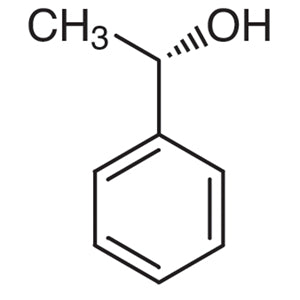
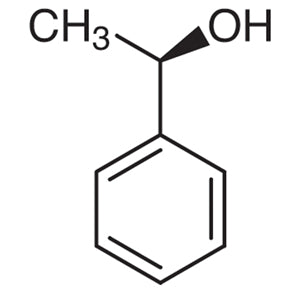
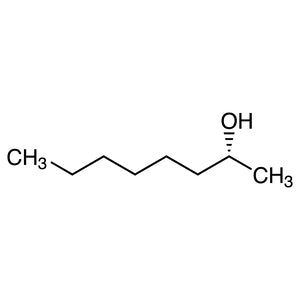
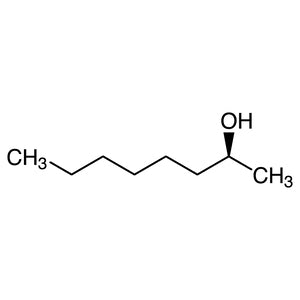
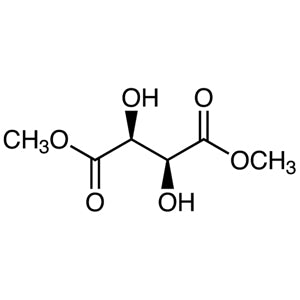
(R)-(-)-2-Butanol is a chiral compound widely used in the field of asymmetric synthesis within laboratory settings. It plays a crucial role in the development of optically active compounds by providing a chiral building block that enables precise control over stereochemistry. This compound is essential for researchers aiming to create enantiomers or diastereomers, which are vital in pharmaceutical and organic chemistry applications. Its unique molecular structure allows for the synthesis of complex molecules with specific spatial configurations, making it a fundamental tool in modern chemical research.
The chemical properties of (R)-(-)-2-Butanol make it a preferred choice for laboratory use. It exhibits chemical stability and is soluble in various organic solvents such as ethylamine and acetone, which facilitates its use in a wide range of synthetic reactions. Its relatively high boiling point ensures that it remains stable during heating processes, reducing the risk of evaporation. Additionally, the presence of a hydroxyl group allows it to participate in multiple types of chemical reactions, including substitution, oxidation, and reduction. These characteristics enhance its versatility and reliability in laboratory environments.
In Indonesian laboratories, (R)-(-)-2-Butanol is commonly used in organic chemistry research, particularly in the synthesis of optically active compounds. It is a key reagent in the development of pharmaceuticals, agrochemicals, and specialty chemicals. Its chiral nature makes it an essential component in asymmetric synthesis, supporting the creation of compounds with specific stereochemical properties. Due to its reliability and effectiveness, it is widely adopted in both academic and industrial research settings across Indonesia.
TCI brochures (PDF)
- Chiral Auxiliaries and Optical Resolving Agents 2025-06-17 · p. 5
- Chiral Building Blocks 2025-04-14 · p. 8
- Asymmetric synthesis applications benefit from (R)-(-)-2-Butanol’s chiral structure, enabling precise control over stereochemical outcomes in complex molecule creation.
- Organic chemistry research relies on this compound for its reactivity and stability, supporting a variety of synthetic pathways in laboratory settings.
- Pharmaceutical development utilizes (R)-(-)-2-Butanol to produce optically active compounds, which are essential for drug design and efficacy.
- Industrial chemical synthesis employs this compound due to its solubility and chemical stability, allowing for efficient reaction processes.
- Academic research in Indonesia frequently uses (R)-(-)-2-Butanol for teaching and experimentation in asymmetric synthesis and stereochemistry.
| Brand | TCI |
|---|---|
| CAS number | 14898-79-4 |
| Molecular formula | — |
| Purity | — |
| Category | Chemistry > Asymmetric Synthesis > Chiral Building Blocks |
| Pack sizes | Available in various quantities as per supplier specifications |
| Physical form | Liquid |
| Storage | Store in a cool, dry place away from direct sunlight |
(R)-(-)-2-Butanol should be stored in a cool, dry location, away from direct sunlight and sources of heat. It is recommended to use airtight containers to prevent evaporation and contamination. Due to its chemical stability, it does not require refrigeration but should be kept in a well-ventilated area. Laboratory personnel should wear appropriate personal protective equipment, such as gloves and safety goggles, when handling this compound. It is important to ensure that the storage area is secure to prevent accidental spills or exposure. Proper labeling of containers is essential for safe handling and to maintain a clear inventory system in the laboratory.
—
Product Categories
Produk Terkait
-
(S)-(+)-2-Butanol TCI B0925
Regular price From Rp 1.749.300,00Regular priceRp 1.223.250,00Sale price From Rp 1.749.300,00 -
(S)-(-)-1-PhenylethylAlcohol TCI P0796
Regular price From Rp 1.431.150,00Regular priceRp 1.000.650,00Sale price From Rp 1.431.150,00 -
(R)-(+)-1-PhenylethylAlcohol TCI P0795
Regular price From Rp 1.220.100,00Regular priceRp 852.600,00Sale price From Rp 1.220.100,00 -
(R)-(-)-2-Octanol TCI O0145
Regular price From Rp 3.155.250,00Regular priceRp 2.206.050,00Sale price From Rp 3.155.250,00 -
(S)-(+)-2-Octanol TCI O0144
Regular price From Rp 5.221.650,00Regular priceRp 3.650.850,00Sale price From Rp 5.221.650,00 -
DimethylD-(-)-Tartrate TCI T1659
Regular price From Rp 584.850,00Regular priceRp 408.450,00Sale price From Rp 584.850,00 -
(S)-(+)-2,2,2-Trifluoro-1-(9-anthryl)ethanol[eeDeterminationReagentbyNMR] TCI T1521
Regular price From Rp 1.644.300,00Regular priceRp 1.149.750,00Sale price From Rp 1.644.300,00 -
(R)-(-)-2,2,2-Trifluoro-1-(9-anthryl)ethanol[e.e.DeterminationReagentbyNMR] TCI T1520
Regular price Rp 2.571.450,00Regular priceRp 1.797.600,00Sale price Rp 2.571.450,00