


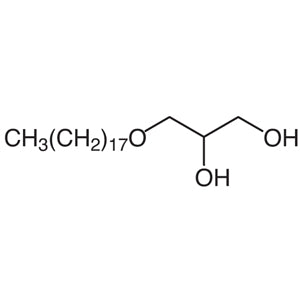
Batyl Alcohol (544-62-7) is a chemical compound widely used in various laboratory reactions. As a fundamental building block in organic chemistry, it plays a crucial role in the synthesis of complex organic molecules. Its versatility makes it an essential component in many chemical processes, including esterification reactions and the production of surfactants. In laboratory settings, Batyl Alcohol is valued for its chemical stability and solubility in common organic solvents such as ethyl acetate and ethanol. These properties make it a reliable choice for experiments requiring non-reactive solvents.
One of the key reasons Batyl Alcohol is preferred is its chemical stability and solubility characteristics. It dissolves well in organic solvents, making it an effective solvent in many chemical applications. Additionally, its relatively high boiling point allows it to be used in reactions that require elevated temperatures without undergoing significant decomposition. These properties contribute to its reliability and consistency in laboratory experiments. Its non-reactive nature also reduces the risk of unwanted side reactions, making it a safe and efficient choice for a wide range of chemical processes.
In Indonesian laboratories, Batyl Alcohol is commonly used in research and development activities across multiple disciplines. It is particularly relevant in organic chemistry, pharmaceutical research, and material science. Its ability to act as a solvent and reactant in various chemical processes makes it a valuable tool for scientists and researchers. The compound's widespread application in these fields highlights its importance in both academic and industrial laboratory settings.
- Organic synthesis reactions benefit from Batyl Alcohol's solubility and chemical stability, making it an ideal solvent for complex molecule formation.
- Esterification processes often utilize Batyl Alcohol as a reactant due to its reactivity and compatibility with ester-forming conditions.
- Surfactant production relies on Batyl Alcohol's ability to reduce surface tension, making it a key component in the formulation of surface-active agents.
- Material science research incorporates Batyl Alcohol in polymer synthesis and coating formulations due to its compatibility with various organic compounds.
- Pharmaceutical development uses Batyl Alcohol as a solvent and intermediate in the synthesis of active pharmaceutical ingredients.
| Brand | TCI |
|---|---|
| CAS number | 544-62-7 |
| Molecular formula | — |
| Purity | — |
| Category | Chemistry > Building Blocks > Non-Heterocyclic Building Blocks |
| Pack sizes | Available in various quantities as per standard laboratory supply |
| Physical form | Liquid |
| Storage | Store in a cool, dry place away from direct sunlight and incompatible materials |
Batyl Alcohol should be stored in a cool, dry location, away from direct sunlight and sources of heat. It is recommended to use sealed containers made of materials compatible with organic solvents, such as glass or high-density polyethylene. Due to its flammable nature, it should be kept away from open flames and ignition sources. Proper ventilation is essential when handling this compound to minimize exposure. In laboratory settings, it is important to follow standard safety protocols, including the use of personal protective equipment. Regular monitoring of storage conditions ensures the compound remains stable and safe for use.
—
Produk Terkait
-
4-IodobenzylAlcohol TCI I0810
Regular price From Rp 2.889.600,00Regular priceRp 2.020.200,00Sale price From Rp 2.889.600,00 -
2-IodobenzylAlcohol TCI I0858
Regular price Rp 1.035.300,00Regular priceRp 723.450,00Sale price Rp 1.035.300,00 -
3-IodobenzylAlcohol TCI I0866
Regular price From Rp 1.510.950,00Regular priceRp 1.056.300,00Sale price From Rp 1.510.950,00 -
SyringylAlcohol TCI Y0033
Regular price From Rp 1.326.150,00Regular priceRp 942.900,00Sale price From Rp 1.326.150,00 -
VeratrylAlcohol TCI V0020
Regular price Rp 1.538.250,00Regular priceRp 1.090.950,00Sale price Rp 1.538.250,00 -
VanillylAlcohol TCI V0018
Regular price From Rp 1.326.150,00Regular priceRp 942.900,00Sale price From Rp 1.326.150,00 -
2,4,6-TrimethylbenzylAlcohol TCI T1905
Regular price Rp 2.041.200,00Regular priceRp 1.426.950,00Sale price Rp 2.041.200,00 -
3,4,5-Tris(benzyloxy)benzylAlcohol TCI T1840
Regular price From Rp 1.881.600,00Regular priceRp 1.331.400,00Sale price From Rp 1.881.600,00


