

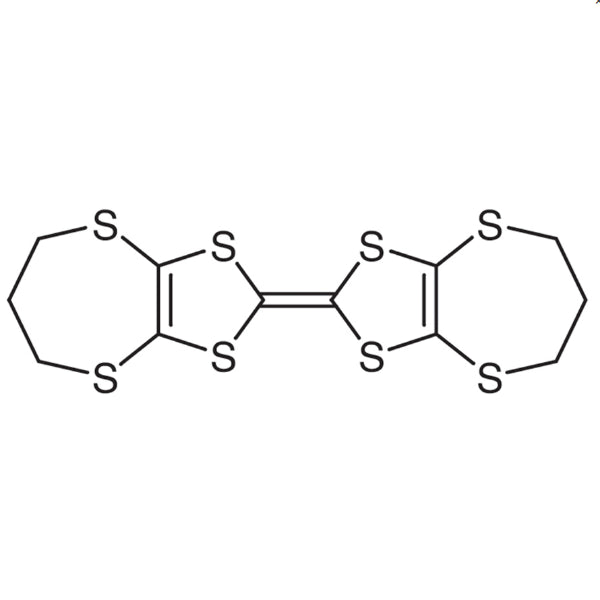
Bis(trimethylenedithio)tetrathiafulvalene (BTTTF), with the CAS number 66946-49-4, is an organic compound widely used in electronic materials research. This material plays a crucial role in laboratories focused on molecular conductors, where it serves as a key component in the study of electronic behavior and structural properties. Its unique molecular structure enables exceptional electronic conductivity, making it a vital tool for researchers exploring advanced electronic materials. BTTTF is particularly relevant in the development of organic semiconductors and superconducting materials, offering insights into the behavior of complex molecular systems under various conditions.
The compound is preferred due to its high electrical conductivity and ability to form stable crystalline structures. These properties allow for precise experimental control, which is essential in material science research. Additionally, BTTTF exhibits chemical stability under specific conditions, ensuring consistent performance during experiments. This stability simplifies handling and enhances reproducibility in laboratory settings, making it a reliable choice for both academic and industrial research. Its versatility in applications extends to various fields, including nanotechnology and electronic device development.
In Indonesian laboratories, BTTTF is commonly used in scientific research at universities and research institutions. It supports studies in molecular electronics, superconductivity, and organic material development. Its availability through suppliers like AMI Scientific ensures that researchers in Indonesia can access this critical material for their experiments and innovations.
TCI brochures (PDF)
- Molecular Conductors 2025-11-13 · p. 4
Related TCI products
- TCI T3380 31366-25-3 Tetrathiafulvalene (purified by sublimation)
- TCI T1571 104515-79-9 Tetrakis(ethylthio)tetrathiafulvalene
- TCI T1282 55492-86-9 Tris(tetrathiafulvalene) Bis(tetrafluoroborate) Complex
- TCI T1119 51501-77-0 Tetrakis(methylthio)tetrathiafulvalene
- TCI T0980 31366-25-3 Tetrathiafulvalene
- TCI T2806 132765-36-7 2,3,6,7-Tetrakis(2-cyanoethylthio)tetrathiafulvalene
- BTTTF is ideal for molecular conductor research due to its unique electronic properties and structural stability, enabling precise studies of charge transport mechanisms.
- It supports superconductivity investigations by providing a stable platform for exploring electron pairing and lattice interactions in complex systems.
- The compound is used in organic semiconductor development because of its high conductivity and compatibility with molecular assembly techniques.
- BTTTF facilitates electronic device prototyping by offering a tunable material for designing novel conductive interfaces and components.
- It is essential in nanomaterial synthesis experiments, where its molecular structure allows for controlled growth of nanostructures with specific electronic properties.
| Brand | TCI |
|---|---|
| CAS number | 66946-49-4 |
| Molecular formula | — |
| Purity | — |
| Category | Materials Science > Electronic Materials > Molecular Conductors |
| Pack sizes | Available in various quantities as per supplier specifications |
| Physical form | Solid |
| Storage | Store in a cool, dry place away from light and moisture |
BTTTF should be stored in a cool, dry environment, away from direct light and moisture to maintain its chemical stability. It is recommended to use airtight containers made of materials that do not react with the compound, such as glass or polyethylene. Laboratory personnel should handle the material with care, using appropriate personal protective equipment to avoid exposure. Due to its high conductivity, it is important to ensure proper insulation during handling to prevent unintended electrical interactions. Regular monitoring of storage conditions is advised to ensure the material remains in optimal condition for research applications.
—
Produk Terkait
-
Tetrathiafulvalene(purifiedbysublimation) TCI T3380
Regular price From Rp 1.351.350,00Regular priceRp 960.750,00Sale price From Rp 1.351.350,00 -
Tetrakis(ethylthio)tetrathiafulvalene TCI T1571
Regular price Rp 4.028.850,00Regular priceRp 2.832.900,00Sale price Rp 4.028.850,00 -
Tris(tetrathiafulvalene)Bis(tetrafluoroborate)Complex TCI T1282
Regular price Rp 5.009.550,00Regular priceRp 3.518.550,00Sale price Rp 5.009.550,00 -
Tetrakis(methylthio)tetrathiafulvalene TCI T1119
Regular price Rp 2.623.950,00Regular priceRp 1.850.100,00Sale price Rp 2.623.950,00 -
Tetrathiafulvalene TCI T0980
Regular price From Rp 3.578.400,00Regular priceRp 2.517.900,00Sale price From Rp 3.578.400,00 -
2,3,6,7-Tetrakis(2-cyanoethylthio)tetrathiafulvalene TCI T2806
Regular price Rp 2.571.450,00Regular priceRp 1.813.350,00Sale price Rp 2.571.450,00 -
Tetrathiafulvalene-7,7,8,8-TetracyanoquinodimethaneComplex TCI T2468
Regular price Rp 8.718.150,00Regular priceRp 6.112.050,00Sale price Rp 8.718.150,00 -
Formyltetrathiafulvalene TCI F0285
Regular price Rp 10.307.850,00Regular priceRp 7.224.000,00Sale price Rp 10.307.850,00


