

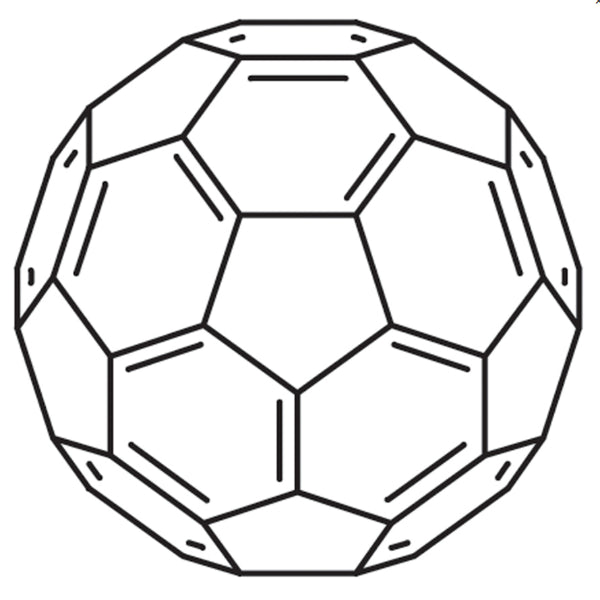
Fullerene C60 (pure), with CAS number 99685-96-8, is a unique carbon compound characterized by its spherical molecular structure composed of 60 carbon atoms arranged in a specific pattern. This material plays a crucial role in laboratory settings, particularly in materials science and electronic research, where its conductive and reactive properties are highly valued. Its ability to act as a molecular conductor makes it an essential component in the development of advanced electronic materials and semiconductors.
The chemical stability of Fullerene C60, combined with its reactivity under certain conditions, makes it a preferred choice for a wide range of experimental applications. Its symmetric molecular structure and presence of free electrons contribute to its versatility in both chemical and physical experiments. These properties enable researchers to explore its potential in optoelectronic devices, energy storage systems, and nanotechnology. The material’s unique characteristics continue to attract scientific interest in the fields of material science and renewable energy.
In Indonesian laboratories, Fullerene C60 is widely used in academic and research institutions for experimental studies. It supports the development of new technologies, especially in the fields of electronics and renewable energy. Its availability in the local market facilitates faster experimentation and innovation, making it an essential resource for researchers aiming to advance scientific knowledge and technological applications.
Advantages (TCI brochure)
- Rubidium- and cesium-doped fullerenes show superconductivity above 30 K
- Cs3C60 superconductivity reported at 38 K
TCI brochures (PDF)
- Organic Transistor (OFET) Materials 2026-05-07 · p. 10
- Molecular Conductors 2025-11-13 · p. 2
- Nanocarbon Materials 2026-09-30 · p. 2
- Solar Cell Materials 2026-04-21 · p. 8
Related TCI products
- TCI B1694 115383-22-7 Fullerene C70
- TCI F1233 115383-22-7 Fullerene C70 (purified by sublimation) [for organic electronics]
- TCI F1232 99685-96-8 Fullerene C60 (purified by sublimation) [for organic electronics]
- TCI B4576 1048679-01-1 Bis-PCBM (mixture of isomers)
- TCI P2744 1426332-00-4 N-Phenyl-2-hexyl[60]fulleropyrrolidine
- TCI P2683 609771-63-3 [6,6]-Phenyl-C71-butyric Acid Methyl Ester (mixture of isomers) [for organic electronics]
- Molecular Conductors Research – Fullerene C60 is ideal for studying conductive properties and developing new materials for electronic applications.
- Semiconductor Development – Its unique structure allows for integration into semiconductor technologies, supporting next-generation electronic devices.
- Optoelectronic Applications – The material’s optical properties make it suitable for use in photovoltaic cells and light-emitting diodes.
- Energy Storage Studies – Fullerene C60’s chemical reactivity and stability are beneficial in researching advanced battery and supercapacitor technologies.
- Nanotechnology Research – Its molecular structure enables exploration in nanomaterial synthesis and functionalization for various scientific applications.
From the TCI brochure
- Alkali-doped fullerene superconductor
- Three-dimensional fullerene salts
| Brand | TCI |
|---|---|
| CAS number | 99685-96-8 |
| Molecular formula | — |
| Purity | — |
| Category | Materials Science > Electronic Materials > Molecular Conductors |
| Pack sizes | Available in standard laboratory quantities |
| Physical form | Powder |
| Storage | Store in a cool, dry place away from light and moisture |
Data from the TCI brochure
| Tc | > 30 K (rubidium- and cesium-doped fullerenes) |
|---|---|
| Tc | 38 K (Cs3C60) |
Source: TCI brochure F2004 (2025-11-13)
Fullerene C60 should be stored in a cool, dry environment, away from direct light and moisture to maintain its chemical stability. It is recommended to use airtight containers made of inert materials such as glass or stainless steel to prevent contamination and degradation. Due to its reactivity under certain conditions, it should be handled with care using appropriate personal protective equipment. In laboratory settings, it is important to ensure good ventilation and avoid exposure to high temperatures or reactive substances. Proper storage and handling procedures help preserve the material’s integrity and ensure safe usage in research applications.
—
Product Categories
- Electronic MaterialsMolecular ConductorsAcceptor Molecules [Molecular Conductors]
- Electronic MaterialsOrganic Solar Cell (OPV) MaterialsAcceptor Materials [Organic Solar Cell (OPV) Materials]
- Electronic MaterialsOrganic Transistor (OFET) Materialsn-Type Organic Semiconductors [Organic Transistor (OFET) Materials]
- Electronic MaterialsPerovskite Solar Cell (PSC) MaterialsCarrier Transport Materials [Perovskite Solar Cell (PSC) Materials]
- Nanocarbon MaterialsFullerenes
Produk Terkait
-
FullereneC70 TCI B1694
Regular price Rp 4.957.050,00Regular priceRp 3.466.050,00Sale price Rp 4.957.050,00 -
FullereneC70(purifiedbysublimation)[fororganicelectronics] TCI F1233
Regular price Rp 8.453.550,00Regular priceRp 5.911.500,00Sale price Rp 8.453.550,00 -
FullereneC60(purifiedbysublimation)[fororganicelectronics] TCI F1232
Regular price Rp 4.771.200,00Regular priceRp 3.335.850,00Sale price Rp 4.771.200,00 -
Bis-PCBM(mixtureofisomers) TCI B4576
Regular price Rp 6.545.700,00Regular priceRp 4.576.950,00Sale price Rp 6.545.700,00 -
N-Phenyl-2-hexyl[60]fulleropyrrolidine TCI P2744
Regular price Rp 10.201.800,00Regular priceRp 7.149.450,00Sale price Rp 10.201.800,00 -
[6,6]-Phenyl-C71-butyricAcidMethylEster(mixtureofisomers)[fororganicelectronics] TCI P2683
Regular price Rp 15.713.250,00Regular priceRp 11.004.000,00Sale price Rp 15.713.250,00 -
[6,6]-Phenyl-C61-butyricAcidMethylEster[fororganicelectronics] TCI P2682
Regular price Rp 9.698.850,00Regular priceRp 6.797.700,00Sale price Rp 9.698.850,00 -
[6,6]-Phenyl-C71-butyricAcidMethylEster(mixtureofisomers) TCI M2550
Regular price Rp 5.537.700,00Regular priceRp 3.888.150,00Sale price Rp 5.537.700,00


