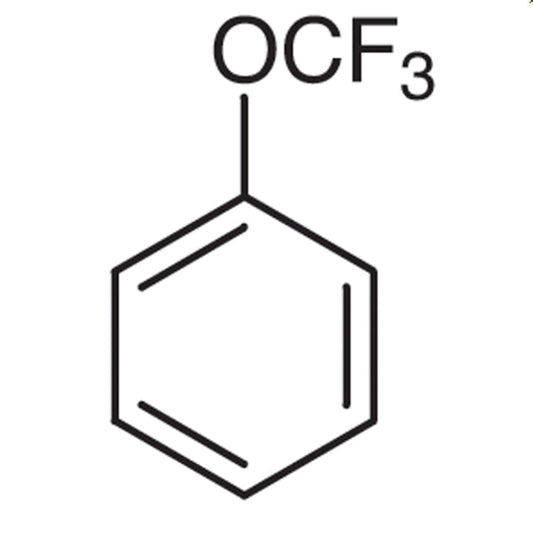
1-Bromo-3-(trifluoromethoxy)benzene is a chemical compound widely used as a building block in the synthesis of complex organic molecules. Its unique structure, featuring a bromo group and a trifluoromethoxy substituent, makes it a valuable reagent in organic chemistry. In laboratory settings, this compound plays a critical role in various synthetic pathways, particularly in reactions involving nucleophilic substitution and cross-coupling. Its versatility allows chemists to design and produce a wide range of fluorinated compounds with tailored properties.
The compound's stability and controlled reactivity make it a preferred choice for researchers working in organic synthesis. The presence of fluorine atoms significantly influences its chemical behavior, enhancing its reactivity in specific reaction conditions. This makes it ideal for applications such as the Suzuki and Sonogashira coupling reactions. Its ability to participate in multiple reaction types contributes to its widespread use in both academic and industrial research environments.
In Indonesian laboratories, 1-Bromo-3-(trifluoromethoxy)benzene is commonly used in scientific research, especially in the fields of organic chemistry and pharmacology. It is a key component in the development of new pharmaceutical compounds and functional materials. Its availability through AMI Scientific ensures that researchers in Indonesia can access this essential reagent for their experimental needs.
TCI brochures (PDF)
- Aryne/Heteroaryne Precursors 2025-09-16 · p. 5
- Fluorination Reagents, Fluorinated Building Blocks 2026-03-18 · p. 43
Related TCI products
- TCI B1772 407-14-7 1-Bromo-4-(trifluoromethoxy)benzene
- TCI T2155 713-65-5 1-Nitro-4-(trifluoromethoxy)benzene
- TCI T2153 103962-05-6 1-Iodo-4-(trifluoromethoxy)benzene
- TCI T2152 175278-00-9 1-Iodo-2-(trifluoromethoxy)benzene
- TCI T2149 461-81-4 1-Chloro-4-(trifluoromethoxy)benzene
- TCI T2147 64115-88-4 1-Bromo-2-(trifluoromethoxy)benzene
- Organic synthesis applications benefit from this compound's reactivity and fluorinated structure, enabling the creation of complex molecular frameworks.
- Pharmaceutical research utilizes its properties to develop new drug compounds with enhanced biological activity and stability.
- Fluorinated material development leverages its unique chemical profile to design advanced polymers and specialty chemicals.
- Nucleophilic substitution reactions rely on its bromo group for efficient bond formation in synthetic pathways.
- Cross-coupling reactions such as Suzuki and Sonogashira benefit from its compatibility with various catalysts and reaction conditions.
| Brand | TCI |
|---|---|
| CAS number | 2252-44-0 |
| Molecular formula | — |
| Purity | — |
| Category | Chemistry > Building Blocks > Fluorinated Building Blocks |
| Pack sizes | Available in various quantities as per standard laboratory supply |
| Physical form | Solid or liquid, depending on the specific product variant |
| Storage | Store in a cool, dry place away from light and incompatible substances |
This compound should be stored in a cool, dry environment, away from direct sunlight and sources of heat. It is recommended to use airtight containers made of materials that are chemically inert, such as glass or high-density polyethylene. Due to its fluorinated nature, it is important to handle it with care, ensuring proper ventilation in the laboratory. Avoid contact with incompatible substances like strong oxidizing agents. Always follow standard safety protocols when working with reactive chemicals, including the use of personal protective equipment. Regular monitoring of storage conditions ensures the compound remains stable and suitable for use in chemical experiments.
—
Produk Terkait
-
1-Bromo-4-(trifluoromethoxy)benzene TCI B1772
Regular price From Rp 875.700,00Regular priceRp 612.150,00Sale price From Rp 875.700,00 -
1-Nitro-4-(trifluoromethoxy)benzene TCI T2155
Regular price From Rp 769.650,00Regular priceRp 537.600,00Sale price From Rp 769.650,00 -
1-Iodo-4-(trifluoromethoxy)benzene TCI T2153
Regular price From Rp 1.167.600,00Regular priceRp 815.850,00Sale price From Rp 1.167.600,00 -
1-Iodo-2-(trifluoromethoxy)benzene TCI T2152
Regular price Rp 1.405.950,00Regular priceRp 982.800,00Sale price Rp 1.405.950,00 -
1-Chloro-4-(trifluoromethoxy)benzene TCI T2149
Regular price Rp 848.400,00Regular priceRp 593.250,00Sale price Rp 848.400,00 -
1-Bromo-2-(trifluoromethoxy)benzene TCI T2147
Regular price From Rp 637.350,00Regular priceRp 445.200,00Sale price From Rp 637.350,00 -
(Trifluoromethoxy)benzene TCI T1617
Regular price Rp 1.220.100,00Regular priceRp 852.600,00Sale price Rp 1.220.100,00 -
5-Bromo-1,3-difluoro-2-(trifluoromethoxy)benzene TCI B5057
Regular price From Rp 1.087.800,00Regular priceRp 760.200,00Sale price From Rp 1.087.800,00