3,5-Bis[3,5-bis(benzyloxy)benzyloxy]benzyl Bromide is a complex chemical compound widely used in materials science, particularly in the synthesis of branched molecules such as dendrimers. This reagent serves as a building block for constructing intricate molecular structures, playing a crucial role in the development of advanced materials with tailored properties. Its ability to form highly controlled, branched architectures makes it indispensable in modern chemical research. In the laboratory, it is employed to gradually extend molecular chains, enabling precise control over size and morphology.
The compound is valued for its chemical stability and controlled reactivity, which are essential for high-precision chemical reactions. Its complex molecular structure allows for the formation of regular branched chains, making it highly suitable for the synthesis of compounds with specific functional properties. The presence of a bromide group at the molecular end facilitates further functionalization or substitution reactions, enhancing its versatility in synthetic applications.
In Indonesian laboratories, this compound is commonly used in polymer material research, especially in the development of dendrimers with applications in medicine, electronics, and environmental science. Its role in creating structured, multifunctional materials makes it a key component in advanced chemical synthesis projects. Researchers rely on its predictable behavior and compatibility with various reaction conditions to achieve desired outcomes in their experiments.
Related TCI products
- TCI B2248 152811-37-5 3,5-Bis[3,5-bis(3,5-dimethoxybenzyloxy)benzyloxy]benzyl Bromide
- TCI B2247 176650-93-4 3,5-Bis(3,5-dimethoxybenzyloxy)benzyl Bromide
- TCI T1840 79831-88-2 3,4,5-Tris(benzyloxy)benzyl Alcohol
- TCI B5121 836-42-0 4-(Benzyloxy)benzyl Chloride
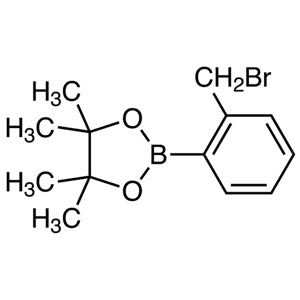
- TCI T3393 377780-72-8 2-(4,4,5,5-Tetramethyl-1,3,2-dioxaborolan-2-yl)benzyl Bromide
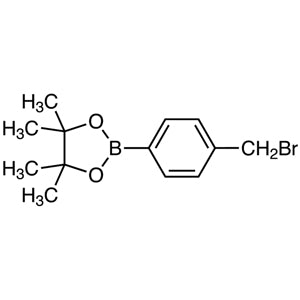
- TCI T2945 138500-85-3 4-(4,4,5,5-Tetramethyl-1,3,2-dioxaborolan-2-yl)benzyl Bromide
- Dendrimer Synthesis: This compound is ideal for creating branched molecular structures due to its ability to form controlled, multi-generation dendrimers.
- Polymer Functionalization: The bromide group allows for efficient substitution reactions, making it suitable for modifying polymer chains with specific functionalities.
- Advanced Material Development: It is used in the creation of materials with tailored properties for applications in electronics and biomedical fields.
- Structural Chemistry Research: Its complex molecular architecture supports studies on molecular self-assembly and hierarchical structures.
- Environmental Material Innovation: It contributes to the development of eco-friendly materials with enhanced performance characteristics.
| Brand | TCI |
|---|---|
| CAS number | 129536-41-0 |
| Molecular formula | — |
| Purity | — |
| Category | Materials Science > Polymer/Macromolecule Reagents > Dendrimer Building Blocks |
| Pack sizes | Available in various quantities as per standard laboratory supply |
| Physical form | Solid or liquid, depending on the specific formulation |
| Storage | Store in a cool, dry place away from light and moisture |
This compound should be stored in a cool, dry environment, away from direct sunlight and moisture to maintain its chemical stability. It is recommended to use airtight containers made of glass or high-density polyethylene to prevent contamination and degradation. Due to its reactivity, it should be handled in a well-ventilated laboratory setting, with appropriate personal protective equipment such as gloves and goggles. Avoid exposure to incompatible substances, and ensure that storage areas are secure to prevent accidental spills or contamination. Regular monitoring of storage conditions is advised to ensure the integrity of the material throughout its shelf life.
—
Product Categories
Produk Terkait
-
3,5-Bis[3,5-bis(3,5-dimethoxybenzyloxy)benzyloxy]benzylBromide TCI B2248
Regular price Rp 5.962.950,00Regular priceRp 4.169.550,00Sale price Rp 5.962.950,00 -
3,5-Bis(3,5-dimethoxybenzyloxy)benzylBromide TCI B2247
Regular price From Rp 3.790.500,00Regular priceRp 2.650.200,00Sale price From Rp 3.790.500,00 -
3,4,5-Tris(benzyloxy)benzylAlcohol TCI T1840
Regular price From Rp 1.881.600,00Regular priceRp 1.331.400,00Sale price From Rp 1.881.600,00 -
4-(Benzyloxy)benzylChloride TCI B5121
Regular price From Rp 1.724.100,00Regular priceRp 1.205.400,00Sale price From Rp 1.724.100,00 -
2-(4,4,5,5-Tetramethyl-1,3,2-dioxaborolan-2-yl)benzylBromide TCI T3393
Regular price From Rp 2.013.900,00Regular priceRp 1.423.800,00Sale price From Rp 2.013.900,00 -
4-(4,4,5,5-Tetramethyl-1,3,2-dioxaborolan-2-yl)benzylBromide TCI T2945
Regular price From Rp 1.618.050,00Regular priceRp 1.146.600,00Sale price From Rp 1.618.050,00 -
2-(Trifluoromethoxy)benzylBromide TCI T2311
Regular price From Rp 1.298.850,00Regular priceRp 908.250,00Sale price From Rp 1.298.850,00 -
4-(Trifluoromethoxy)benzylBromide TCI T1781
Regular price From Rp 928.200,00Regular priceRp 648.900,00Sale price From Rp 928.200,00