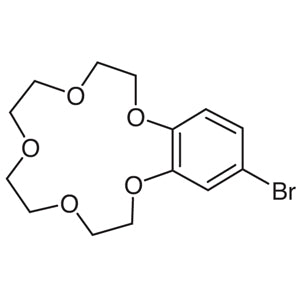
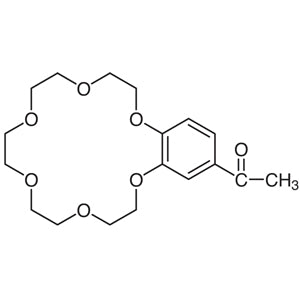
4'-Bromobenzo-18-crown 6-Ether is a synthetic chemical compound widely used in laboratory settings for its ability to form complexes with metal ions. This compound is particularly valuable in chemical synthesis and metal complexation reactions, where it serves as a chelating agent. Its unique molecular structure allows it to selectively bind to alkali metal ions such as sodium and potassium, making it an essential reagent in various analytical and synthetic processes. In the laboratory, it plays a crucial role in controlling reaction pathways and enhancing the efficiency of chemical synthesis.
The compound's effectiveness stems from its high affinity for metal ions and its stability under controlled conditions. Its molecular architecture enables specific interactions with organic molecules, making it ideal for applications requiring precise ion coordination. The predictable chemical behavior and structural complexity of 4'-Bromobenzo-18-crown 6-Ether contribute to its reliability in experimental settings. These properties make it a preferred choice for researchers working in organic and analytical chemistry.
In Indonesian laboratories, 4'-Bromobenzo-18-crown 6-Ether is commonly used in both fundamental and applied research. It is a key component in the development of new synthetic methods and the study of molecular interactions. Many research institutions and universities in Indonesia rely on this compound for its consistent performance and versatility. Its application spans across various scientific disciplines, supporting both educational and industrial research activities.
TCI brochures (PDF)
- Macrocycles for Host-Guest Chemistry 2026-03-24 · p. 4
Related TCI products
- Metal ion complexation in analytical chemistry for selective ion detection and separation.
- Organic synthesis reactions where chelation of alkali metal ions is required to control reaction mechanisms.
- Research in coordination chemistry to study the interaction between metal ions and organic ligands.
- Development of new synthetic methodologies in organic chemistry laboratories.
- Support for analytical techniques such as ion exchange and chromatographic separations.
| Brand | TCI |
|---|---|
| CAS number | 75460-28-5 |
| Molecular formula | — |
| Purity | — |
| Category | Chemistry > Synthetic Reagents > Chelation/Complexation Compounds |
| Pack sizes | Available in various quantities as per standard laboratory reagent packaging |
| Physical form | Solid or powder, depending on the specific formulation |
| Storage | Store in a cool, dry place away from moisture and direct sunlight |
This compound should be stored in a cool, dry environment to maintain its chemical stability. It is recommended to use airtight containers to prevent exposure to moisture and air, which can affect its performance. While no specific hazards are noted, standard laboratory safety protocols should be followed when handling it. Ensure that the storage area is well-ventilated and free from potential contaminants. Proper labeling of containers is essential for safe handling and to prevent accidental use. Always wear appropriate personal protective equipment when working with this material to ensure laboratory safety.
—
Produk Terkait
-
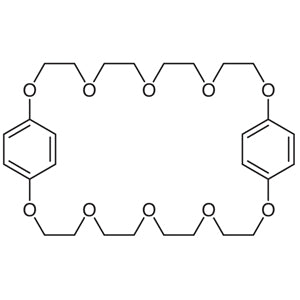
Bis(1,4-phenylene)-34-crown10-Ether TCI B2245
Regular price Rp 12.639.900,00Regular priceRp 8.854.650,00Sale price Rp 12.639.900,00 -
4'-Bromobenzo-15-crown5-Ether TCI B2189
Regular price From Rp 5.246.850,00Regular priceRp 3.684.450,00Sale price From Rp 5.246.850,00 -
Benzo-18-crown6-Ether TCI B1539
Regular price From Rp 1.590.750,00Regular priceRp 1.127.700,00Sale price From Rp 1.590.750,00 -
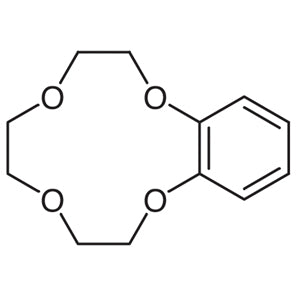
Benzo-12-crown4-Ether TCI B1249
Regular price From Rp 2.491.650,00Regular priceRp 1.757.700,00Sale price From Rp 2.491.650,00 -
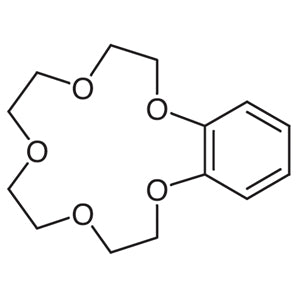
Benzo-15-crown5-Ether TCI B1154
Regular price From Rp 1.776.600,00Regular priceRp 1.257.900,00Sale price From Rp 1.776.600,00 -
4'-Acetylbenzo-18-crown6-Ether TCI A1604
Regular price Rp 9.514.050,00Regular priceRp 6.668.550,00Sale price Rp 9.514.050,00 -
4'-Acetylbenzo-15-crown5-Ether TCI A1603
Regular price Rp 3.630.900,00Regular priceRp 2.554.650,00Sale price Rp 3.630.900,00 -
1-Aza-12-crown4-Ether TCI A1552
Regular price From Rp 2.889.600,00Regular priceRp 2.035.950,00Sale price From Rp 2.889.600,00