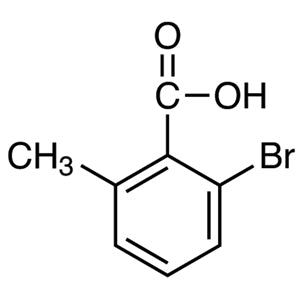
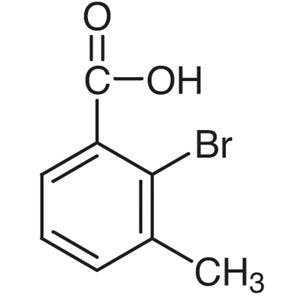
3-Bromo-4-methylbenzoic acid is a chemical compound widely used in organic synthesis reactions within laboratory settings. It serves as a key building block for the development of more complex chemical structures, playing a crucial role in various synthetic pathways. This compound is commonly found in chemical laboratories as a raw material for the production of other compounds, making it an essential reagent for researchers. Its versatility allows it to be employed in multiple chemical transformations, contributing to the advancement of chemical research and development.
The compound is known for its high reactivity and stability, which make it a preferred choice in laboratory applications. The presence of both a bromo group and a carboxylic acid group enhances its utility in different types of reactions, such as substitution and esterification. These functional groups provide the necessary reactivity for forming new chemical bonds and modifying molecular structures. Additionally, its physical properties allow for easy handling and compatibility with various laboratory conditions, making it a reliable choice for chemical synthesis.
In Indonesian laboratories, 3-Bromo-4-methylbenzoic acid is extensively used in chemical research, particularly in the fields of organic synthesis and analytical chemistry. Its role in creating complex molecules and its contribution to the study of chemical properties make it a valuable tool for scientists and researchers. The compound is frequently utilized in both academic and industrial settings, supporting a wide range of chemical investigations and innovations.
TCI brochures (PDF)
- Aryne/Heteroaryne Precursors 2025-09-16 · p. 5
Related TCI products
- Organic synthesis reactions benefit from this compound due to its bromo and carboxylic acid groups, enabling substitution and esterification processes.
- It is ideal for the preparation of substituted aromatic compounds, as its structure allows for efficient functional group modification.
- In analytical chemistry, it serves as a standard for qualitative and quantitative analysis due to its well-defined chemical properties.
- The compound is used in the development of pharmaceutical intermediates, where its reactivity supports the synthesis of complex drug molecules.
- It is also applied in the study of reaction mechanisms, providing insights into the behavior of brominated carboxylic acids under different conditions.
| Brand | TCI |
|---|---|
| CAS number | 7697-26-9 |
| Molecular formula | — |
| Purity | — |
| Category | Chemistry > Building Blocks > Non-Heterocyclic Building Blocks |
| Pack sizes | Available in various quantities as per supplier specifications |
| Physical form | Solid, crystalline appearance |
| Storage | Store in a cool, dry place away from moisture and direct sunlight |
This compound should be stored in a cool, dry environment to maintain its chemical integrity. It is recommended to keep it in a tightly sealed container to prevent exposure to moisture and air. Due to its reactivity, it should be handled with care, using appropriate personal protective equipment such as gloves and safety goggles. Avoid contact with incompatible materials and ensure proper ventilation in the workspace. Storage conditions should be controlled to prevent degradation and maintain the compound's effectiveness in laboratory applications. Always follow standard laboratory safety protocols when working with this material.
—
Produk Terkait
-
2-Bromo-5-methylbenzoicAcid TCI B4145
Regular price From Rp 1.563.450,00Regular priceRp 1.108.800,00Sale price From Rp 1.563.450,00 -
2-Bromo-6-methylbenzoicAcid TCI B4097
Regular price From Rp 1.483.650,00Regular priceRp 1.053.150,00Sale price From Rp 1.483.650,00 -
2-Bromo-4-methylbenzoicAcid TCI B3879
Regular price From Rp 848.400,00Regular priceRp 609.000,00Sale price From Rp 848.400,00 -
2-Bromo-3-methylbenzoicAcid TCI B3636
Regular price From Rp 822.150,00Regular priceRp 590.100,00Sale price From Rp 822.150,00 -
4-Bromo-2-methylbenzoicAcid TCI B3337
Regular price From Rp 3.312.750,00Regular priceRp 2.332.050,00Sale price From Rp 3.312.750,00 -
3-Bromo-2-methylbenzoicAcid TCI B3221
Regular price From Rp 1.881.600,00Regular priceRp 1.331.400,00Sale price From Rp 1.881.600,00 -
4-Bromo-3-methylbenzoicAcid TCI B3113
Regular price From Rp 1.140.300,00Regular priceRp 812.700,00Sale price From Rp 1.140.300,00 -
5-Bromo-2-methylbenzoicAcid TCI B3050
Regular price From Rp 822.150,00Regular priceRp 590.100,00Sale price From Rp 822.150,00