


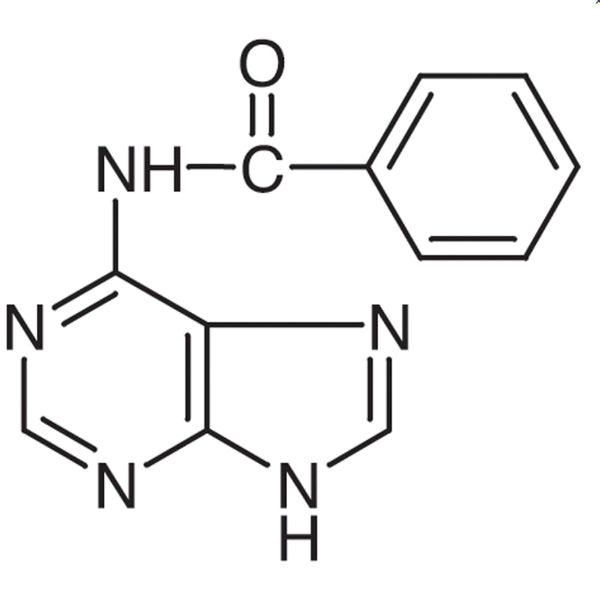
N6-Benzoyladenine is a chemical compound classified under nucleosides and serves as a key reagent in biochemical experiments. It is widely used in research related to organic synthesis, particularly in biochemistry and pharmacology. This compound plays a crucial role in nucleotide modification processes, which are fundamental to the development of new drugs and genetic research. In the laboratory, it functions as a foundational material for chemical reactions requiring specific nucleoside structures. Its chemical structure is complex, enabling it to interact effectively with various reagents.
The compound’s unique chemical properties make it a preferred choice for high-precision reactions. It exhibits stability under certain conditions, which simplifies storage and long-term use. Its ability to participate in diverse chemical reactions makes it indispensable in synthetic pathways. The specificity of its chemical behavior ensures reliable results in experiments that demand accuracy. This reliability is especially important in applications such as organic synthesis and nucleotide modification.
In Indonesian laboratories, N6-Benzoyladenine is commonly used by researchers in universities and research institutions. It is particularly relevant in biomedical research, where it supports the development of new therapeutic agents. Its application in genetic studies and drug discovery highlights its importance in advancing scientific knowledge. The compound is a vital component in many experimental setups, contributing to the success of various research projects.
TCI brochures (PDF)
- Nucleosides, Nucleotides, Nucleic Acids and Related Reagents 2026-03-23 · p. 9
- Organic synthesis applications benefit from N6-Benzoyladenine due to its ability to participate in complex chemical reactions and its structural versatility.
- Nucleotide modification processes rely on this compound for its role in creating modified nucleosides essential for drug development and genetic research.
- Biochemical research utilizes N6-Benzoyladenine for its stability and reactivity, supporting experiments in pharmacology and molecular biology.
- Drug development projects incorporate this compound as a key reagent in the synthesis of novel therapeutic agents.
- Genetic studies use N6-Benzoyladenine to explore nucleotide structures and their modifications, contributing to advancements in molecular genetics.
| Brand | TCI |
|---|---|
| CAS number | 4005-49-6 |
| Molecular formula | — |
| Purity | — |
| Category | Life Science > Biochemicals and Reagents > Nucleosides, Nucleotides, Oligonucleotides |
| Pack sizes | Available in standard laboratory quantities |
| Physical form | Solid |
| Storage | Store in a cool, dry place away from direct light |
N6-Benzoyladenine should be stored in a cool, dry environment to maintain its stability and prevent degradation. It is recommended to keep the compound in a sealed container to minimize exposure to moisture and air. Suitable storage conditions include a controlled temperature range, typically between 15°C and 25°C. Laboratory personnel should handle the compound with care, using appropriate personal protective equipment to ensure safety. Due to its chemical reactivity, it should be stored away from incompatible substances. Proper labeling and secure storage are essential to prevent accidental exposure and maintain the integrity of the compound during long-term use.
—
Produk Terkait
-
N6-Benzyladenine TCI B1088
Regular price From Rp 955.500,00Regular priceRp 683.550,00Sale price From Rp 955.500,00 -
3-Methyladenine TCI M2518
Regular price Rp 3.472.350,00Regular priceRp 2.443.350,00Sale price Rp 3.472.350,00 -
N6-Dibenzoyladenosine2',3'-Dibenzoate TCI B3460
Regular price From Rp 1.881.600,00Regular priceRp 1.331.400,00Sale price From Rp 1.881.600,00 -
N6-Benzoyladenosine TCI B3093
Regular price From Rp 1.483.650,00Regular priceRp 1.053.150,00Sale price From Rp 1.483.650,00 -
6-Azauracil TCI A0558
Regular price From Rp 610.050,00Regular priceRp 442.050,00Sale price From Rp 610.050,00 -
AdenineSulfateDihydrate TCI A0151
Regular price From Rp 3.074.400,00Regular priceRp 2.165.100,00Sale price From Rp 3.074.400,00 -
AdenineHydrochlorideHemihydrate TCI A0150
Regular price From Rp 717.150,00Regular priceRp 516.600,00Sale price From Rp 717.150,00 -
Adenine TCI A0149
Regular price From Rp 1.749.300,00Regular priceRp 1.239.000,00Sale price From Rp 1.749.300,00


