2,6-Bis(4,4,5,5-tetramethyl-1,3,2-dioxaborolan-2-yl)benzo[1,2-b:4,5-b']dithiophene is a highly reactive organoboron compound used in advanced chemical synthesis processes. This compound plays a crucial role in laboratory settings where complex molecular structures are required, particularly in the development of organic materials and heterocyclic compounds. Its unique structure, incorporating both boron and dithiophene groups, enables it to participate in a wide range of chemical reactions, making it an essential reagent for synthetic chemists.
The compound’s reactivity and ability to form stable bonds with various ligands make it a preferred choice for researchers working on high-precision molecular synthesis. Its versatility allows it to be used in multiple reaction types, including substitution and hydroboration reactions. The presence of the dithiophene group also contributes to its chemical stability, enabling it to be used under a variety of reaction conditions. These properties make it a valuable tool for laboratories requiring reliable and efficient chemical reagents.
In Indonesian laboratories, this compound is commonly used in organic chemistry research, especially in the synthesis of complex organic materials and heterocyclic compounds. Its application in coupling reactions such as the Suzuki-Miyaura reaction highlights its importance in creating molecules with specific structural features. Researchers in Indonesia rely on this compound for its consistent performance and adaptability in various experimental setups.
TCI brochures (PDF)
- Thiophenes 2026-06-29 · p. 11
- Suzuki-Miyaura Cross Coupling Reaction 2025-12-01 · p. 17
- Boron Compounds 2025-10-07 · p. 18
- Building Blocks for Organic Semiconductor 2026-03-24 · p. 27
Related TCI products
- TCI B5821 171364-86-6 2-(Benzo[b]thiophen-3-yl)-4,4,5,5-tetramethyl-1,3,2-dioxaborolane
- TCI T3236 912824-84-1 4-(4,4,5,5-Tetramethyl-1,3,2-dioxaborolan-2-yl)dibenzothiophene
- TCI B4774 113893-08-6 Benzo[b]thiophene-3-boronic Acid (contains varying amounts of Anhydride)
- TCI B2893 98437-23-1 Benzo[b]thiophene-2-boronic Acid (contains varying amounts of Anhydride)
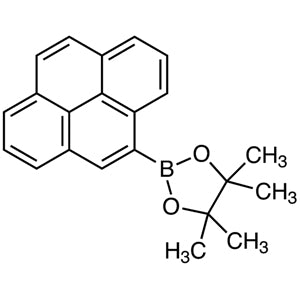
- TCI T3857 888950-09-2 4-(4,4,5,5-Tetramethyl-1,3,2-dioxaborolan-2-yl)pyrene
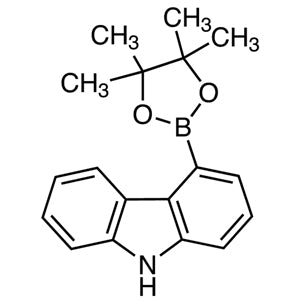
- TCI T3747 1255309-13-7 4-(4,4,5,5-Tetramethyl-1,3,2-dioxaborolan-2-yl)-9H-carbazole
- Organic synthesis for creating complex heterocyclic compounds due to its reactivity and structural versatility.
- Coupling reactions such as Suzuki-Miyaura for efficient bond formation between aromatic and alkenyl groups.
- Development of organic materials with tailored electronic properties due to its unique molecular framework.
- Research in polymer chemistry for functional group introduction and cross-linking applications.
- Advanced chemical studies requiring high-precision molecular construction and modification.
| Brand | TCI |
|---|---|
| CAS number | 861398-06-3 |
| Molecular formula | — |
| Purity | — |
| Category | Chemistry > Organometallic Reagents > Organoboron [Organometallic Reagents] |
| Pack sizes | Available in various quantities as per standard laboratory supply |
| Physical form | Solid (exact form may vary depending on supplier) |
| Storage | Store in a cool, dry place away from moisture and direct sunlight |
This compound should be stored in a cool, dry environment to maintain its chemical integrity and reactivity. It is recommended to use airtight containers to prevent exposure to moisture and air, which could affect its stability. Due to its organoboron nature, it is important to handle it with care, using appropriate personal protective equipment such as gloves and safety goggles. Storage should be in a well-ventilated area to minimize any potential hazards. Avoid direct contact with skin or inhalation of vapors during handling. Proper labeling and safe storage practices are essential to ensure the compound remains effective for laboratory use.
—
Produk Terkait
-
2-(Benzo[b]thiophen-3-yl)-4,4,5,5-tetramethyl-1,3,2-dioxaborolane TCI B5821
Regular price Rp 4.266.150,00Regular priceRp 2.998.800,00Sale price Rp 4.266.150,00 -
4-(4,4,5,5-Tetramethyl-1,3,2-dioxaborolan-2-yl)dibenzothiophene TCI T3236
Regular price From Rp 1.272.600,00Regular priceRp 905.100,00Sale price From Rp 1.272.600,00 -
Benzo[b]thiophene-3-boronicAcid(containsvaryingamountsofAnhydride) TCI B4774
Regular price From Rp 1.272.600,00Regular priceRp 905.100,00Sale price From Rp 1.272.600,00 -
Benzo[b]thiophene-2-boronicAcid(containsvaryingamountsofAnhydride) TCI B2893
Regular price From Rp 795.900,00Regular priceRp 572.250,00Sale price From Rp 795.900,00 -
4-(4,4,5,5-Tetramethyl-1,3,2-dioxaborolan-2-yl)pyrene TCI T3857
Regular price Rp 4.452.000,00Regular priceRp 3.129.000,00Sale price Rp 4.452.000,00 -
4-(4,4,5,5-Tetramethyl-1,3,2-dioxaborolan-2-yl)-9H-carbazole TCI T3747
Regular price Rp 5.246.850,00Regular priceRp 3.684.450,00Sale price Rp 5.246.850,00 -
3-(4,4,5,5-Tetramethyl-1,3,2-dioxaborolan-2-yl)-9-(p-tolyl)-9H-carbazole TCI T3612
Regular price From Rp 1.113.000,00Regular priceRp 793.800,00Sale price From Rp 1.113.000,00 -
1,3,5-Tris(4,4,5,5-tetramethyl-1,3,2-dioxaborolan-2-yl)benzene TCI T3515
Regular price From Rp 2.332.050,00Regular priceRp 1.646.400,00Sale price From Rp 2.332.050,00