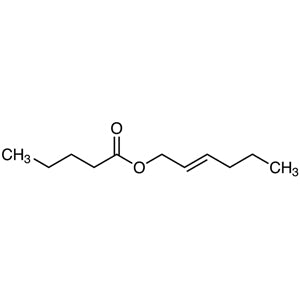
Butyl Valerate is a chemical compound widely used as a foundational material in various laboratory reactions. It serves as a key building block in the synthesis of complex organic compounds, particularly in the development of aromatic and ester-based molecules. Its simple molecular structure plays a crucial role in enabling chemical reactions that lead to the formation of diverse chemical products. In laboratory settings, Butyl Valerate is frequently utilized in esterification processes and the creation of compounds with specific aromatic properties.
The chemical properties of Butyl Valerate make it a preferred choice for laboratory use. It exhibits chemical stability and is not easily reactive with other chemical substances, which simplifies handling and storage. This stability ensures that the compound remains effective throughout its use in various experimental procedures. Additionally, its distinct aroma makes it relevant in applications related to fragrance and cosmetic formulations. The compound is non-toxic and easily degradable, contributing to its safety profile in laboratory environments.
In Indonesian laboratories, Butyl Valerate is extensively used in chemical research and pharmaceutical industries. It is a common material in organic synthesis experiments and aroma testing. Its availability and affordability make it a practical choice for academic institutions and research centers. The compound supports a wide range of experimental needs, from basic chemical reactions to more advanced synthesis processes.
TCI brochures (PDF)
- Lipids 2025-12-17 · p. 12
- Esterification Reactions - Butyl Valerate is commonly used in esterification processes due to its stability and reactivity in forming ester compounds.
- Aroma Testing - The distinct aroma of Butyl Valerate makes it suitable for testing and developing fragrance compounds in cosmetic and food industries.
- Organic Synthesis - It serves as a building block for the synthesis of complex organic molecules, particularly aromatic and ester-based compounds.
- Chemical Research - Its chemical stability and predictable behavior make it ideal for use in various chemical research applications.
- Pharmaceutical Development - Butyl Valerate is used in the formulation and testing of pharmaceutical compounds due to its non-toxic nature and chemical compatibility.
| Brand | — |
|---|---|
| CAS number | — |
| Molecular formula | — |
| Purity | — |
| Category | — |
| Pack sizes | — |
| Physical form | — |
| Storage | — |
- Brand - TCI
- CAS Number - 591-68-4
- Category - Chemistry > Building Blocks > Non-Heterocyclic Building Blocks
- Pack Sizes - Available in various quantities as per standard laboratory supply
- Physical Form - Liquid
- Storage Note - Store in a cool, dry place away from direct sunlight
Butyl Valerate should be stored in a cool, dry environment, away from direct sunlight and sources of heat. It is recommended to use airtight containers to prevent contamination and maintain its chemical integrity. Due to its stability, it does not require special refrigeration but should be protected from moisture and air exposure. In laboratory settings, it is important to handle the compound with care, using appropriate personal protective equipment when necessary. Proper labeling and storage conditions ensure the safety and effectiveness of the compound during its use and long-term preservation.
—
Produk Terkait
-
MethylValerate TCI V0005
Regular price Rp 557.550,00Regular priceRp 389.550,00Sale price Rp 557.550,00 -
EthylValerate TCI V0004
Regular price From Rp 452.550,00Regular priceRp 316.050,00Sale price From Rp 452.550,00 -
PentylValerate TCI P1929
Regular price From Rp 769.650,00Regular priceRp 537.600,00Sale price From Rp 769.650,00 -
trans-2-HexenylValerate TCI H1444
Regular price Rp 3.100.650,00Regular priceRp 2.168.250,00Sale price Rp 3.100.650,00 -
BetamethasoneValerate TCI B4157
Regular price From Rp 1.405.950,00Regular priceRp 998.550,00Sale price From Rp 1.405.950,00 -
MethylValerate[StandardMaterialforGC] TCI S0303
Regular price Rp 2.016.000,00Regular priceRp 1.409.100,00Sale price Rp 2.016.000,00 -
beta-Estradiol17-Valerate TCI E0876
Regular price From Rp 2.571.450,00Regular priceRp 1.813.350,00Sale price From Rp 2.571.450,00