![137829-79-9 [[(4-tert-Butyl-3,5-dimethyl-1H-pyrrol-2-yl)(4-tert-butyl-3,5-dimethyl-2H-pyrrol-2-ylidene)methyl]methane](difluoroborane) - AMI Scientific](http://amiscientific.com/cdn/shop/files/TCI2510B4400.jpg?v=1768815604&width=1946)
![137829-79-9 [[(4-tert-Butyl-3,5-dimethyl-1H-pyrrol-2-yl)(4-tert-butyl-3,5-dimethyl-2H-pyrrol-2-ylidene)methyl]methane](difluoroborane) - AMI Scientific](http://amiscientific.com/cdn/shop/files/TCI2510B4400.jpg?v=1768815604&width=1445)
This complex chemical compound, known as TCI B4400, belongs to the category of dipyrromethene dyes and is widely used in advanced materials research. It is a specialized reagent that plays a crucial role in the development of optical and photonic materials. Its unique molecular structure, consisting of two pyrrol units connected to a methane core, along with a difluoroborane group, makes it highly effective in fluorescence applications. In the laboratory, it serves as a foundational material for synthesizing pigments and compounds with high fluorescence properties.
The compound's ability to absorb and emit light with high efficiency is a key factor in its popularity among researchers. Its chemical stability ensures consistent performance across various experimental conditions. The complex molecular structure also contributes to its durability and reliability in laboratory settings. These characteristics make it a preferred choice for scientists working on advanced optical and photonic projects.
In Indonesian laboratories, this compound is highly relevant for research in optical materials and photonics. Many research institutions and universities in Indonesia are actively developing new technologies that require materials with high fluorescence properties. The availability and performance of TCI B4400 make it a preferred choice for these applications, supporting innovation in the field of material science.
TCI brochures (PDF)
- Boron Compounds 2025-10-07 · p. 28
Related TCI products
- TCI B4489 151486-56-5 [[(4-Butyl-3,5-dimethyl-1H-pyrrol-2-yl)(4-butyl-3,5-dimethyl-2H-pyrrol-2-ylidene)methyl]methane](difluoroborane)
- TCI E1065 131083-16-4 [[(4-Ethyl-3,5-dimethyl-1H-pyrrol-2-yl)(4-ethyl-3,5-dimethyl-2H-pyrrol-2-ylidene)methyl]methane](difluoroborane)
- TCI D5724 121207-31-6 [[(3,5-Dimethyl-1H-pyrrol-2-yl)(3,5-dimethyl-2H-pyrrol-2-ylidene)methyl]methane](difluoroborane) (purified by sublimation)
- TCI D4341 121207-31-6 [[(3,5-Dimethyl-1H-pyrrol-2-yl)(3,5-dimethyl-2H-pyrrol-2-ylidene)methyl]methane](difluoroborane)
- TCI T3127 157410-23-6 [[(3,4,5-Trimethyl-1H-pyrrol-2-yl)(3,4,5-trimethyl-2H-pyrrol-2-ylidene)methyl]carbonitrile](difluoroborane)
- TCI M2609 892505-41-8 [2-[(Methylthio)(2H-pyrrol-2-ylidene)methyl]-1H-pyrrole](difluoroborane)
- Photonic Material Development: This compound is ideal for creating advanced photonic materials due to its high fluorescence efficiency and stable molecular structure.
- Optical Sensor Fabrication: Its ability to absorb and emit light makes it suitable for developing sensitive optical sensors used in various analytical applications.
- Fluorescent Pigment Synthesis: It serves as a key reagent in the synthesis of pigments with high fluorescence, used in both industrial and academic research.
- Material Characterization Studies: Its unique properties allow it to be used in studies that require precise optical and material behavior analysis.
- Research in Advanced Imaging Technologies: It supports the development of imaging technologies that rely on high-quality fluorescent materials for enhanced resolution and accuracy.
| Brand | TCI |
|---|---|
| CAS number | 137829-79-9 |
| Molecular formula | — |
| Purity | — |
| Category | Materials Science > Photonic Materials and Optical Materials > Dipyrromethene Dyes |
| Pack sizes | — |
| Physical form | — |
| Storage | Store in a cool, dry place away from light and moisture |
This compound should be stored in a cool, dry environment, away from direct light and moisture to maintain its chemical stability. It is recommended to use airtight containers made of materials that are chemically inert to prevent any unwanted reactions. Due to its complex molecular structure, it is important to handle it with care during preparation and experimentation. Proper ventilation should be ensured in the laboratory to minimize exposure. Always follow standard safety protocols when working with such compounds to ensure a safe and controlled environment.
—
Produk Terkait
-
[[(4-Butyl-3,5-dimethyl-1H-pyrrol-2-yl)(4-butyl-3,5-dimethyl-2H-pyrrol-2-ylidene)methyl]methane](difluoroborane) TCI B4489
Regular price Rp 5.537.700,00Regular priceRp 3.888.150,00Sale price Rp 5.537.700,00 -
[[(4-Ethyl-3,5-dimethyl-1H-pyrrol-2-yl)(4-ethyl-3,5-dimethyl-2H-pyrrol-2-ylidene)methyl]methane](difluoroborane) TCI E1065
Regular price Rp 2.491.650,00Regular priceRp 1.757.700,00Sale price Rp 2.491.650,00 -
[[(3,5-Dimethyl-1H-pyrrol-2-yl)(3,5-dimethyl-2H-pyrrol-2-ylidene)methyl]methane](difluoroborane)(purifiedbysublimation) TCI D5724
Regular price From Rp 2.597.700,00Regular priceRp 1.832.250,00Sale price From Rp 2.597.700,00 -
[[(3,5-Dimethyl-1H-pyrrol-2-yl)(3,5-dimethyl-2H-pyrrol-2-ylidene)methyl]methane](difluoroborane) TCI D4341
Regular price Rp 6.067.950,00Regular priceRp 4.258.800,00Sale price Rp 6.067.950,00 -
[[(3,4,5-Trimethyl-1H-pyrrol-2-yl)(3,4,5-trimethyl-2H-pyrrol-2-ylidene)methyl]carbonitrile](difluoroborane) TCI T3127
Regular price Rp 5.644.800,00Regular priceRp 3.962.700,00Sale price Rp 5.644.800,00 -
[2-[(Methylthio)(2H-pyrrol-2-ylidene)methyl]-1H-pyrrole](difluoroborane) TCI M2609
Regular price From Rp 3.312.750,00Regular priceRp 2.332.050,00Sale price From Rp 3.312.750,00 -
[1-[(3,5-Dimethyl-1H-pyrrol-2-yl)(3,5-dimethyl-2H-pyrrol-2-ylidene)methyl]-4-iodobenzene](difluoroborane) TCI D4632
Regular price From Rp 3.870.300,00Regular priceRp 2.721.600,00Sale price From Rp 3.870.300,00 -
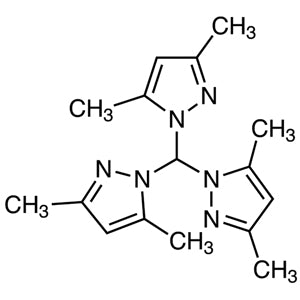
Tris(3,5-dimethyl-1-pyrazolyl)methane TCI T3025
Regular price From Rp 1.272.600,00Regular priceRp 905.100,00Sale price From Rp 1.272.600,00
![151486-56-5 [[(4-Butyl-3,5-dimethyl-1H-pyrrol-2-yl)(4-butyl-3,5-dimethyl-2H-pyrrol-2-ylidene)methyl]methane](difluoroborane) - AMI Scientific](http://amiscientific.com/cdn/shop/files/TCI2510B4489.jpg?v=1768815625&width=533)
![[[(4-Ethyl-3,5-dimethyl-1H-pyrrol-2-yl)(4-ethyl-3,5-dimethyl-2H-pyrrol-2-ylidene)methyl]methane](difluoroborane) (CAS 131083-16-4) - TCI E1065 - AMI Scientific](http://amiscientific.com/cdn/shop/files/TCI2510E1065.jpg?v=1768818777&width=533)
![[[(3,5-Dimethyl-1H-pyrrol-2-yl)(3,5-dimethyl-2H-pyrrol-2-ylidene)methyl]methane](difluoroborane) (purified by sublimation) (CAS 121207-31-6) - TCI D5724 - AMI Scientific](http://amiscientific.com/cdn/shop/files/TCI2510D5724.jpg?v=1769180709&width=533)
![[[(3,5-Dimethyl-1H-pyrrol-2-yl)(3,5-dimethyl-2H-pyrrol-2-ylidene)methyl]methane](difluoroborane) (CAS 121207-31-6) - TCI D4341 - AMI Scientific](http://amiscientific.com/cdn/shop/files/TCI2510D4341.jpg?v=1768818079&width=533)
![157410-23-6 [[(3,4,5-Trimethyl-1H-pyrrol-2-yl)(3,4,5-trimethyl-2H-pyrrol-2-ylidene)methyl]carbonitrile](difluoroborane) - AMI Scientific](http://amiscientific.com/cdn/shop/files/TCI2510T3127.jpg?v=1769058164&width=533)
![892505-41-8 [2-[(Methylthio)(2H-pyrrol-2-ylidene)methyl]-1H-pyrrole](difluoroborane) - AMI Scientific](http://amiscientific.com/cdn/shop/files/TCI2510M2609.jpg?v=1768361702&width=533)
![[1-[(3,5-Dimethyl-1H-pyrrol-2-yl)(3,5-dimethyl-2H-pyrrol-2-ylidene)methyl]-4-iodobenzene](difluoroborane) (CAS 250734-47-5) - TCI D4632 - AMI Scientific](http://amiscientific.com/cdn/shop/files/TCI2510D4632.jpg?v=1769142022&width=533)