

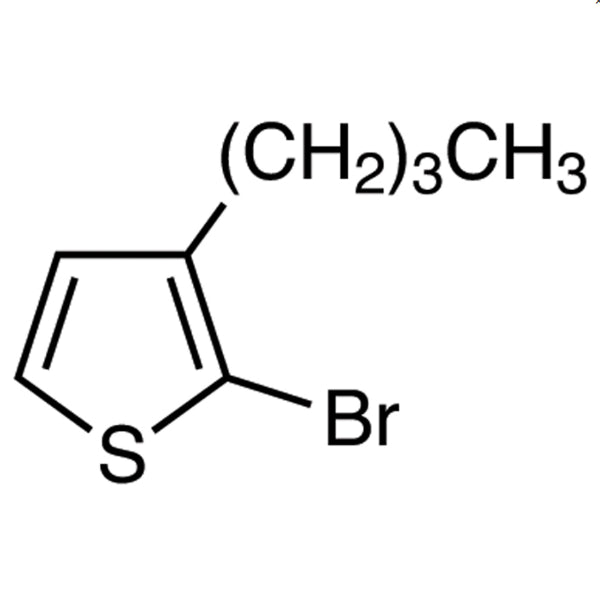
2-Bromo-3-butylthiophene is an organic compound widely used in semiconductor material research. It plays a crucial role in the development of new materials with specific electronic properties. This compound is commonly found in organic synthesis processes, where it serves as a building block for creating advanced materials. Its molecular structure enables it to participate in various chemical reactions, making it a versatile tool for researchers. In Indonesian laboratories, it is a key component in studies focused on optoelectronic devices and solar cell technologies.
The compound's high reactivity and unique molecular structure make it a preferred choice for chemical synthesis. The presence of both bromo and butylthiophene groups enhances its ability to interact with other molecules, allowing for the formation of complex structures. These properties make it ideal for applications requiring precise chemical modifications. Its reactivity also supports the development of new materials with tailored electronic characteristics, which is essential in modern material science research.
In Indonesian laboratories, 2-Bromo-3-butylthiophene is frequently used in scientific research, particularly in the fields of material technology and energy. It is commonly found in projects aimed at developing alternative materials for electronic and optical devices. Its role in the synthesis of organic semiconductors highlights its importance in advancing sustainable and efficient electronic technologies.
TCI brochures (PDF)
- Thiophenes 2026-06-29 · p. 2
- Building Blocks for Organic Semiconductor 2026-03-24 · p. 25
Related TCI products
- TCI B1458 34722-01-5 3-Butylthiophene
- TCI B5475 925899-21-4 2-Bromo-5-(2-ethylhexyl)thiophene
- TCI B5458 704890-84-6 2-[(5'-Bromo-[2,2'-bithiophen]-5-yl)methylene]malononitrile
- TCI B5457 176787-96-5 5'-Bromo-[2,2'-bithiophene]-5-carbonitrile
- TCI B5456 1308671-90-0 3-(5-Bromo-2-thienyl)-2,5-bis(2-ethylhexyl)-6-(2-thienyl)pyrrolo[3,4-c]pyrrole-1,4-dione
- TCI B5420 241477-71-4 2-Bromo-3-cyclohexylthiophene
- Organic semiconductor development for electronic device fabrication due to its molecular reactivity and structural versatility.
- Synthesis of optoelectronic materials for use in solar cells and light-emitting diodes because of its ability to form complex molecular structures.
- Research in energy-efficient materials for next-generation electronic components due to its role in creating novel semiconductor compounds.
- Development of alternative electronic materials to reduce reliance on traditional semiconductor sources through chemical modification.
- Exploration of new chemical interactions in material science to enhance electronic properties and device performance.
| Brand | TCI |
|---|---|
| CAS number | 145543-82-4 |
| Molecular formula | — |
| Purity | — |
| Category | Materials Science > Material Building Blocks > Small Molecule Semiconductor Building Blocks |
| Pack sizes | Available in standard laboratory quantities |
| Physical form | Solid or liquid, depending on supplier packaging |
| Storage | Store in a cool, dry place away from light and incompatible substances |
This compound should be stored in a cool, dry place away from direct sunlight and sources of heat. It is recommended to use airtight containers to prevent exposure to moisture and air. Due to its reactivity, it should be kept separate from incompatible chemicals such as strong oxidizers or bases. Proper personal protective equipment, including gloves and safety goggles, should be worn when handling. Always ensure good ventilation in the laboratory to minimize inhalation risks. Regular monitoring of storage conditions is essential to maintain the compound's integrity and safety.
—
Produk Terkait
-
3-Butylthiophene TCI B1458
Regular price From Rp 742.350,00Regular priceRp 534.450,00Sale price From Rp 742.350,00 -
2-Bromo-5-(2-ethylhexyl)thiophene TCI B5475
Regular price From Rp 3.180.450,00Regular priceRp 2.239.650,00Sale price From Rp 3.180.450,00 -
2-[(5'-Bromo-[2,2'-bithiophen]-5-yl)methylene]malononitrile TCI B5458
Regular price From Rp 1.351.350,00Regular priceRp 960.750,00Sale price From Rp 1.351.350,00 -
5'-Bromo-[2,2'-bithiophene]-5-carbonitrile TCI B5457
Regular price From Rp 2.013.900,00Regular priceRp 1.423.800,00Sale price From Rp 2.013.900,00 -
3-(5-Bromo-2-thienyl)-2,5-bis(2-ethylhexyl)-6-(2-thienyl)pyrrolo[3,4-c]pyrrole-1,4-dione TCI B5456
Regular price Rp 7.075.950,00Regular priceRp 4.963.350,00Sale price Rp 7.075.950,00 -
2-Bromo-3-cyclohexylthiophene TCI B5420
Regular price From Rp 3.815.700,00Regular priceRp 2.683.800,00Sale price From Rp 3.815.700,00 -
2-Bromo-3-octadecylthiophene TCI B5410
Regular price Rp 2.306.850,00Regular priceRp 1.628.550,00Sale price Rp 2.306.850,00 -
2-Bromo-3-hexadecylthiophene TCI B5409
Regular price Rp 2.439.150,00Regular priceRp 1.720.950,00Sale price Rp 2.439.150,00


