9,10-Bis(4,4,5,5-tetramethyl-1,3,2-dioxaborolan-2-yl)anthracene is a chemical compound widely used in organic reactions, particularly in the synthesis of heterocyclic compounds and complex molecular structures. As a member of the organoboron family, it plays a crucial role in various coupling reactions, including the Suzuki-Miyaura reaction. This compound is highly valued in laboratory settings for its ability to facilitate the formation of aromatic structures with high precision. Its chemical properties make it an essential reagent for researchers aiming to develop new materials and pharmaceutical compounds.
The compound is known for its stability under specific conditions and its reactivity in organoboron-based reactions. Its non-polar nature allows it to dissolve efficiently in organic solvents, making it suitable for a wide range of synthetic processes. These characteristics contribute to its effectiveness in creating complex molecular architectures. Additionally, its compatibility with various reaction conditions ensures reliable results in both academic and industrial research environments.
In Indonesian laboratories, this compound is commonly used in organic chemistry research, especially in pharmaceutical and material science applications. Researchers in educational institutions and research organizations frequently rely on it to develop new compounds with potential applications in biotechnology and advanced materials. Its versatility and reliability make it a preferred choice for high-precision chemical synthesis.
TCI brochures (PDF)
- Boron Compounds 2025-10-07 · p. 17
- Building Blocks for Organic Semiconductor 2026-03-24 · p. 9
Related TCI products
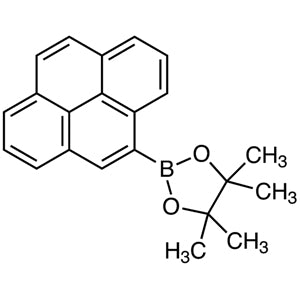
- TCI T3857 888950-09-2 4-(4,4,5,5-Tetramethyl-1,3,2-dioxaborolan-2-yl)pyrene
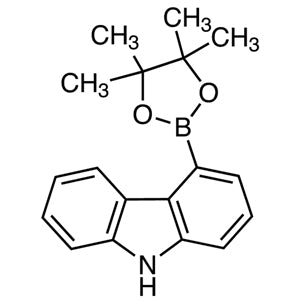
- TCI T3747 1255309-13-7 4-(4,4,5,5-Tetramethyl-1,3,2-dioxaborolan-2-yl)-9H-carbazole
- TCI T3612 1345614-94-9 3-(4,4,5,5-Tetramethyl-1,3,2-dioxaborolan-2-yl)-9-(p-tolyl)-9H-carbazole
- TCI T3515 365564-05-2 1,3,5-Tris(4,4,5,5-tetramethyl-1,3,2-dioxaborolan-2-yl)benzene
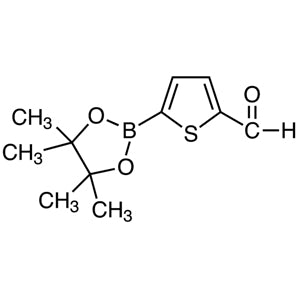
- TCI T3485 1040281-83-1 5-(4,4,5,5-Tetramethyl-1,3,2-dioxaborolan-2-yl)thiophene-2-carboxaldehyde
- TCI T3452 785051-54-9 9-[4-(4,4,5,5-Tetramethyl-1,3,2-dioxaborolan-2-yl)phenyl]-9H-carbazole
- Organic synthesis of heterocyclic compounds due to its reactivity in coupling reactions and ability to form complex molecular structures.
- Development of pharmaceutical compounds through efficient participation in Suzuki-Miyaura and other organoboron reactions.
- Creation of advanced materials with aromatic structures by enabling precise chemical modifications in laboratory settings.
- Research in material science for the synthesis of novel polymers and functional materials with specific chemical properties.
- Support for biotechnology applications in the design of bioactive molecules requiring high chemical precision and stability.
| Brand | TCI |
|---|---|
| CAS number | 863992-56-7 |
| Molecular formula | — |
| Purity | — |
| Category | Chemistry > Organometallic Reagents > Organoboron [Organometallic Reagents] |
| Pack sizes | Available in various quantities as per supplier specifications |
| Physical form | Solid |
| Storage | Store in a cool, dry place away from moisture and direct sunlight |
This compound should be stored in a cool, dry environment to maintain its chemical integrity and prevent degradation. It is recommended to keep it in a tightly sealed container to avoid exposure to moisture and air. Due to its non-polar nature, it is best stored in glass or high-density polyethylene containers to ensure stability. Laboratory personnel should handle it with care, using appropriate personal protective equipment such as gloves and safety goggles. It is important to ensure proper ventilation when working with this compound to minimize any potential health risks. Regular monitoring of storage conditions is advised to maintain optimal performance in chemical reactions.
—
Produk Terkait
-
4-(4,4,5,5-Tetramethyl-1,3,2-dioxaborolan-2-yl)pyrene TCI T3857
Regular price Rp 4.452.000,00Regular priceRp 3.129.000,00Sale price Rp 4.452.000,00 -
4-(4,4,5,5-Tetramethyl-1,3,2-dioxaborolan-2-yl)-9H-carbazole TCI T3747
Regular price Rp 5.246.850,00Regular priceRp 3.684.450,00Sale price Rp 5.246.850,00 -
3-(4,4,5,5-Tetramethyl-1,3,2-dioxaborolan-2-yl)-9-(p-tolyl)-9H-carbazole TCI T3612
Regular price From Rp 1.113.000,00Regular priceRp 793.800,00Sale price From Rp 1.113.000,00 -
1,3,5-Tris(4,4,5,5-tetramethyl-1,3,2-dioxaborolan-2-yl)benzene TCI T3515
Regular price From Rp 2.332.050,00Regular priceRp 1.646.400,00Sale price From Rp 2.332.050,00 -
5-(4,4,5,5-Tetramethyl-1,3,2-dioxaborolan-2-yl)thiophene-2-carboxaldehyde TCI T3485
Regular price Rp 2.013.900,00Regular priceRp 1.423.800,00Sale price Rp 2.013.900,00 -
9-[4-(4,4,5,5-Tetramethyl-1,3,2-dioxaborolan-2-yl)phenyl]-9H-carbazole TCI T3452
Regular price From Rp 1.801.800,00Regular priceRp 1.275.750,00Sale price From Rp 1.801.800,00 -
2-(4,4,5,5-Tetramethyl-1,3,2-dioxaborolan-2-yl)-9H-carbazole TCI T3441
Regular price From Rp 2.597.700,00Regular priceRp 1.832.250,00Sale price From Rp 2.597.700,00 -
4-[4-(4,4,5,5-Tetramethyl-1,3,2-dioxaborolan-2-yl)phenyl]pyridine TCI T3400
Regular price From Rp 1.618.050,00Regular priceRp 1.146.600,00Sale price From Rp 1.618.050,00