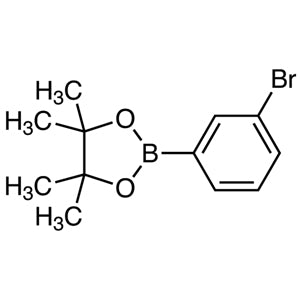
2-(4-Bromophenyl)-4,4,5,5-tetramethyl-1,3,2-dioxaborolane is an organoboron compound widely used in chemical reactions, particularly in the synthesis of complex molecules. This reagent plays a crucial role in modern organic chemistry by enabling efficient and selective transformations. Its unique structure allows it to participate in various coupling reactions, making it a versatile tool for synthetic chemists. It is especially valuable in the development of aromatic and heterocyclic compounds, which are essential in pharmaceutical and materials science research.
The compound is known for its stability under a range of chemical conditions and its high reactivity towards transition metals. These properties make it an ideal candidate for use in catalytic processes, where precise control over reaction pathways is required. Its ability to form stable intermediates and its compatibility with a variety of functional groups further enhance its utility in laboratory settings. The compound’s reactivity and structural complexity contribute to its effectiveness in producing specific and efficient chemical outcomes.
In Indonesian laboratories, this reagent is commonly used in organic chemistry research, particularly in the synthesis of new compounds and molecular modifications. Its availability in solid form and stability under controlled conditions make it a preferred choice for researchers seeking high-quality chemical materials. Due to its specificity and performance, it is frequently selected by scientists working in organic chemistry and pharmaceutical fields. Its applications are broad and extend to various research areas where precise chemical reactions are essential.
TCI brochures (PDF)
- Suzuki-Miyaura Cross Coupling Reaction 2025-12-01 · p. 17
- Boron Compounds 2025-10-07 · p. 15
Related TCI products
- TCI B6024 594823-67-3 2-(3-Bromophenyl)-4,4,5,5-tetramethyl-1,3,2-dioxaborolane
- TCI T4407 1609484-75-4 4,4,5,5-Tetramethyl-2-(spiro[fluorene-9,9'-xanthen]-4-yl)-1,3,2-dioxaborolane
- TCI T4387 1160862-12-3 4,4,5,5-Tetramethyl-2-(spiro[fluorene-9,9'-xanthen]-2-yl)-1,3,2-dioxaborolane
- TCI T4061 870004-04-9 4,4,5,5-Tetramethyl-2-(4-vinylphenyl)-1,3,2-dioxaborolane
- TCI T3875 1080632-76-3 2-([1,1':4',1''-Terphenyl]-4-yl)-4,4,5,5-tetramethyl-1,3,2-dioxaborolane
- TCI T3831 269410-26-6 4,4,5,5-Tetramethyl-2-(4-phenoxyphenyl)-1,3,2-dioxaborolane
- Used in the synthesis of aromatic and heterocyclic compounds due to its ability to participate in coupling reactions like Suzuki-Miyaura and Heck, which are fundamental in creating complex molecular structures.
- Applied in pharmaceutical research for the development of new drugs, as its reactivity allows for the efficient modification of molecular frameworks.
- Utilized in organic synthesis for the creation of novel compounds, leveraging its stability and compatibility with various functional groups.
- Employed in catalytic processes where transition metal interactions are required, due to its high reactivity and structural versatility.
- Found in molecular modification studies, where precise chemical transformations are necessary for the synthesis of advanced chemical materials.
| Brand | TCI |
|---|---|
| CAS number | 68716-49-4 |
| Molecular formula | — |
| Purity | — |
| Category | Chemistry > Organometallic Reagents > Organoboron [Organometallic Reagents] |
| Pack sizes | Available in various quantities as per standard laboratory requirements |
| Physical form | Solid |
| Storage | Store in a cool, dry place away from moisture and direct sunlight |
This compound should be stored in a cool, dry environment to maintain its stability and prevent degradation. It is recommended to use airtight containers to protect it from moisture and air exposure. Due to its chemical nature, it should be kept away from incompatible substances such as strong oxidizers. Proper labeling of storage containers is essential for safety and identification. Laboratory personnel should wear appropriate personal protective equipment when handling this material. Regular monitoring of storage conditions ensures the compound remains in optimal condition for use in research applications.
—
Produk Terkait
-
2-(3-Bromophenyl)-4,4,5,5-tetramethyl-1,3,2-dioxaborolane TCI B6024
Regular price From Rp 848.400,00Regular priceRp 609.000,00Sale price From Rp 848.400,00 -
4,4,5,5-Tetramethyl-2-(spiro[fluorene-9,9'-xanthen]-4-yl)-1,3,2-dioxaborolane TCI T4407
Regular price From Rp 1.008.000,00Regular priceRp 720.300,00Sale price From Rp 1.008.000,00 -
4,4,5,5-Tetramethyl-2-(spiro[fluorene-9,9'-xanthen]-2-yl)-1,3,2-dioxaborolane TCI T4387
Regular price Rp 3.922.800,00Regular priceRp 2.758.350,00Sale price Rp 3.922.800,00 -
4,4,5,5-Tetramethyl-2-(4-vinylphenyl)-1,3,2-dioxaborolane TCI T4061
Regular price From Rp 4.108.650,00Regular priceRp 2.888.550,00Sale price From Rp 4.108.650,00 -
2-([1,1':4',1''-Terphenyl]-4-yl)-4,4,5,5-tetramethyl-1,3,2-dioxaborolane TCI T3875
Regular price Rp 3.392.550,00Regular priceRp 2.387.700,00Sale price Rp 3.392.550,00 -
4,4,5,5-Tetramethyl-2-(4-phenoxyphenyl)-1,3,2-dioxaborolane TCI T3831
Regular price From Rp 795.900,00Regular priceRp 572.250,00Sale price From Rp 795.900,00 -
4,4,5,5-Tetramethyl-2-(4-nitrophenyl)-1,3,2-dioxaborolane TCI T3710
Regular price From Rp 1.087.800,00Regular priceRp 775.950,00Sale price From Rp 1.087.800,00 -
4,4,5,5-Tetramethyl-2-[3-(trifluoromethyl)phenyl]-1,3,2-dioxaborolane TCI T3707
Regular price From Rp 2.068.500,00Regular priceRp 1.461.600,00Sale price From Rp 2.068.500,00