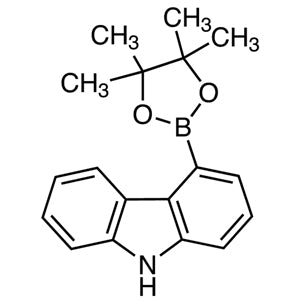
3-(tert-Butyl)-9H-carbazole is a chemical compound widely used in scientific research, particularly in the field of materials science. This compound plays a crucial role in the synthesis of complex molecules that find applications in electrochemistry and semiconductor technology. As a member of the carbazole family, it possesses a stable aromatic structure, making it a valuable building block for developing materials with unique optical and electronic properties. Its versatility and chemical stability make it a key component in various laboratory processes aimed at creating advanced materials for modern technological applications.
The compound’s chemical stability, resistance to chemical reactions, and ability to form bonds with various functional groups are the primary factors that make it a preferred choice in material synthesis. These properties allow researchers to customize its structure for specific applications, enhancing its utility in the development of new materials. The ease with which it can be modified also makes it an ideal candidate for creating compounds with tailored optical and electronic characteristics. This adaptability is particularly beneficial in the design of advanced semiconductor materials and optoelectronic devices.
In Indonesian laboratories, 3-(tert-Butyl)-9H-carbazole is commonly used as a raw material for the development of new materials in the fields of information technology and energy. Its role in synthesizing complex compounds that exhibit unique properties makes it an essential tool for researchers working on next-generation materials. The compound’s reliability and performance in various chemical processes further solidify its importance in the scientific community.
TCI brochures (PDF)
- Carbazoles 2025-06-27 · p. 2
- Building Blocks for Organic Semiconductor 2026-03-24 · p. 18
Related TCI products
- TCI T3882 6558-85-6 1,3,6,8-Tetramethyl-9H-carbazole
- TCI T3747 1255309-13-7 4-(4,4,5,5-Tetramethyl-1,3,2-dioxaborolan-2-yl)-9H-carbazole
- TCI T3642 1630723-98-6 N,N,N',N'-Tetrakis(4-methoxyphenyl)-9H-carbazole-3,6-diamine
- TCI T3612 1345614-94-9 3-(4,4,5,5-Tetramethyl-1,3,2-dioxaborolan-2-yl)-9-(p-tolyl)-9H-carbazole
- TCI T3452 785051-54-9 9-[4-(4,4,5,5-Tetramethyl-1,3,2-dioxaborolan-2-yl)phenyl]-9H-carbazole
- TCI T3441 1242412-60-7 2-(4,4,5,5-Tetramethyl-1,3,2-dioxaborolan-2-yl)-9H-carbazole
- Used in semiconductor material development due to its stable aromatic structure and ability to form functionalized derivatives.
- Applied in optoelectronic research for creating materials with tunable optical properties and electronic behavior.
- Utilized in electrochemical studies for its chemical stability and compatibility with various reaction conditions.
- Employed in synthetic chemistry for the preparation of complex organic molecules with specific functional groups.
- Integrated into material engineering projects to design advanced materials with enhanced electronic and optical characteristics.
| Brand | TCI |
|---|---|
| CAS number | 22401-74-7 |
| Molecular formula | — |
| Purity | — |
| Category | Materials Science > Material Building Blocks > Small Molecule Semiconductor Building Blocks |
| Pack sizes | Available in standard laboratory quantities as per supplier specifications |
| Physical form | Solid, crystalline or amorphous depending on production batch |
| Storage | Store in a cool, dry place away from light and incompatible substances |
This compound should be stored in a cool, dry environment, away from direct sunlight and sources of heat. It is recommended to keep it in a tightly sealed container to prevent moisture absorption and contamination. Proper ventilation is essential when handling the material to minimize exposure to vapors. Due to its chemical stability, it does not require refrigeration but should be protected from extreme temperature fluctuations. Laboratory personnel should wear appropriate personal protective equipment, such as gloves and safety goggles, when handling this compound to ensure safety during synthesis and experimentation.
—
Produk Terkait
-
1,3,6,8-Tetramethyl-9H-carbazole TCI T3882
Regular price From Rp 4.108.650,00Regular priceRp 2.888.550,00Sale price From Rp 4.108.650,00 -
4-(4,4,5,5-Tetramethyl-1,3,2-dioxaborolan-2-yl)-9H-carbazole TCI T3747
Regular price Rp 5.246.850,00Regular priceRp 3.684.450,00Sale price Rp 5.246.850,00 -
N,N,N',N'-Tetrakis(4-methoxyphenyl)-9H-carbazole-3,6-diamine TCI T3642
Regular price From Rp 9.778.650,00Regular priceRp 6.853.350,00Sale price From Rp 9.778.650,00 -
3-(4,4,5,5-Tetramethyl-1,3,2-dioxaborolan-2-yl)-9-(p-tolyl)-9H-carbazole TCI T3612
Regular price From Rp 1.113.000,00Regular priceRp 793.800,00Sale price From Rp 1.113.000,00 -
9-[4-(4,4,5,5-Tetramethyl-1,3,2-dioxaborolan-2-yl)phenyl]-9H-carbazole TCI T3452
Regular price From Rp 1.801.800,00Regular priceRp 1.275.750,00Sale price From Rp 1.801.800,00 -
2-(4,4,5,5-Tetramethyl-1,3,2-dioxaborolan-2-yl)-9H-carbazole TCI T3441
Regular price From Rp 2.597.700,00Regular priceRp 1.832.250,00Sale price From Rp 2.597.700,00 -
9-[3-(4,4,5,5-Tetramethyl-1,3,2-dioxaborolan-2-yl)phenyl]carbazole TCI T3386
Regular price From Rp 2.013.900,00Regular priceRp 1.423.800,00Sale price From Rp 2.013.900,00 -
9,9'-(5-Bromo-1,3-phenylene)bis(9H-carbazole) TCI B5502
Regular price From Rp 2.835.000,00Regular priceRp 1.998.150,00Sale price From Rp 2.835.000,00