


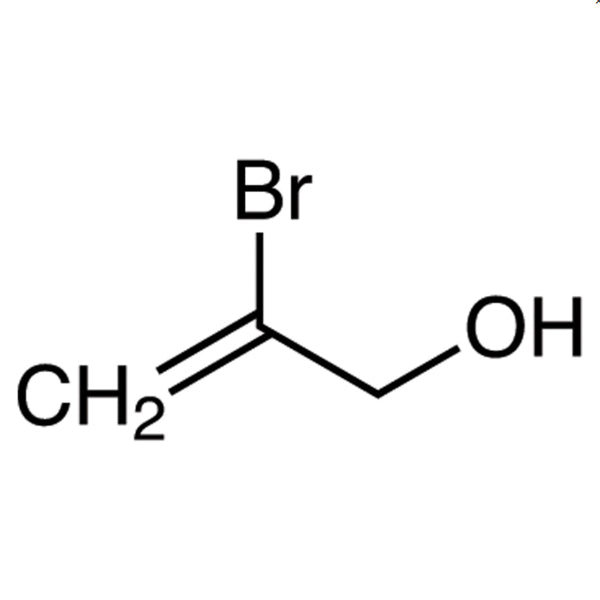
2-Bromoallyl Alcohol (TCI B5347) is a chemical compound widely used in organic synthesis as a fundamental building block in laboratory settings. This compound plays a crucial role in the development of complex organic molecules, particularly in reactions requiring high reactivity. Its simple molecular structure enables it to participate in various chemical transformations, making it an essential component for researchers working on synthetic pathways. In Indonesian laboratories, it is a common reagent used in both academic and industrial research environments.
The compound's reactivity stems from its functional groups, including a hydroxyl group and a bromo substituent. These groups make it highly suitable for substitution, addition, and elimination reactions. The presence of both functional groups allows it to act as a versatile intermediate in the synthesis of heterocyclic compounds and alkyl chain derivatives. Its reactivity also makes it a valuable precursor for compounds requiring specific reactivity and stability characteristics.
In Indonesian laboratories, 2-Bromoallyl Alcohol is frequently used in organic chemistry research, especially in higher education institutions and research centers. It is a key reagent in the synthesis of various synthetic compounds used across multiple fields, including pharmaceuticals and materials science. Due to its reactivity, it requires careful handling and proper storage to ensure safety and effectiveness in experimental processes.
- Organic synthesis is a primary application where 2-Bromoallyl Alcohol is used to create complex molecules through various chemical reactions.
- Heterocyclic compound synthesis benefits from its reactivity, allowing for the formation of ring structures essential in pharmaceutical and industrial applications.
- Alkyl chain modification is another key use, as the compound enables the transformation of alkyl chains into diverse chemical products.
- Polymer chemistry research utilizes this compound for the development of new materials with specific chemical properties.
- Analytical chemistry applications rely on its reactivity for the preparation of reference standards and reagents in qualitative and quantitative analyses.
| Brand | TCI |
|---|---|
| CAS number | 598-19-6 |
| Molecular formula | — |
| Purity | — |
| Category | Chemistry > Building Blocks > Non-Heterocyclic Building Blocks |
| Pack sizes | Available in various quantities as per supplier specifications |
| Physical form | Liquid |
| Storage | Requires storage in a cool, dry place away from light and incompatible materials |
2-Bromoallyl Alcohol should be stored in a cool, dry place, away from direct sunlight and sources of heat. It is recommended to use airtight containers made of materials that are chemically inert, such as glass or high-density polyethylene. Due to its reactivity, it should be kept separate from strong oxidizing agents, bases, and other reactive substances. Proper ventilation is essential when handling this compound to minimize exposure. Laboratory personnel should wear appropriate personal protective equipment, including gloves, goggles, and a lab coat, to ensure safety during handling and use.
—
Produk Terkait
-
4-IodobenzylAlcohol TCI I0810
Regular price From Rp 2.889.600,00Regular priceRp 2.020.200,00Sale price From Rp 2.889.600,00 -
2-IodobenzylAlcohol TCI I0858
Regular price Rp 1.035.300,00Regular priceRp 723.450,00Sale price Rp 1.035.300,00 -
3-IodobenzylAlcohol TCI I0866
Regular price From Rp 1.510.950,00Regular priceRp 1.056.300,00Sale price From Rp 1.510.950,00 -
SyringylAlcohol TCI Y0033
Regular price From Rp 1.326.150,00Regular priceRp 942.900,00Sale price From Rp 1.326.150,00 -
VeratrylAlcohol TCI V0020
Regular price Rp 1.538.250,00Regular priceRp 1.090.950,00Sale price Rp 1.538.250,00 -
VanillylAlcohol TCI V0018
Regular price From Rp 1.326.150,00Regular priceRp 942.900,00Sale price From Rp 1.326.150,00 -
2,4,6-TrimethylbenzylAlcohol TCI T1905
Regular price Rp 2.041.200,00Regular priceRp 1.426.950,00Sale price Rp 2.041.200,00 -
3,4,5-Tris(benzyloxy)benzylAlcohol TCI T1840
Regular price From Rp 1.881.600,00Regular priceRp 1.331.400,00Sale price From Rp 1.881.600,00


