

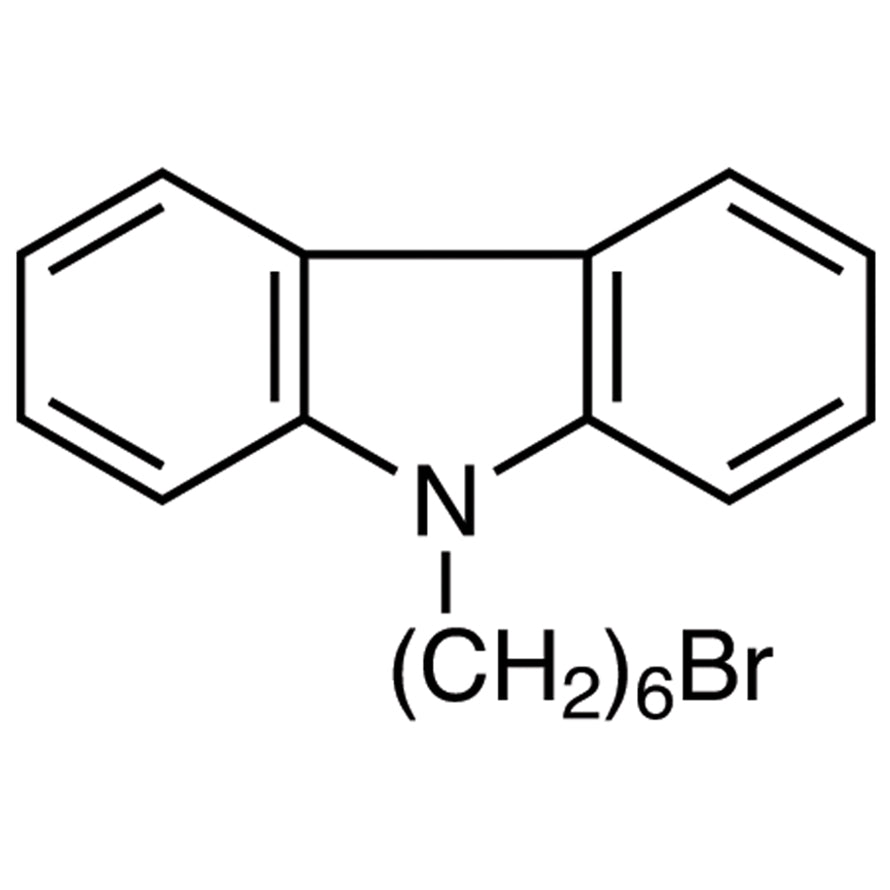
9-(6-Bromohexyl)-9H-carbazole is a chemical compound widely used in semiconductor and materials research within laboratory settings. As a small molecule building block, it serves as a foundational element in the development of materials with tailored electronic properties. This compound is particularly valuable for its ability to participate in complex synthesis processes, enabling the creation of advanced materials for various technological applications. Its role in the laboratory extends beyond mere synthesis, as it contributes to the exploration of new material properties and functionalities.
The compound's unique chemical properties make it a preferred choice for researchers working on organic electronics and optoelectronic devices. Its molecular structure allows for precise modifications, enabling the tuning of electronic and optical characteristics. The stability of the compound under controlled laboratory conditions further enhances its reliability in synthetic processes. Additionally, its compatibility with a range of functional groups makes it versatile for a wide array of chemical reactions. These attributes collectively position it as a key component in modern materials science research.
In Indonesian laboratories, 9-(6-Bromohexyl)-9H-carbazole is commonly used in material science and semiconductor technology research. It supports the development of organic light-emitting diodes (OLEDs), solar cells, and other electronic components. Its application is particularly relevant in academic and industrial research settings where the synthesis of advanced materials is essential. The compound’s predictable behavior and chemical versatility make it an indispensable tool for researchers in the field.
TCI brochures (PDF)
- Building Blocks for Organic Semiconductor 2026-03-24 · p. 19
Related TCI products
- TCI T3882 6558-85-6 1,3,6,8-Tetramethyl-9H-carbazole
- TCI T3747 1255309-13-7 4-(4,4,5,5-Tetramethyl-1,3,2-dioxaborolan-2-yl)-9H-carbazole
- TCI T3642 1630723-98-6 N,N,N',N'-Tetrakis(4-methoxyphenyl)-9H-carbazole-3,6-diamine
- TCI T3612 1345614-94-9 3-(4,4,5,5-Tetramethyl-1,3,2-dioxaborolan-2-yl)-9-(p-tolyl)-9H-carbazole
- TCI T3452 785051-54-9 9-[4-(4,4,5,5-Tetramethyl-1,3,2-dioxaborolan-2-yl)phenyl]-9H-carbazole
- TCI T3441 1242412-60-7 2-(4,4,5,5-Tetramethyl-1,3,2-dioxaborolan-2-yl)-9H-carbazole
- Organic semiconductor synthesis due to its ability to form stable conjugated structures.
- OLED material development because of its tunable optical properties and electronic behavior.
- Photovoltaic cell research as a building block for organic photovoltaic materials.
- Organic electronic device fabrication due to its compatibility with various functional groups.
- Advanced material characterization for studying molecular interactions and electronic properties.
| Brand | TCI |
|---|---|
| CAS number | 94847-10-6 |
| Molecular formula | — |
| Purity | — |
| Category | Materials Science > Material Building Blocks > Small Molecule Semiconductor Building Blocks |
| Pack sizes | Available in various quantities as per standard laboratory supply |
| Physical form | Solid |
| Storage | Store in a cool, dry place away from light and moisture |
This compound should be stored in a cool, dry environment, away from direct sunlight and moisture to maintain its stability. It is recommended to use airtight containers made of glass or high-density polyethylene to prevent contamination and degradation. Due to its chemical nature, it should be handled in a well-ventilated area, and appropriate personal protective equipment such as gloves and safety goggles should be worn. Avoid exposure to incompatible substances, and ensure that storage conditions are consistent with standard laboratory safety protocols. Proper labeling and secure storage are essential to prevent accidental use or spillage.
—
Produk Terkait
-
1,3,6,8-Tetramethyl-9H-carbazole TCI T3882
Regular price From Rp 4.108.650,00Regular priceRp 2.888.550,00Sale price From Rp 4.108.650,00 -
4-(4,4,5,5-Tetramethyl-1,3,2-dioxaborolan-2-yl)-9H-carbazole TCI T3747
Regular price Rp 5.246.850,00Regular priceRp 3.684.450,00Sale price Rp 5.246.850,00 -
N,N,N',N'-Tetrakis(4-methoxyphenyl)-9H-carbazole-3,6-diamine TCI T3642
Regular price From Rp 9.778.650,00Regular priceRp 6.853.350,00Sale price From Rp 9.778.650,00 -
3-(4,4,5,5-Tetramethyl-1,3,2-dioxaborolan-2-yl)-9-(p-tolyl)-9H-carbazole TCI T3612
Regular price From Rp 1.113.000,00Regular priceRp 793.800,00Sale price From Rp 1.113.000,00 -
9-[4-(4,4,5,5-Tetramethyl-1,3,2-dioxaborolan-2-yl)phenyl]-9H-carbazole TCI T3452
Regular price From Rp 1.801.800,00Regular priceRp 1.275.750,00Sale price From Rp 1.801.800,00 -
2-(4,4,5,5-Tetramethyl-1,3,2-dioxaborolan-2-yl)-9H-carbazole TCI T3441
Regular price From Rp 2.597.700,00Regular priceRp 1.832.250,00Sale price From Rp 2.597.700,00 -
9-[3-(4,4,5,5-Tetramethyl-1,3,2-dioxaborolan-2-yl)phenyl]carbazole TCI T3386
Regular price From Rp 2.013.900,00Regular priceRp 1.423.800,00Sale price From Rp 2.013.900,00 -
9,9'-(5-Bromo-1,3-phenylene)bis(9H-carbazole) TCI B5502
Regular price From Rp 2.835.000,00Regular priceRp 1.998.150,00Sale price From Rp 2.835.000,00




![TCI T3452 785051-54-9 9-[4-(4,4,5,5-Tetramethyl-1,3,2-dioxaborolan-2-yl)phenyl]-9H-carbazole](http://amiscientific.com/cdn/shop/files/TCI2510T3452_518a1e1f-7ced-4151-b182-32f6686d3431.jpg?v=1792664124&width=533)
![785051-54-9 9-[4-(4,4,5,5-Tetramethyl-1,3,2-dioxaborolan-2-yl)phenyl]-9H-carbazole - AMI Scientific](http://amiscientific.com/cdn/shop/files/TCI2510T3452.jpg?v=1769143736&width=533)


![TCI T3386 870119-58-7 9-[3-(4,4,5,5-Tetramethyl-1,3,2-dioxaborolan-2-yl)phenyl]carbazole](http://amiscientific.com/cdn/shop/files/TCI2510T3386_154ad7f2-94d9-4d9c-893e-53083556bdba.jpg?v=1792664082&width=533)
![870119-58-7 9-[3-(4,4,5,5-Tetramethyl-1,3,2-dioxaborolan-2-yl)phenyl]carbazole - AMI Scientific](http://amiscientific.com/cdn/shop/files/TCI2510T3386.jpg?v=1769143726&width=533)
