TCI C1058 N-Cinnamoyl-N-(2,3-xylyl)hydroxylamine (CAS 69891-38-9) is an organic reagent from the N-aryl hydroxamic acid class. TCI lists it under Analytical Reagents for spectroscopy, within its analytical chemistry range. In the molecule, an N-hydroxy amide group sits next to a carbonyl group, and together they form a chelating site that can bind metal ions. This is why reagents of this class are well known in analytical chemistry, mainly for forming metal complexes that can be observed or extracted.
What makes this type of reagent useful is that it forms complexes with certain metal ions through two donor oxygen atoms. These complexes may be coloured or soluble in organic solvents, so they can be used in spectrophotometric methods and in solvent extraction. The cinnamoyl and xylyl groups give the molecule a hydrophobic character, which helps it dissolve in organic solvents. This makes it a practical choice for extraction-based procedures. The analyst still needs to find the best conditions, such as pH and choice of solvent, by optimising the method.
In Indonesia, this reagent suits analytical chemistry laboratories in universities, research centres, and testing laboratories that develop or study methods for determining metals. Lecturers and students can use it to teach and research chelation chemistry, complex formation, and spectrophotometric analysis. Research groups and method-development teams can use it as a ligand when they explore new procedures for separating and quantifying metal ions in a range of sample matrices.
- Spectrophotometric metal determination: the reagent can form coloured complexes with certain metal ions, so those ions can be measured with UV-Vis absorption methods after the conditions have been optimised.
- Solvent extraction of metal ions: the cinnamoyl and xylyl groups make it hydrophobic, so its metal complexes dissolve in organic solvents, which allows extraction and separation from aqueous solutions.
- Analytical method development: research and testing laboratories can use this hydroxamic acid ligand to design and validate new procedures for determining metals, adjusting pH and solvent for each case.
- Teaching chelation chemistry: university laboratories can use it to show how the N-hydroxy amide and carbonyl groups bind metal ions through two donor oxygen atoms.
- Coordination chemistry research: researchers studying metal–ligand complex formation can use this N-aryl hydroxamic acid as a model chelating agent when comparing complex stability and extraction behaviour.
| Brand | TCI (product code C1058) |
|---|---|
| CAS number | 69891-38-9 |
| Molecular formula | — |
| Purity | — |
| Category | Analytical Chemistry > Analytical Reagents > Spectroscopy Reagents |
| Pack sizes | please contact AMI Scientific for available pack sizes |
| Physical form | — |
| Storage | follow the conditions on the TCI label and Safety Data Sheet |
- Chemical class: N-aryl hydroxamic acid (chelating reagent)
Keep this reagent in its original, tightly closed manufacturer's container in a cool, dry, well-ventilated place, away from direct sunlight, heat sources, and strong oxidising agents. If you transfer portions, use clean, dry, chemically compatible glass containers with secure caps, and label them clearly with the product name, CAS number, and date opened. Wear standard laboratory protective equipment when handling the reagent, including gloves, safety glasses, and a lab coat. Weigh and prepare solutions in a fume hood or a well-ventilated area to limit exposure to dust or solvent vapours. Before use, read the Safety Data Sheet supplied by TCI for specific hazard, first-aid, and disposal information. Dispose of waste solutions and metal complexes according to your institution's chemical waste procedures.
—
Produk Terkait
-
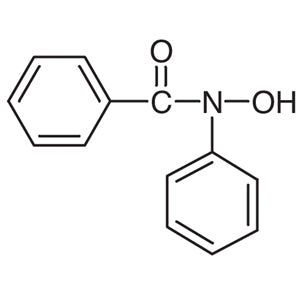
N-Benzoyl-N-phenylhydroxylamine TCI P0158
Regular price From Rp 1.483.650,00Regular priceRp 1.053.150,00Sale price From Rp 1.483.650,00 -
CinnamoylChloride TCI P0133
Regular price Rp 1.246.350,00Regular priceRp 887.250,00Sale price Rp 1.246.350,00 -
o-Tolyl3,5-XylylEther TCI T2213
Regular price From Rp 3.683.400,00Regular priceRp 2.575.650,00Sale price From Rp 3.683.400,00 -
4,4'-Bis[di(3,5-xylyl)amino]-4''-phenyltriphenylamine TCI B2269
Regular price Rp 5.405.400,00Regular priceRp 3.795.750,00Sale price Rp 5.405.400,00 -
N-IsopropylhydroxylamineHydrochloride TCI I0877
Regular price From Rp 1.618.050,00Regular priceRp 1.146.600,00Sale price From Rp 1.618.050,00